THE CLASSIC COLLECTION✦To Cuba and BackCLASSIC FREE BOOKS
To Cuba and Back
Richard Henry Dana
THE CLASSIC COLLECTION · 1851
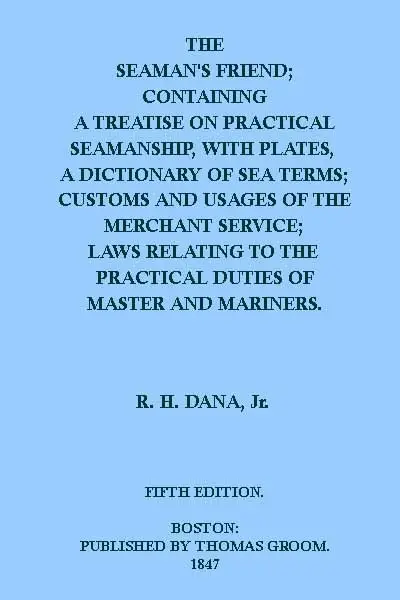
"The Seaman's Friend" by Richard Henry Dana is a comprehensive guide on practical seamanship written in the early 19th century. This work serves as a crucial resource for sailors, providing detailed information about ship construction, rigging, and the laws and customs governing maritime life. It is particularly aimed at those new to sea life and includes technical diagrams and practical advice for both novice and experienced mariners. The beginning of the book outlines its purpose and dedication to various stakeholders in the maritime industry, including sailors, ship owners, and legal authorities. It introduces the first section, which focuses on practical seamanship, including the construction of vessels and the management of sails and rigging. The text elaborates on the technical specifications and proportions vital for building and operating merchant vessels, offering insights into the various kinds of equipment and terminology pertinent to seamanship. This foundational content sets the stage for deeper explorations into the complexities of maritime duties and regulations as the book progresses.
Introduction adapted from the source catalogue; source summaries may be automatically generated.
Free to read · English · 87,833 words · No account needed
MAKE TIME FOR A GOOD BOOK
On by default. Untick to stop anonymous reading totals. Each page counts after 10 seconds in view. How this works.
Anonymous counting is on unless you have switched it off.
LEE. The side opposite to that from which the wind blows; as, if a vessel has the wind on her starboard side, that will be the weather, and the larboard will be the lee side.
A lee shore is the shore upon which the wind is blowing.
Under the lee of anything, is when you have that between you and the
wind.
By the lee. The situation of a vessel, going free, when she has fallen off so much as to bring the wind round her stern, and to take her sails aback on the other side.
LEE-BOARD. A board fitted to the lee side of flat-bottomed boats, to prevent their drifting to leeward.
LEE-GAGE. (See GAGE.)
LEEWAY. What a vessel loses by drifting to leeward. When sailing close-hauled with all sail set, a vessel should make no leeway. If the topgallant sails are furled, it is customary to allow one point; under close-reefed topsails, two points; when under one close-reefed sail, four or five points.
LEECH, or LEACH. The border or edge of a sail, at the sides.
LEEFANGE. An iron bar, upon which the sheets of fore-and-aft sails traverse. Also, a rope rove through the cringle of a sail which has a bonnet to it, for hauling in, so as to lace on the bonnet. Not much used.
LEEWARD. (Pronounced lu-ard.) The lee side. In a direction opposite to that from which the wind blows, which is called windward. The opposite of lee is weather, and of leeward is windward; the two first being adjectives.
LIE-TO, is to stop the progress of a vessel at sea, either by counter-bracing the yards, or by reducing sail so that she will make little or no headway, but will merely come to and fall off by the counteraction of the sails and helm.
LIFE-LINES. Ropes carried along yards, booms, &c., or at any part of the vessel, for men to hold on by.
LIFT. A rope or tackle, going from the yard-arms to the mast-head, to support and move the yard. Also, a term applied to the sails when the wind strikes them on the leeches and raises them slightly.
LIGHT. To move or lift anything along; as, to "Light out to windward!" that is, haul the sail over to windward. The light sails are all above the topsails, also the studdingsails and flying jib.
LIGHTER. A large boat, used in loading and unloading vessels.
LIMBERS, or LIMBER-HOLES. Holes cut in the lower part of the
floor-timbers, next the keelson, forming a passage for the water
fore-and-aft.
Limber-boards are placed over the limbers, and are movable.
Limber-rope. A rope rove fore-and-aft through the limbers, to clear
them if necessary.
Your reading position is saved on this browser. Take it to another device with a library code. Reading pages adapt to text, rather than matching a printed edition.
BEHIND THE BOOK
This eBook is for the use of anyone anywhere in the United States and most other parts of the world at no cost and with almost no restrictions whatsoever. You may copy it, give it away or re-use it under the terms of the Project Gutenberg License included with this eBook or online at www.gutenberg.org. If you are not located in the United States, you will have to check the laws of the country where you are located before using this eBook. Read the source licence.
The original source file, including credits and licence, is retained by this library. Request an original-format copy at no charge. Please include the book title and Project Gutenberg identifier #40958.
KEEP YOUR CURIOSITY GOING

John Muir

Asa Gray
Asa Gray

Florence Nightingale
Elizabeth Robins Pennell
Denison Olmsted