THE CLASSIC COLLECTION✦To Cuba and BackCLASSIC FREE BOOKS
To Cuba and Back
Richard Henry Dana
THE CLASSIC COLLECTION · 1851
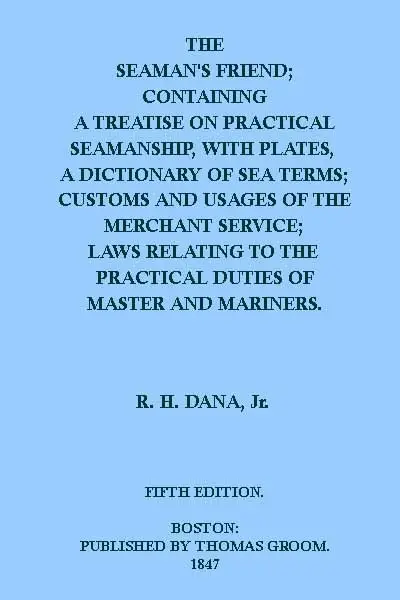
"The Seaman's Friend" by Richard Henry Dana is a comprehensive guide on practical seamanship written in the early 19th century. This work serves as a crucial resource for sailors, providing detailed information about ship construction, rigging, and the laws and customs governing maritime life. It is particularly aimed at those new to sea life and includes technical diagrams and practical advice for both novice and experienced mariners. The beginning of the book outlines its purpose and dedication to various stakeholders in the maritime industry, including sailors, ship owners, and legal authorities. It introduces the first section, which focuses on practical seamanship, including the construction of vessels and the management of sails and rigging. The text elaborates on the technical specifications and proportions vital for building and operating merchant vessels, offering insights into the various kinds of equipment and terminology pertinent to seamanship. This foundational content sets the stage for deeper explorations into the complexities of maritime duties and regulations as the book progresses.
Introduction adapted from the source catalogue; source summaries may be automatically generated.
Free to read · English · 87,833 words · No account needed
MAKE TIME FOR A GOOD BOOK
On by default. Untick to stop anonymous reading totals. Each page counts after 10 seconds in view. How this works.
Anonymous counting is on unless you have switched it off.
Revenue duties and obligations. List of crew. Certificate. Sea letter. Passport. List of passengers. Manifest. Sea stores. Unloading. Post-office. Report. Citizenship. Coasting license. Power to sell and hypothecate. Keeping and delivering cargo. Deviation. Collision. Pilot. Wages and advances.
REVENUE DUTIES AND OBLIGATIONS.--The master of every vessel bound on a foreign voyage, before clearance, must give to the collector of the customs a list of the crew, specifying their names, places of birth and residence, and containing a description of their persons; whereupon he is entitled to a certified copy of the same from the collector. This copy he must deliver, under a penalty of $400, to the first boarding officer upon his arrival in the United States, and produce the persons named therein, unless the same have been discharged in a foreign country, with the consent of the consul or other commercial agent thereto certified in writing under his hand and official seal; or by showing that they have died or absconded, or been impressed into foreign service.[31] The duplicate list of the crew shall be a fair copy, in one uniform handwriting, without erasure or interlineation.[32]
[31] Act 1803, ch. 62, §1.
[32] Act 1840, ch. 28, §1.
The owners must also obtain from the collector of the customs a certified copy of the shipping articles. This must be produced by the master before any consul or commercial agent who may demand it, and all erasures in it or writings in a different hand shall be deemed fraudulent, unless satisfactorily explained.[33]
[33] Do.
The master of every vessel of the United States, on arriving at a foreign port, must deposit with the consul, or other commercial agent, his certificate of registry, sea letter, and passport (if he have one,) under a penalty of $500. The consul returns them to him, upon his obtaining a clearance.[34]
[34] Act 1803, ch. 62, §2.
Upon arriving in the United States, the master must report to the collector a list of passengers, specifying their names, age, sex, occupation, the country of which they are citizens, and that in which they intend to reside. This is under a penalty of $500.[35]
[35] Act 1819, ch. 170, §4.
Vessels arriving from foreign ports must unlade and deliver their cargoes between sunrise and sunset, unless by special permission of the collector of the port.
In making out manifests of cargoes, the master must specify what articles are to be deemed sea stores, and declare the same upon oath. If the collector deems the amount excessive, he may charge them with a duty. If the cargo is found to exceed the manifest, the excess is forfeited to the government, and the master is liable to pay treble the amount.[36]
[36] Act 1799, ch. 128, §45.
Your reading position is saved on this browser. Take it to another device with a library code. Reading pages adapt to text, rather than matching a printed edition.
BEHIND THE BOOK
This eBook is for the use of anyone anywhere in the United States and most other parts of the world at no cost and with almost no restrictions whatsoever. You may copy it, give it away or re-use it under the terms of the Project Gutenberg License included with this eBook or online at www.gutenberg.org. If you are not located in the United States, you will have to check the laws of the country where you are located before using this eBook. Read the source licence.
The original source file, including credits and licence, is retained by this library. Request an original-format copy at no charge. Please include the book title and Project Gutenberg identifier #40958.
KEEP YOUR CURIOSITY GOING

John Muir

Asa Gray
Asa Gray

Florence Nightingale
Elizabeth Robins Pennell
Denison Olmsted