THE CLASSIC COLLECTION✦An outlaw’s diary: the CommuneCLASSIC FREE BOOKS
An outlaw’s diary: the Commune
Cécile Tormay
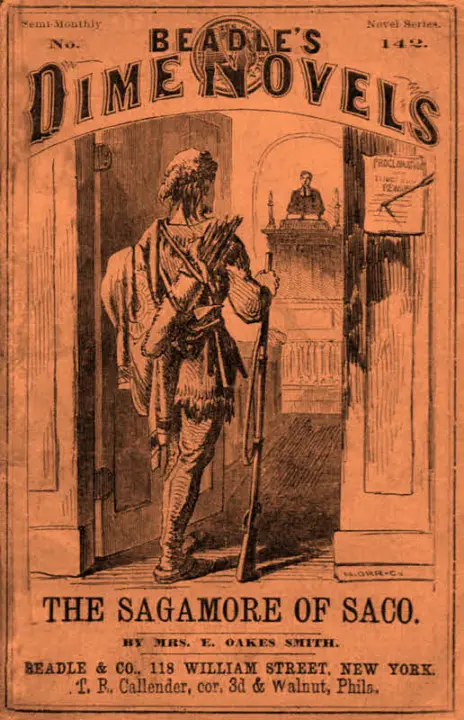
THE CLASSIC COLLECTION · 1868
"The Sagamore of Saco" by Elizabeth Oakes Smith is a historical fiction novel written in the late 19th century. The narrative unfolds during the early colonial period in New England, encompassing themes of love, conflict, and societal tensions through the experiences of young John Bonyton and his beloved, Hope Vines. The story is set against a backdrop of early colonial life, capturing the complexities of relationships between settlers and Native Americans, and the impending conflicts arising from suspicion and prejudice. The opening of the novel introduces us to the emotional turmoil surrounding John Bonyton, whose fierce love for Hope Vines stands at odds with societal expectations and familial pressures. As the narrative unfolds, it reveals the character dynamics between John, Hope, and their parents, particularly reflecting on the clashes between Puritanical beliefs and individual desires. At the same time, a dark undercurrent of jealousy from Acashee, a Native American girl enamored with John, hints at perilous circumstances that could ensnare Hope, culminating in rising tensions as the characters navigate their intertwined fates amidst cultural strife and personal aspirations.
Introduction adapted from the source catalogue; source summaries may be automatically generated.
Free to read · English · 46,077 words · No account needed
MAKE TIME FOR A GOOD BOOK
On by default. Untick to stop anonymous reading totals. Each page counts after 10 seconds in view. How this works.
Anonymous counting is on unless you have switched it off.
Acashee unconsciously dropped her hold of Hope, and passed her hand over her own head, which the former observing, asked, lightly:
“Who did it? and why?”
The woman now seized her by the arm, and bending down, hissed through
her clenched teeth:
“John Bonyton did it.”
Hope Vines dropped to the floor as if a shot had penetrated her heart, and there she lay with no sign of life, to the evident gratification of the other, who left her to recover as best she might, while she busied herself in preparing a meal over the coals. Seeing Hope rise to her feet, and stand erect and motionless at the mouth of the cave, she called out:
“Skake, come and eat.”
Receiving no answer, and perhaps weary of this useless teasing, she strode across the space, and shaking her by the arm, cried again:
“Come and eat.”
“I will eat,” answered Hope, softly, taking corn and dried venison. There was a strange light in her eye which the woman saw, but did not understand, for she went on in her former vein:
“The Spider caught a bad snake when she wove a net for Hope Vines.”
The latter covered her face with both her hands, and the veins of her forehead swelled above them. Yet when she uncovered her eyes they were red, not with tears, but with the effort to suppress them.
“It is a long, long time that I have been here, Acashee,” she murmured,
softly.
“Have you never passed the curtain of water since Samoset brought you here?” asked the net-weaver; and she fixed her eyes searchingly upon the face of the other, who neither quailed nor changed color beneath her gaze, but answered in the same sorrowful accent:
“How should little Hope penetrate the vail of water? Who is left to her
now!”
“You remember that I once told you, ‘You had a friend; you have a foe.’ The white boy and girl shouldn’t have scorned the red girl. Acashee is glad down to the bottom of her soul. John Bonyton is more wretched than I am.”
Hope’s eyes dilated and her breast heaved.
“Tell me where you saw John Bonyton, Acashee?”
“Oh, he wears the eagle tuft bravely, and they call him Sagamore of Saco now.” And she laughed in scorn.
“Oh, the long, weary years!” murmured Hope.
“Where is O-ye-ah?” asked the other.
“She died a moon ago.”
“Did she make you a great medicine-woman?”
Hope rose to her feet with dignity, her brow contracted, and her eyes gleaming with unearthly radiance. She pointed upward and said:
Your reading position is saved on this browser. Take it to another device with a library code. Reading pages adapt to text, rather than matching a printed edition.
BEHIND THE BOOK
This eBook is for the use of anyone anywhere in the United States and most other parts of the world at no cost and with almost no restrictions whatsoever. You may copy it, give it away or re-use it under the terms of the Project Gutenberg License included with this eBook or online at www.gutenberg.org. If you are not located in the United States, you will have to check the laws of the country where you are located before using this eBook. Read the source licence.
The original source file, including credits and licence, is retained by this library. Request an original-format copy at no charge. Please include the book title and Project Gutenberg identifier #56007.
KEEP YOUR CURIOSITY GOING
Cécile Tormay

Moritz Busch
Coulson Kernahan
John L. Ransom

Maurice Baring
Frances Wright