Pan-Germany
André Chéradame
THE CLASSIC COLLECTION · 1916
"The PanGerman Plot Unmasked: Berlin's formidable peace-trap of 'the drawn war'" by André Chéradame is a historical account written in the early 20th century. This work delves into the intricacies of Germany's expansive Pangerman ambitions during World War I, examining the plans orchestrated by Kaiser Wilhelm II to dominate Europe and the surrounding regions. The text is likely to appeal to those interested in understanding the socio-political dynamics leading up to the war and the ideological framework behind Germany's military strategies. The opening of the book introduces readers to the core idea of the Pangerman doctrine, describing it as a dangerous ideology that extends far beyond merely uniting German-speaking populations. Chéradame outlines the origins of the Pangerman plan, tracing its evolution and detailing the historical context of Germany's ambitions from the late 19th century leading into World War I. The author sets the stage for a comprehensive analysis of how these ideological underpinnings influenced the martial decisions of Germany and the impact of events like the Treaty of Bucharest on the balance of power in Europe. By establishing both a historical narrative and a strong warning about the implications of these geopolitical strategies, the opening chapters set the tone for the book's exploration of the “drawn war” narrative and its relevance to global security.
Introduction adapted from the source catalogue; source summaries may be automatically generated.
Free to read · English · 66,477 words · No account needed
MAKE TIME FOR A GOOD BOOK
On by default. Untick to stop anonymous reading totals. Each page counts after 10 seconds in view. How this works.
Anonymous counting is on unless you have switched it off.
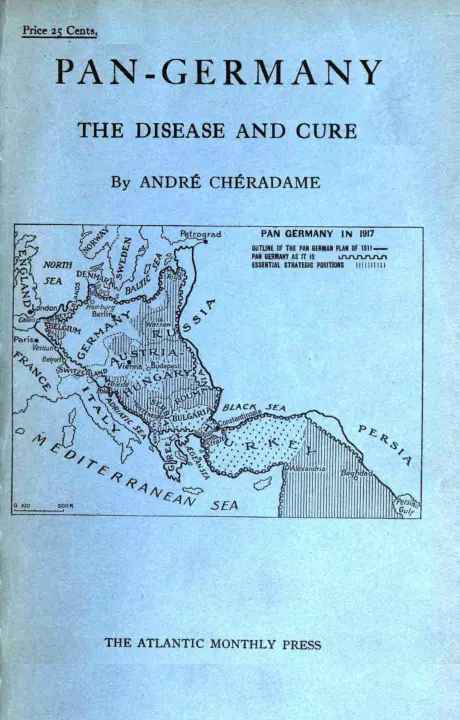
Besides, we must add that the programme, which is fully described below, was drawn up by Tannenberg on the supposition, on which the Berlin Government also reckoned, that England would not take part in the war. In order to purchase her neutrality, Tannenberg advocated dividing the colonies of the other European powers between London and Berlin. But now that England has thrown herself into the struggle, it is clear that, assuming Germany to be victorious, she would take possession also of those colonies which Tannenberg proposed to assign to Great Britain, since Britain would be incapable of resisting. It follows that the world-wide acquisitions of Pangermany, sketched in the plan of 1911 and summarized below, are in fact less than Germany would be able to effect, since having presumably accomplished the scheme of domination “from Hamburg to the Persian Gulf,” no organized force on earth would be powerful enough to curb the boundless ambition of Berlin.
We have proved above that if the Allies allowed Germany to secure her hold on Austria-Hungary, the predominant and exclusive influence of Berlin over all the Balkans and Turkey would be inevitable. Tannenberg (op. cit., p. 323) explains that finally Asia Minor, Syria, and Mesopotamia, Palestine, Western Persia, and the larger part of Arabia would pass under the absolute protectorate of the German Empire, making a total of, say, 3,200,000 square kilometres and 16,500,000 inhabitants.
Once masters of the coasts of the Adriatic, the Ægean, the Dardanelles, and Aden, helped by the Panislamic propaganda, the Turco-German seizure of Egypt, and therefore the Suez Canal, would necessarily follow. Germany, if she commanded these essential strategical points, would then obviously be able to retake her colonies in Africa and Oceania.
Square Native
Kilometres. Population.
Togo 87,000 1,003,000 Kameroon 790,000 2,540,000 South-West Africa 835,000 87,000 Eastern Africa 995,000 7,510,000 Kaiser Wilhelm Land, Bismarck Archipelago, Caroline Islands, Marshall Islands, the Marianes, Samoa 245,000 647,000 --------- ---------- Making a total of 2,952,000 11,787,000
Always on the assumption which we have made, the Allies, having given way in Europe, could not prevent Great-Germany from snatching, according to Tannenberg’s programme, the Belgian, Portuguese, and Dutch Colonies, namely:
Square Native
Kilometres. Population.
Belgian Congo 2,365,000 15,000,000 Portuguese Angola 1,270,000 4,200,000 Dutch East Indies 2,045,000 38,106,000 --------- ---------- Total 5,680,000 57,306,000
Next would come the turn of those French colonies, the cession of which to Great Germany was foreshadowed by Tannenberg, op. cit., p. 313.
Square Native
Kilometres. Population.
Morocco 416,000 3,000,000 French Congo 1,439,000 9,800,000 Madagascar 585,000 3,232,000 Mayotta and the Comoros Islands 2,000 97,000 Reunion 2,000 173,000 Obok and dependencies (East Africa) 120,000 208,000 Indo-China 803,000 16,990,000 French Islands of Oceania 24,000 88,000 --------- ---------- Making a total of 3,391,000 33,588,000
Your reading position is saved on this browser. Take it to another device with a library code. Reading pages adapt to text, rather than matching a printed edition.
André Chéradame
BEHIND THE BOOK
This eBook is for the use of anyone anywhere in the United States and most other parts of the world at no cost and with almost no restrictions whatsoever. You may copy it, give it away or re-use it under the terms of the Project Gutenberg License included with this eBook or online at www.gutenberg.org. If you are not located in the United States, you will have to check the laws of the country where you are located before using this eBook. Read the source licence.
The original source file, including credits and licence, is retained by this library. Request an original-format copy at no charge. Please include the book title and Project Gutenberg identifier #59250.
KEEP YOUR CURIOSITY GOING
Cécile Tormay

Moritz Busch
John L. Ransom
Frances Wright
Cécile Tormay

Mabel Potter Daggett