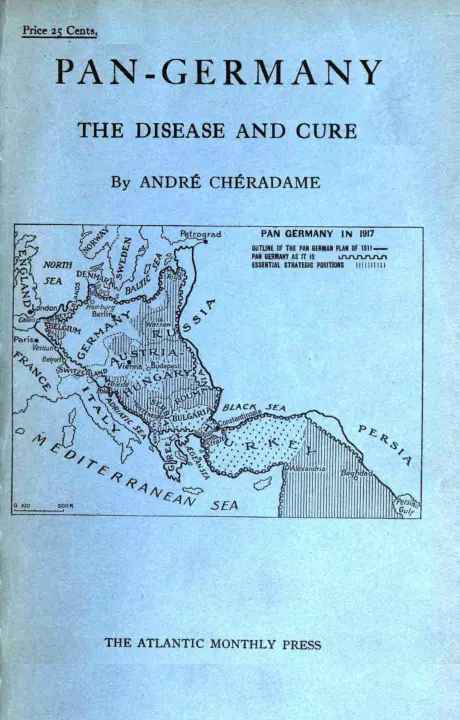
Pan-Germany
André Chéradame
THE CLASSIC COLLECTION · 1916
"The PanGerman Plot Unmasked: Berlin's formidable peace-trap of 'the drawn war'" by André Chéradame is a historical account written in the early 20th century. This work delves into the intricacies of Germany's expansive Pangerman ambitions during World War I, examining the plans orchestrated by Kaiser Wilhelm II to dominate Europe and the surrounding regions. The text is likely to appeal to those interested in understanding the socio-political dynamics leading up to the war and the ideological framework behind Germany's military strategies. The opening of the book introduces readers to the core idea of the Pangerman doctrine, describing it as a dangerous ideology that extends far beyond merely uniting German-speaking populations. Chéradame outlines the origins of the Pangerman plan, tracing its evolution and detailing the historical context of Germany's ambitions from the late 19th century leading into World War I. The author sets the stage for a comprehensive analysis of how these ideological underpinnings influenced the martial decisions of Germany and the impact of events like the Treaty of Bucharest on the balance of power in Europe. By establishing both a historical narrative and a strong warning about the implications of these geopolitical strategies, the opening chapters set the tone for the book's exploration of the “drawn war” narrative and its relevance to global security.
Introduction adapted from the source catalogue; source summaries may be automatically generated.
Free to read · English · 66,477 words · No account needed
MAKE TIME FOR A GOOD BOOK
On by default. Untick to stop anonymous reading totals. Each page counts after 10 seconds in view. How this works.
Anonymous counting is on unless you have switched it off.
The Pangerman plot in its broad outlines was laid as early as 1895, but since that date events have happened throughout the world, which encouraged Pangermans to enlarge the structure of their scheme.
In 1898 the Fashoda incident almost caused a breach between France and England. In 1905 Japan compelled Russia to sign peace after a long war which exhausted all the Tsar’s military resources and disturbed the balance of power in Europe for a long time to the advantage of Germany. In 1909 the Vienna Government, under cover of the veiled ultimatum which Berlin sent to the Tsar, carried out the annexation of Bosnia and Herzegovina, countries which are almost entirely peopled by Serbians. This seizure of a huge Slav territory was a great triumph for Germanism. On November 3rd, 1910, at the Potsdam meeting, the Kaiser obtained from the Tsar’s Government the abandonment of all opposition to the completion of the Bagdad railway. England and France took up the same attitude. On July 1st, 1911, the Kaiser ventured on the Agadir episode, which was clearly an attempt to force a quarrel on France. It led to the Franco-German treaty of November 4th, 1911, which ceded to Germany 275,000 square kilometres of the French Congo, while at the same time the commerce of Morocco was heavily mortgaged in favour of Germany.
These various events deeply injured the interests of France, England and Russia; but these powers preferred to submit to the hardest sacrifices rather than undertake the dreadful responsibility of letting loose a fearful war on Europe. The Pangermans misread this attitude as a sign of weakness, and of a desire to keep the peace at all costs; and accordingly they were encouraged to entertain high hopes of huge success in a near future. That is why the original Pangerman plan of 1895, considerably altered, became the perfected plan of 1911.
This plan of 1911 (see map) provided in Europe and in Western Asia:
1º. The establishment, under German rule, of a vast Confederation of Central Europe, comprising:
+------------------------------------+-----------+------------+ | | Square | | | |Kilometres.|Inhabitants.| +------------------------------------+-----------+------------+ | In the West: | | | | Holland | 38,141 | 6,114,000 | | Belgium | 29,451 | 7,500,000 | | Luxemburg | 2,586 | 260,000 | | Switzerland* | 41,324 | 3,800,000 | | The Departments of the North of | | | | France to the N.E. of a line drawn | | | | from the S. of Belfort to the | | | | mouth of the Somme about | 50,271 | 5,768,000 | | +-----------+------------+ | Total | 161,773 | 23,442,000 | | +-----------+------------+ | To the East: | | | | Russian Poland | 127,320 | 12,467,000 | | Baltic Provinces, Esthonia, | | | | Livonia, Courland | 94,564 | 2,686,000 | | The three Russian Governments | | | | of Kovno, Vilna, Grodno | 121,840 | 5,728,000 | | +-----------+------------+ | Total | 343,724 | 20,881,000 | | +-----------+------------+ | To the South-East: | | | | Austria-Hungary† | 676,616 | 50,000,000 | +------------------------------------+-----------+------------+ | These three groups form a grand total of 1,182,113 Square | | Kilometres and 94,323,000 inhabitants. | +-------------------------------------------------------------+
* Minus eventually the French and Italian Cantons which the Pangermans declare that they do not care to annex.
Your reading position is saved on this browser. Take it to another device with a library code. Reading pages adapt to text, rather than matching a printed edition.
André Chéradame
BEHIND THE BOOK
This eBook is for the use of anyone anywhere in the United States and most other parts of the world at no cost and with almost no restrictions whatsoever. You may copy it, give it away or re-use it under the terms of the Project Gutenberg License included with this eBook or online at www.gutenberg.org. If you are not located in the United States, you will have to check the laws of the country where you are located before using this eBook. Read the source licence.
The original source file, including credits and licence, is retained by this library. Request an original-format copy at no charge. Please include the book title and Project Gutenberg identifier #59250.
KEEP YOUR CURIOSITY GOING
Cécile Tormay

Moritz Busch
John L. Ransom
Frances Wright
Cécile Tormay

Mabel Potter Daggett