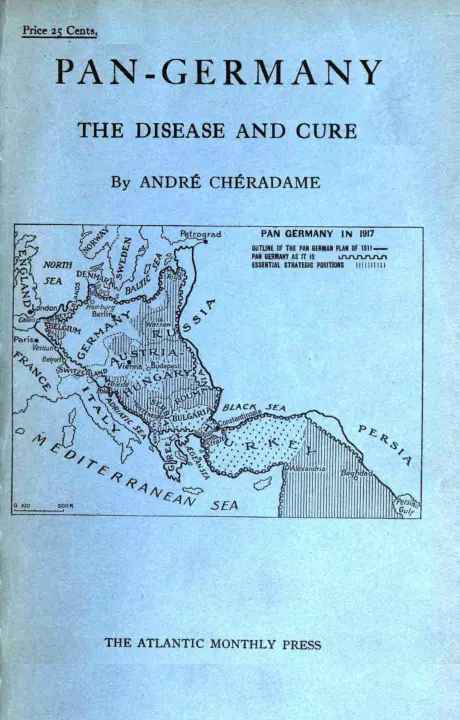
Pan-Germany
André Chéradame
THE CLASSIC COLLECTION · 1916
"The PanGerman Plot Unmasked: Berlin's formidable peace-trap of 'the drawn war'" by André Chéradame is a historical account written in the early 20th century. This work delves into the intricacies of Germany's expansive Pangerman ambitions during World War I, examining the plans orchestrated by Kaiser Wilhelm II to dominate Europe and the surrounding regions. The text is likely to appeal to those interested in understanding the socio-political dynamics leading up to the war and the ideological framework behind Germany's military strategies. The opening of the book introduces readers to the core idea of the Pangerman doctrine, describing it as a dangerous ideology that extends far beyond merely uniting German-speaking populations. Chéradame outlines the origins of the Pangerman plan, tracing its evolution and detailing the historical context of Germany's ambitions from the late 19th century leading into World War I. The author sets the stage for a comprehensive analysis of how these ideological underpinnings influenced the martial decisions of Germany and the impact of events like the Treaty of Bucharest on the balance of power in Europe. By establishing both a historical narrative and a strong warning about the implications of these geopolitical strategies, the opening chapters set the tone for the book's exploration of the “drawn war” narrative and its relevance to global security.
Introduction adapted from the source catalogue; source summaries may be automatically generated.
Free to read · English · 66,477 words · No account needed
MAKE TIME FOR A GOOD BOOK
On by default. Untick to stop anonymous reading totals. Each page counts after 10 seconds in view. How this works.
Anonymous counting is on unless you have switched it off.
THE STILL NEUTRAL STATES WHOSE INDEPENDENCE WOULD BE DIRECTLY THREATENED BY THE ACHIEVEMENT OF THE “HAMBURG TO THE PERSIAN GULF” SCHEME AND THEREFORE BY GERMANY’S CAPTURE OF AUSTRIA-HUNGARY 183
I. The example of Portugal, p. 183.—II. Holland, p. 187.—III. Switzerland, p. 191.—IV. The States of South America, p. 193.—V. The United States, p. 198.
What has been set forth in the preceding nine chapters appears to justify the following conclusions 213
The Poles in the East of Germany 1
The Danes in Prussia 2
The Germans and the non-Germans in Austria-Hungary 3
The Pangerman plan of 1911 12
The Antigermanic barrier in the Balkans after the treaty of Bukarest (10th August, 1913) 28
The nationalities in Austria-Hungary 32
The three barriers of Antigermanic peoples in the Balkans and in Austria-Hungary 43
The German claims in the West (beginning of 1916) 46
The German claims in the East 53
The German claims in the South and South-East 57
The plan of 1911 and the extent of its execution at the beginning of 1916 64
The great political questions raised by the war 68
The German fortress at the beginning of 1916 72
The consequences of the dodge called “The Drawn Game” 79
Asiatic consequences of the accomplishment of the scheme “From Hamburg to the Persian Gulf” 95
World-wide consequences of the “Hamburg to the Persian Gulf” scheme, as provided for by the plan of 1911 101
The crucial point of the European problem 113
Great Bulgaria 133
Serbian Macedonia 137
Greece after the treaty of Bukarest 147
Great Roumania 153
The nationalities in Turkey 170
Encroachments planned by Bulgaria on neighbouring States 181
Portugal and Colonial Pangermanism 185
The Neutral States of Europe and Pangermanism 188
Colonial Pangermanism and South America 194
Distribution of German-born Germans in the United States 201
Relation between the Pangerman plan of 1911 and the Pangerman gains at the beginning of 1916 217
The Pangerman gains at the beginning of 1916 223
European States interested in the solution of the Austro-Hungarian question 231
The States of Asia and America, interested in the solution of the Austro-Hungarian question 233
My reasons for commending M. Chéradame’s most instructive work to the earnest attention of my countrymen and countrywomen are three-fold.
In the first place, M. Chéradame stands conspicuous amongst that very small body of politicians who warned Europe betimes of the German danger. The fact that in the past he proved a true prophet gives him a special claim to be heard when he states his views as regards the present and the future.
In the second place, I entertain a strong opinion that M. Chéradame’s diagnosis of the present situation is, in all its main features, correct.
Your reading position is saved on this browser. Take it to another device with a library code. Reading pages adapt to text, rather than matching a printed edition.
André Chéradame
BEHIND THE BOOK
This eBook is for the use of anyone anywhere in the United States and most other parts of the world at no cost and with almost no restrictions whatsoever. You may copy it, give it away or re-use it under the terms of the Project Gutenberg License included with this eBook or online at www.gutenberg.org. If you are not located in the United States, you will have to check the laws of the country where you are located before using this eBook. Read the source licence.
The original source file, including credits and licence, is retained by this library. Request an original-format copy at no charge. Please include the book title and Project Gutenberg identifier #59250.
KEEP YOUR CURIOSITY GOING
Cécile Tormay

Moritz Busch
John L. Ransom
Frances Wright
Cécile Tormay

Mabel Potter Daggett