Pan-Germany
André Chéradame
THE CLASSIC COLLECTION · 1916
"The PanGerman Plot Unmasked: Berlin's formidable peace-trap of 'the drawn war'" by André Chéradame is a historical account written in the early 20th century. This work delves into the intricacies of Germany's expansive Pangerman ambitions during World War I, examining the plans orchestrated by Kaiser Wilhelm II to dominate Europe and the surrounding regions. The text is likely to appeal to those interested in understanding the socio-political dynamics leading up to the war and the ideological framework behind Germany's military strategies. The opening of the book introduces readers to the core idea of the Pangerman doctrine, describing it as a dangerous ideology that extends far beyond merely uniting German-speaking populations. Chéradame outlines the origins of the Pangerman plan, tracing its evolution and detailing the historical context of Germany's ambitions from the late 19th century leading into World War I. The author sets the stage for a comprehensive analysis of how these ideological underpinnings influenced the martial decisions of Germany and the impact of events like the Treaty of Bucharest on the balance of power in Europe. By establishing both a historical narrative and a strong warning about the implications of these geopolitical strategies, the opening chapters set the tone for the book's exploration of the “drawn war” narrative and its relevance to global security.
Introduction adapted from the source catalogue; source summaries may be automatically generated.
Free to read · English · 66,477 words · No account needed
MAKE TIME FOR A GOOD BOOK
On by default. Untick to stop anonymous reading totals. Each page counts after 10 seconds in view. How this works.
Anonymous counting is on unless you have switched it off.
1º. The formation of a great German Confederation which was to put under the absolute supremacy of the present German Empire (540,858 square kilometres and 68 million inhabitants) foreign territories situated around Germany, which form a superficies of 1,182,113 square kilometres and hold 94 million inhabitants.
The figures given (pp. 52, 56 and 61) suffice to prove that the German seizure of these territories extended at the beginning of 1916:
Square Kilometres.
To the West 90,478
To the East 260,000
To the South (Austria-Hungary) 676,616
---------
Total 1,027,094
Germany has therefore, so far as concerns the territories to be absorbed into the Germanic Confederation, achieved her programme in the proportion of 86%, or about nine-tenths.
2º. The absolute subordination to Germany of all the Balkan States, whose superficies is 499,275 square kilometres, holding 22 million inhabitants. We have seen above (p. 61), that the German seizure actually extends over 215,585 square kilometres. The German programme, therefore, as regards the Balkans, has been achieved in the proportion of 43%.
3º. The more or less veiled seizure by Germany of the Ottoman Empire, being 1,792,900 square kilometres, holding 20 million inhabitants. Now, early in 1916 the exclusive German influence was felt over the whole of Turkey. As regards her the German plan had therefore been achieved in the proportion of 100%.
Let us now group the figures which will enable us to show in what proportion the whole Pangerman plan of 1911 has been actually achieved by Germany:
+-------------------------------------+-------------+-------------+ | | Provisions | Actual | | | of the 1911 |achievements.| | |plan. Square | Square | | | Kilometres. | Kilometres.| +-------------------------------------+-------------+-------------+ |1. Territories to be absorbed in the | | | | great Germanic Confederation | 1,182,113 | 1,027,094 | |2. Balkans | 499,275 | 215,585 | |3. Turkey | 1,792,900 | 1,792,900 | | +-------------+-------------+ | Total | 3,474,288 | 3,035,579 | +-------------------------------------+-------------+-------------+
These figures prove to demonstration that early in 1916 Germany had achieved the Pangerman plan of 1911 in the enormous proportion of 87%, or about nine-tenths.
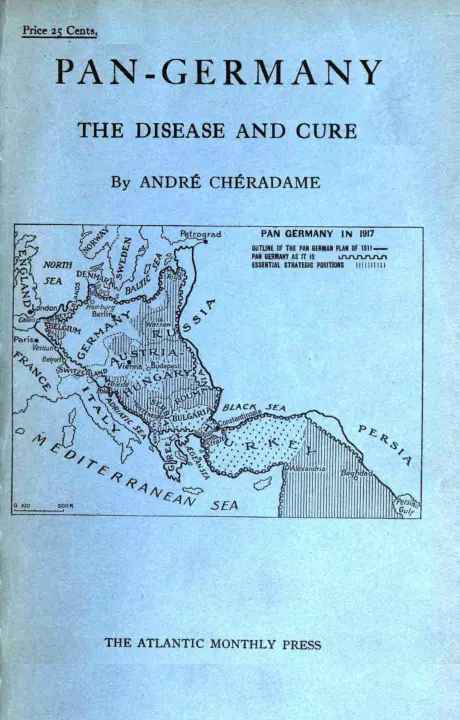
This figure is graphically confirmed by the annexed map; we can see at a glance the geographical as well as superficial relations which exist between the boundaries of the plan of 1911 and the fronts occupied early in 1916 by armies exclusively subordinate to Berlin.
These geographical and mathematical considerations, the importance of which cannot escape us, explain why and under what conditions Germany wished to make peace. She wished it simply because, as the Frankfurter Zeitung owned, without mincing matters, in December, 1915, the goal of the war had been reached.
Nine-tenths of the whole of the Pangerman plan of 1911 having been practically achieved, in spite of England’s intervention, which, however, had upset the German Staff’s plan, it is absolutely clear that the results obtained by Germany have been considerable in the extreme. Nothing could therefore be more to her advantage now than to succeed in putting an end to the war at a time when German influence extends unchecked over almost the whole of the invaded territories.
Your reading position is saved on this browser. Take it to another device with a library code. Reading pages adapt to text, rather than matching a printed edition.
André Chéradame
BEHIND THE BOOK
This eBook is for the use of anyone anywhere in the United States and most other parts of the world at no cost and with almost no restrictions whatsoever. You may copy it, give it away or re-use it under the terms of the Project Gutenberg License included with this eBook or online at www.gutenberg.org. If you are not located in the United States, you will have to check the laws of the country where you are located before using this eBook. Read the source licence.
The original source file, including credits and licence, is retained by this library. Request an original-format copy at no charge. Please include the book title and Project Gutenberg identifier #59250.
KEEP YOUR CURIOSITY GOING
Cécile Tormay

Moritz Busch
John L. Ransom
Frances Wright
Cécile Tormay

Mabel Potter Daggett