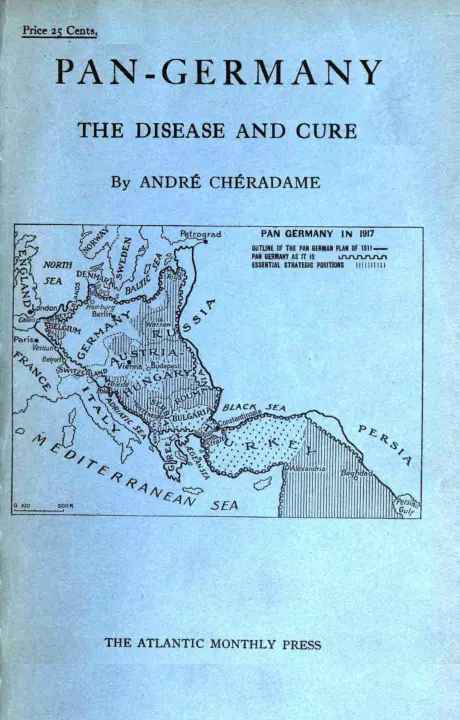
Pan-Germany
André Chéradame
THE CLASSIC COLLECTION · 1916
"The PanGerman Plot Unmasked: Berlin's formidable peace-trap of 'the drawn war'" by André Chéradame is a historical account written in the early 20th century. This work delves into the intricacies of Germany's expansive Pangerman ambitions during World War I, examining the plans orchestrated by Kaiser Wilhelm II to dominate Europe and the surrounding regions. The text is likely to appeal to those interested in understanding the socio-political dynamics leading up to the war and the ideological framework behind Germany's military strategies. The opening of the book introduces readers to the core idea of the Pangerman doctrine, describing it as a dangerous ideology that extends far beyond merely uniting German-speaking populations. Chéradame outlines the origins of the Pangerman plan, tracing its evolution and detailing the historical context of Germany's ambitions from the late 19th century leading into World War I. The author sets the stage for a comprehensive analysis of how these ideological underpinnings influenced the martial decisions of Germany and the impact of events like the Treaty of Bucharest on the balance of power in Europe. By establishing both a historical narrative and a strong warning about the implications of these geopolitical strategies, the opening chapters set the tone for the book's exploration of the “drawn war” narrative and its relevance to global security.
Introduction adapted from the source catalogue; source summaries may be automatically generated.
Free to read · English · 66,477 words · No account needed
MAKE TIME FOR A GOOD BOOK
On by default. Untick to stop anonymous reading totals. Each page counts after 10 seconds in view. How this works.
Anonymous counting is on unless you have switched it off.
The term “Drawn Game” evidently denotes that each country would keep the frontiers which existed before the war; also that each country would bear the burden of the outlays it has made during the struggle. But we will argue on a hypothesis infinitely more favourable for the Western Allies than that of the so-called “Drawn Game” in order to demonstrate super-abundantly and as decisively as possible what would be concealed behind this apparent and partial German capitulation.
Let us suppose (see map, p. 79) that, in consequence of victorious offensives of the Allies, Germany should declare herself disposed, not only to evacuate totally Poland, the French Departments, Belgium, and Luxemburg, but also to restore Alsace-Lorraine to France, and even to give, as an indemnity all the rest of the left bank of the Rhine, under the sole and tacit condition that Germany should keep her preponderant influence, direct or indirect, over Austria-Hungary, the Balkans and Turkey.
There are surely in the Allied Western countries many worthy people who, at present, no more see the result of such a peace, than a year ago they understood the enormous influences which the Balkans would exert on the course of the war. These good creatures, weary of the prolonged strife, would at once say: “After all, these are most acceptable terms: Alsace-Lorraine, the left bank of the Rhine!... let us make peace.”
If matters are probed to the bottom it will be easily seen that, should the Allies negotiate peace with Germany on such a basis, the restitution of Alsace-Lorraine could only be temporary; for with such a peace as that, Germany would secure all the elements of power which might enable her, after a very short respite, to retake Alsace-Lorraine, and in the end to overcome all the Allies and to achieve in its entirety the Pangerman plan, not only in Europe, but in Asia, nay in the whole world.
To relinquish the left bank of the Rhine, according to our hypothesis, would mean for Germany that she would lose:
Square
Provinces. Kilometres. Population.
Rhenish-Prussia 27,000 7,000,000
Rhenish-Bavaria 5,928 1,000,000
Alsace-Lorraine 14,522 2,000,000
------ ----------
Total 47,450 10,000,000
The present German Empire would therefore be reduced to 493,408 square kilometres and 58 million inhabitants. But this loss in the West would be far more than counterbalanced by that close union of Austria-Hungary to the German Empire, which would be none the less real because it would be disguised. On this reckoning Berlin’s influence would be exercised directly and absolutely over:
Square Kilometres. Population. German Empire curtailed in the West 493,408 58,000,000 Austria-Hungary 676,616 50,000,000 --------- ----------- Total 1,170,024 108,000,000
It is evident that a solid block of States, established in Central Europe under the direction of Berlin, would exercise, simply by contiguity an absolutely preponderant pressure on:
Your reading position is saved on this browser. Take it to another device with a library code. Reading pages adapt to text, rather than matching a printed edition.
André Chéradame
BEHIND THE BOOK
This eBook is for the use of anyone anywhere in the United States and most other parts of the world at no cost and with almost no restrictions whatsoever. You may copy it, give it away or re-use it under the terms of the Project Gutenberg License included with this eBook or online at www.gutenberg.org. If you are not located in the United States, you will have to check the laws of the country where you are located before using this eBook. Read the source licence.
The original source file, including credits and licence, is retained by this library. Request an original-format copy at no charge. Please include the book title and Project Gutenberg identifier #59250.
KEEP YOUR CURIOSITY GOING
Cécile Tormay

Moritz Busch
John L. Ransom
Frances Wright
Cécile Tormay

Mabel Potter Daggett