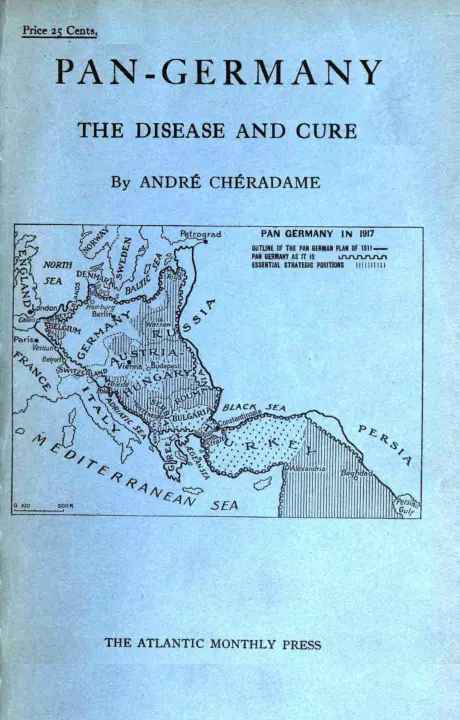
Pan-Germany
André Chéradame
THE CLASSIC COLLECTION · 1916
"The PanGerman Plot Unmasked: Berlin's formidable peace-trap of 'the drawn war'" by André Chéradame is a historical account written in the early 20th century. This work delves into the intricacies of Germany's expansive Pangerman ambitions during World War I, examining the plans orchestrated by Kaiser Wilhelm II to dominate Europe and the surrounding regions. The text is likely to appeal to those interested in understanding the socio-political dynamics leading up to the war and the ideological framework behind Germany's military strategies. The opening of the book introduces readers to the core idea of the Pangerman doctrine, describing it as a dangerous ideology that extends far beyond merely uniting German-speaking populations. Chéradame outlines the origins of the Pangerman plan, tracing its evolution and detailing the historical context of Germany's ambitions from the late 19th century leading into World War I. The author sets the stage for a comprehensive analysis of how these ideological underpinnings influenced the martial decisions of Germany and the impact of events like the Treaty of Bucharest on the balance of power in Europe. By establishing both a historical narrative and a strong warning about the implications of these geopolitical strategies, the opening chapters set the tone for the book's exploration of the “drawn war” narrative and its relevance to global security.
Introduction adapted from the source catalogue; source summaries may be automatically generated.
Free to read · English · 66,477 words · No account needed
MAKE TIME FOR A GOOD BOOK
On by default. Untick to stop anonymous reading totals. Each page counts after 10 seconds in view. How this works.
Anonymous counting is on unless you have switched it off.
There are also some Russians who still imagine that in 1915 the Allied diplomacy made a mistake in not undoing the consequences of the treaty of Bukarest; whereas in point of fact that is just what has been done, and what, as we saw in Chapter II., § I., constituted the fundamental error of the Allied policy in the Balkans. According to these Russians the treaty of Bukarest should have been set aside in order to restore Bulgaria to the limits assigned to it by the treaty of San Stefano. This is the point of view maintained as late as March, 1916, by M. Milioukoff from the tribune of the Duma. I have explained (p. 138), why on the west the Bulgaria of the San Stefano treaty by no means corresponded to the racial facts, and for what reasons Macedonia, forming the south of Serbia, is very far from being Bulgarian. A striking proof of it is that the Bulgarians have just massacred there a quantity of Serbians. With regard to the ethnography of the region we may introduce into the discussion a new argument, as original perhaps as it is convincing. To tell the truth the most accurate account of the ethnographic position of Macedonia is that which has been handed down to us for generations by the Cooks—it is a Macédoine. In the great dictionary of Larousse, vol. x, p. 855, edition of 1873, and therefore anterior by five years to the treaty of San Stefano (1878), we read: “Macédoine (Macedonia), a dish composed of a great number of different vegetables or fruits. ‘This word,’ says Ch. Nodier, ‘was probably first applied to a very miscellaneous dish in allusion to the incredible medley of peoples on whom Philip and Alexander imposed the laws of Macedonia.’”
Now these various peoples are the Turks, the Albanians, the Bulgarians, the Jews, the Roumanians, and the Serbians, who inhabit the south of Serbia. Thus the ancient tradition handed down by the cooks, whose impartiality in matters of ethnography will not be disputed, undoubtedly contradicts the theory of the ethnographical unity of Bulgaria mapped out by the treaty of San Stefano; and it must be remembered that in 1878 Russian diplomacy had special reasons, which no longer exist, for treating the whole of that Bulgaria as exclusively Bulgarian. The words of M. Milioukoff prove that the erroneous ideas of 1878 still linger in the minds of some Russians. Happily among the vast majority of our Eastern Allies the logic of facts has dissipated those sentimental leanings to Bulgaria which were once so strong. Indeed, the Bulgarians themselves have powerfully assisted the Russians to arrive at a juster appreciation of the true situation. At the end of 1915, in the first effervescence of their affection for Germany, the newspapers of Sofia announced that the Bulgarians are not Slavs but Tartar-Mongols, and that this racial consideration, added to all the rest, goes to show that along with the Turks and the Magyars they should form the “Turanian block,” which, in association with Germany, will master and hold down the Slavs and Latins in Europe. Hence the Bulgarian dodge of a separate peace with the Allies has very little chance of being seriously considered in Russia. But unfortunately some of those same Englishmen, whose erroneous information greatly contributed to the Balkan mistakes of 1915, are actually supporting it. I shall only refer here to Englishmen who have no official position. Among them must particularly be named the brothers Charles and Noel Buxton, who have long been at the head of a committee which is called the Balkan Committee, but which in fact has always been systematically Bulgarophile. Now by an odd coincidence the brothers Buxton have into the bargain Germanophile leanings. Le Temps of January 10th, 1916, noticed a curious book of theirs which had lately appeared, and which the journal described as “pacificist dreams.” These gentlemen appear to advocate a premature peace with Berlin as well as with Sofia, a policy which is characteristic of them. Still more dangerous is the activity of some underground workers who masquerade as correspondents of English newspapers in the Balkans. Amongst them are some who, holding views that were true enough in the time of Gladstone but are wrong to-day, systematically favour the Bulgarians. Such is their prejudice that they have failed to see the bearing of the treaty of Bukarest, and did not so much as suspect the existence of the treaties which Bulgaria concluded with Germany and Turkey in the spring of 1914, and which have just been disclosed by M. Radoslavoff (see p. 154). These correspondents, in virtue of the undeserved credit given them in London, contributed in large measure to delude the British authorities in 1915 as to the true intentions of Bulgaria down to the moment when it stepped into the arena at the side of Germany. From this grievous error has resulted the crushing of Serbia, with its manifold consequences. In spite of these plain facts staring them in the face, some incorrigible Englishmen are still unconvinced. While they acknowledge the very great difficulties of the actual situation of the Bulgarians, they nevertheless arrive at this paradoxical conclusion that the Allies should make peace with the Bulgarians and suffer them to retain their present conquests.
Your reading position is saved on this browser. Take it to another device with a library code. Reading pages adapt to text, rather than matching a printed edition.
André Chéradame
BEHIND THE BOOK
This eBook is for the use of anyone anywhere in the United States and most other parts of the world at no cost and with almost no restrictions whatsoever. You may copy it, give it away or re-use it under the terms of the Project Gutenberg License included with this eBook or online at www.gutenberg.org. If you are not located in the United States, you will have to check the laws of the country where you are located before using this eBook. Read the source licence.
The original source file, including credits and licence, is retained by this library. Request an original-format copy at no charge. Please include the book title and Project Gutenberg identifier #59250.
KEEP YOUR CURIOSITY GOING
Cécile Tormay

Moritz Busch
John L. Ransom
Frances Wright
Cécile Tormay

Mabel Potter Daggett