THE CLASSIC COLLECTION✦An outlaw’s diary: the CommuneCLASSIC FREE BOOKS
An outlaw’s diary: the Commune
Cécile Tormay
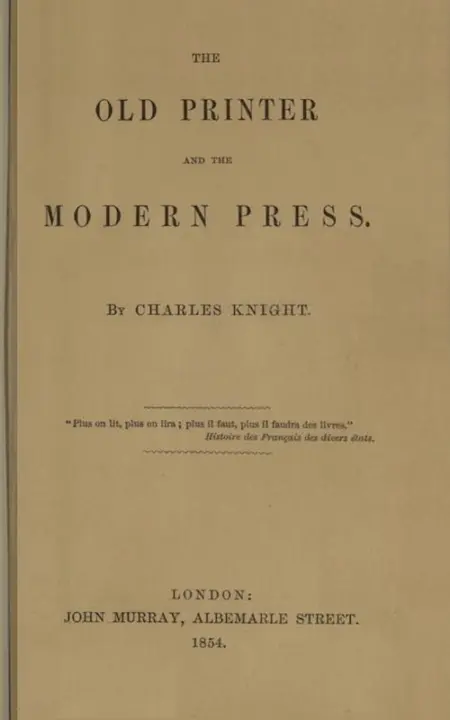
THE CLASSIC COLLECTION · 1854
"The Old Printer and the Modern Press" by Charles Knight is a historical account written in the mid-19th century. The work explores the life of William Caxton, the first English printer, highlighting his contributions to the dissemination of knowledge through the printed word. The narrative reflects on various themes, including the evolution of the English language, the cultural landscape before and after the introduction of printing, and the socio-economic changes triggered by this revolutionary technology. At the start of the narrative, the context surrounding Caxton’s early life is established, particularly focusing on the Weald of Kent where he grew up. The text discusses the linguistic environment of the time, noting the transition from French to English in education, and the scarcity of books before the advent of printing. Knight paints a vivid picture of Caxton's formative years, illustrating the societal isolation and linguistic variations in his rural upbringing. The opening portion sets the stage for understanding Caxton’s later accomplishments and the profound impact of printing on English literature, culture, and society.
Introduction adapted from the source catalogue; source summaries may be automatically generated.
Free to read · English · 88,831 words · No account needed
MAKE TIME FOR A GOOD BOOK
On by default. Untick to stop anonymous reading totals. Each page counts after 10 seconds in view. How this works.
Anonymous counting is on unless you have switched it off.
The terrible quarter of a century that had preceded the Restoration, and the new tastes which the return of the Stuarts brought to England, would seem to have swept away even the remembrances of the popular literature of Elizabeth and James. Edward Phillips, the nephew of Milton, has a remarkable passage with reference to the poets: "As for the antiquated and fallen into obscurity from their former credit and reputation, they are for the most part those who have written beyond the verge of the present age; for let us look back as far as about thirty or forty years, and we shall find a profound silence of the poets beyond that time, except of some few dramatics, of whose real worth the interest of the now flourishing stage cannot but be sensible."[21] This was written in 1674. What had the people to read who had forgotten Spenser, and Daniel, and Drayton; and Herbert—who knew little of Shakspere, except in the translations of Davenant and Dryden; and who, unquestionably, had small relish for the popular prose of another age, such as Bacon's 'Essays'? They had rhyming tragedies; they had obscene comedies; they had their Sedleys and Rochesters. It is not wonderful that the popular taste soon grew corrupted. Pepys says (1666), "To Deptford by water, reading Othello, Moor of Venice, which I ever heretofore esteemed a mighty good play; but having so lately read The Adventures of Five Hours, it seems a mean thing." Their "light reading" was a marvel—that romance literature which at one time was as popular in its degree as the shilling novel of our own day. We have before us Mr. Samuel Speed's Catalogue of Books, printed for him in 1670. The first is 'Pharamond, the famed Romance, written by the author of those other two eminent volumes Cassandra and Cleopatra.' These famed and eminent volumes are large folios, translated from the French of M. de la Calprenede. If Calprenede was the Dumas, Madeleine Scudery was the Eugene Sue of those days. No popularity that these moderns have obtained by their feuilletons could have exceeded the excitement produced here, as well as in France, by the wonderful folios of their predecessors. 'Artamenes' and 'Clelia,' to say nothing of 'Almahide' and 'The Illustrious Bassa,' were in every mansion of the ladies of quality. The matron and her daughters sate at their embroidery while the companion read aloud, night after night, a page or two of these interminable adventures, in which Greeks and Romans talked the language of the Grand Monarque; and the intrigues of the court, and the characters of its personages, were mysteriously shadowed forth in what were called "Portraits." What signified that they were stupid? They were as level to the comprehension of their high-born readers as the penny novels of the present day are to the intelligence of the factory-girl. They had a long popularity, and were reprinted again and again, in their eight or ten volumes, when the age of duodecimos had arrived. They had been fashionable, and that was enough. Character they had none, and very little of human passions. They were constructed upon the admirable recipe of Molière in the 'Précieuses Ridicules'—a lover without feeling; a mistress without preference; mutual insensibility; sedulous attention to forms; a declaration in a garden; the banishment of the lover by the coquetting fair; perseverance; timid confessions; rivals; persecutions of fathers; jealousies conceived under false appearances; laments; despairs; abductions; and all that. Mammas thought they were wisely instructing their daughters, when they permitted Mademoiselle Scudery to teach them "des règles dont, en bonne galanterie, on ne saurait se dispenser." In vain Molière, and Boileau, and Scarron laughed at the great heroic romances. They held their own till Le Sage in France, and Defoe and Fielding in England, spoke the language of real life. They show us how long the great and little vulgar will feed upon husks, till some real fruit is offered to them. But it is remarkable how, in the same age, works of real genius and works of intense dulness will run side by side. It may be a question how far 'Don Quixote' drove out the romances of chivalry. 'Tartufe,' and 'Le Malade Imaginaire' were of the same era as that of the wonderful productions in which Cyrus was talking galanterie to Mandane through a thousand folio pages. When Pepys thought 'Othello' a mean thing compared with 'The Adventures of Five Hours' he also bought "Hudibras, both parts, the book now in greatest fashion for drollery;" but he tells us his honest mind when he says, "I cannot, I confess, see enough where the wit lies." Voltaire had a different standard of taste when he wrote, "I never met with so much wit in one single book as in this." The politics of 'Hudibras' made it "in greatest fashion;" the wit shot over the heads of the idle, dissipated, slavish, and corrupt courtiers who gave it their patronage, but eventually left its author to starve. Butler became popular in another generation; and so did Milton. The first edition of 'Paradise Lost' sufficed for a circulation of seven years.
Your reading position is saved on this browser. Take it to another device with a library code. Reading pages adapt to text, rather than matching a printed edition.
BEHIND THE BOOK
This eBook is for the use of anyone anywhere in the United States and most other parts of the world at no cost and with almost no restrictions whatsoever. You may copy it, give it away or re-use it under the terms of the Project Gutenberg License included with this eBook or online at www.gutenberg.org. If you are not located in the United States, you will have to check the laws of the country where you are located before using this eBook. Read the source licence.
The original source file, including credits and licence, is retained by this library. Request an original-format copy at no charge. Please include the book title and Project Gutenberg identifier #59966.
KEEP YOUR CURIOSITY GOING
Cécile Tormay

Moritz Busch
John L. Ransom
Frances Wright
Cécile Tormay

Mabel Potter Daggett