THE CLASSIC COLLECTION✦An outlaw’s diary: the CommuneCLASSIC FREE BOOKS
An outlaw’s diary: the Commune
Cécile Tormay
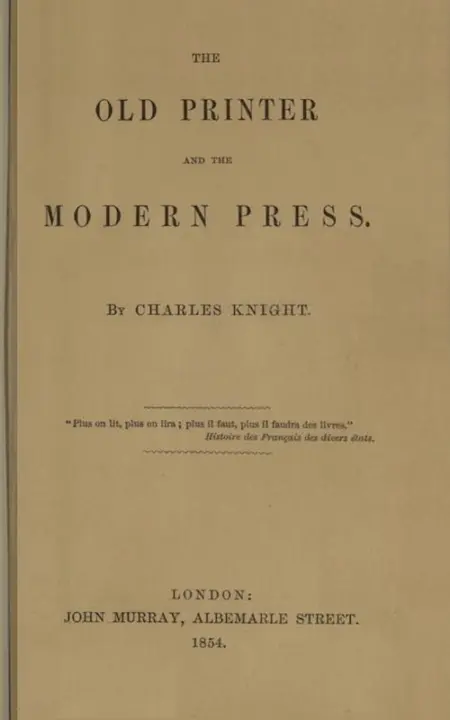
THE CLASSIC COLLECTION · 1854
"The Old Printer and the Modern Press" by Charles Knight is a historical account written in the mid-19th century. The work explores the life of William Caxton, the first English printer, highlighting his contributions to the dissemination of knowledge through the printed word. The narrative reflects on various themes, including the evolution of the English language, the cultural landscape before and after the introduction of printing, and the socio-economic changes triggered by this revolutionary technology. At the start of the narrative, the context surrounding Caxton’s early life is established, particularly focusing on the Weald of Kent where he grew up. The text discusses the linguistic environment of the time, noting the transition from French to English in education, and the scarcity of books before the advent of printing. Knight paints a vivid picture of Caxton's formative years, illustrating the societal isolation and linguistic variations in his rural upbringing. The opening portion sets the stage for understanding Caxton’s later accomplishments and the profound impact of printing on English literature, culture, and society.
Introduction adapted from the source catalogue; source summaries may be automatically generated.
Free to read · English · 88,831 words · No account needed
MAKE TIME FOR A GOOD BOOK
On by default. Untick to stop anonymous reading totals. Each page counts after 10 seconds in view. How this works.
Anonymous counting is on unless you have switched it off.
The rude historical Drama was then just arising to familiarise the people with their country's annals. In ten more years the press would teem with play-books; for the triumphant era was approaching of those who, in 1579, Stephen Gosson denounced to uttermost perdition in his 'Pleasant invective against poets, pipers, jesters, and such-like caterpillars of a commonwealth.' That species of popular literature is almost absent from the Registers of 1582; but the materials upon which much of the romantic drama is founded were familiar to the readers of this period. Who were the readers, we may judge from the titles of some of these novels. One will indicate a class:—'The Wonderful Adventures of Simonides, gathered as well for the instruction of our noble young gentlemen as our honourable courtly ladies.' The translators and writers of these romances seem to have had no notion of a class of readers beyond the circle of the rich and the high-born. Sidney's 'Arcadia' is called 'The Countess of Pembroke's Arcadia;' and in his Dedication to "My dear Lady and Sister," he says, "It is done only for you, and to you; ... for indeed for severer eyes it is not, being but a trifle, and that triflingly handled." A few years after came Robert Greene, and other writers of imagination, who were equally starved in writing plays for the stage-managers and stories for the stationers. Greene's 'Pandosto,' afterwards called 'Dorastus and Fawnia,' is a small quarto of 56 pages, in which Shakspere found the story of 'The Winter's Tale.' The author describes this novelet as "pleasant for age to avoid dreary thoughts; profitable for youth to eschew other wanton pastimes; and bringing to both a desired content." He dedicates it "To the Gentlemen Readers, Health;" and to these "Gentlemen" he says, "If any condemn my rashness for troubling your ears with so many unlearned pamphlets, I will straight shroud myself under the shadow of your courtesies." The scholar was addressing the "gentlemen" of the Inns of Court and of the Universities. He was looking to a ruder class of readers when, in 1591, he published 'A Notable Discovery of Cosenage,' having himself, as he confesses, kept villainous company. This tract he addresses "To the young Gentlemen, Merchants, Apprentices, Farmers, and plain Countrymen." Here is a great extension of the reading public: but we have some doubts if Greene's tract ever reached "Farmers and plain Countrymen." The question arises, how were books to be circulated in the provinces? It was more than a century later before some of the largest towns, such as Birmingham, had their booksellers. The pedlers who kept the fairs and markets were the booksellers of the early days of the press. The last new pamphlet travelled into the country in the same pack with the last new ruff; it travelled many miles, and found few buyers. And yet for some popular books the demand was not contemptible. Sir Thomas Challoner translated 'The Praise of Folly,' of Erasmus, which was published in 1577; and the Stationers' Company stipulated with the publisher that he should print "not above 1500 of any impression," and that "any of the Company may lay on with him, reasonably, at every impression." Mr. Collier, who gives this curious extract from "the Stationers' Registers," thinks that this meant "sharing the profits." It meant that whilst the sheets were at press any member of the Company might print off a reasonable number for his own sale. To "lay on" is still a technical term in printing. Challoner's Erasmus was an amusing book for the scholar, and had, no doubt, a special sale amongst teachers and students. Philip Stubbes, in his 'Anatomy of Abuses,' first published in 1583, bitterly complains that "pamphlets of toys and babbleries corrupt men's minds and pervert good wits;" and he especially laments that such books, being "better esteemed and more vendible than the godliest and sagest books that be," have caused "that worthy Book of Martyrs, made by that famous father and excellent instrument in God his Church, Master John Foxe, so little to be accepted." We might have concluded that, even in those days of limited bookselling, the great popular book of the 'Acts and Monuments' would have had an universal sale, with its wonderful woodcuts and its deep interest for the bulk of the people. But when its excitement was simply historical, two centuries afterwards, the same book would be found in many a peasant's cottage, for the sole reason that it might be purchased in small portions by a periodical outlay. Whilst the wares of worthy John Fox were sleeping in the bookseller's warehouse, the people were buying their 'Almanacs and Prognostications,' which Christopher Barker, speaking of their patentee, calls "a pretty commodity towards an honest man's living." They were buying, in this year of 1582, 'The Dial of Destiny,' an astrological treatise; 'The Examination and Confession of Witches;' 'The Execution of Edmund Campion, the Jesuit;' 'The Interpretation of Dreams;' 'A Treatise of the rare and strange Wonders seen in the Air.' They were buying 'A Ballad of the Lamentation of a modest Maiden being deceitfully forsaken;' A Ballad entitled 'Now we go, of the Papists' new overthrow;' 'The picture of two pernicious Varlets, called Prig Pickthank and Clem Clawback;' 'A Ballad entitled a doleful Ditty, declaring the unfortunate hap of two faithful friends, the one went out of her wits and the other for sorrow died.' They were buying story-books in prose and rhyme,—accounts of murders and treasons, of fires and earthquakes,—and songs, "old and plain." The Court had its 'Euphues, very pleasant for all gentlemen to read;' and the City its mirror of Court manners, entitled 'How a young gentleman may behave himself in all companies.'
Your reading position is saved on this browser. Take it to another device with a library code. Reading pages adapt to text, rather than matching a printed edition.
BEHIND THE BOOK
This eBook is for the use of anyone anywhere in the United States and most other parts of the world at no cost and with almost no restrictions whatsoever. You may copy it, give it away or re-use it under the terms of the Project Gutenberg License included with this eBook or online at www.gutenberg.org. If you are not located in the United States, you will have to check the laws of the country where you are located before using this eBook. Read the source licence.
The original source file, including credits and licence, is retained by this library. Request an original-format copy at no charge. Please include the book title and Project Gutenberg identifier #59966.
KEEP YOUR CURIOSITY GOING
Cécile Tormay

Moritz Busch
John L. Ransom
Frances Wright
Cécile Tormay

Mabel Potter Daggett