THE CLASSIC COLLECTION✦An outlaw’s diary: the CommuneCLASSIC FREE BOOKS
An outlaw’s diary: the Commune
Cécile Tormay
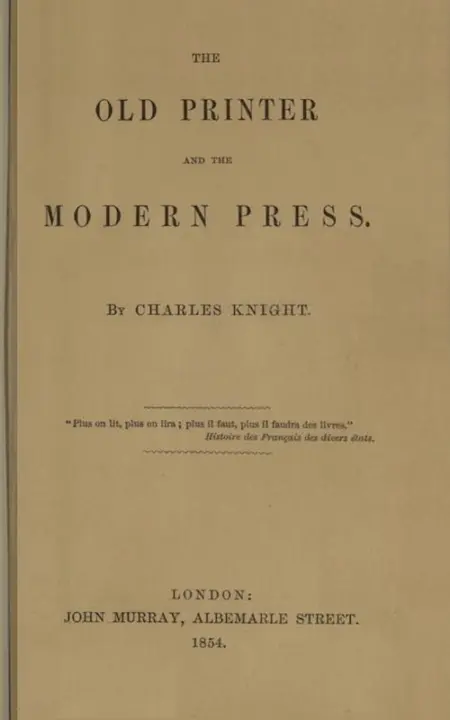
THE CLASSIC COLLECTION · 1854
"The Old Printer and the Modern Press" by Charles Knight is a historical account written in the mid-19th century. The work explores the life of William Caxton, the first English printer, highlighting his contributions to the dissemination of knowledge through the printed word. The narrative reflects on various themes, including the evolution of the English language, the cultural landscape before and after the introduction of printing, and the socio-economic changes triggered by this revolutionary technology. At the start of the narrative, the context surrounding Caxton’s early life is established, particularly focusing on the Weald of Kent where he grew up. The text discusses the linguistic environment of the time, noting the transition from French to English in education, and the scarcity of books before the advent of printing. Knight paints a vivid picture of Caxton's formative years, illustrating the societal isolation and linguistic variations in his rural upbringing. The opening portion sets the stage for understanding Caxton’s later accomplishments and the profound impact of printing on English literature, culture, and society.
Introduction adapted from the source catalogue; source summaries may be automatically generated.
Free to read · English · 88,831 words · No account needed
MAKE TIME FOR A GOOD BOOK
On by default. Untick to stop anonymous reading totals. Each page counts after 10 seconds in view. How this works.
Anonymous counting is on unless you have switched it off.
And also of your charity call to remembrance The soul of William Caxton, first printer of this book In Latin tongue at Cologne, himself to advance, That every well-disposed man may thereon look: And John Tate the younger joy mote [may] he brook, Which hath late in England made this paper thin, That now in our English this book is printed in."
"Fairly rhymed, Wynkyn," said Lettou. "But John Tate the younger is a bold fellow. Of a surety England can never support a Paper-mill of its own."
"Come, to business," said William of Mechlin.
[Footnote 13: He always, in these marks, associated the device of Caxton with his own; glorying, as he well might, in succeeding to the business of his honoured master, and continuing for so many years the good work which he had begun.]
[Footnote 14: These are the words with which this book closes.]
[Footnote 15:
"Wynkyn de Worde this hath set in print,
In William Caxton's house:—so fill the case."
Stanzas to 'Scala Perfectionis,' 1494.]
[Footnote 16: To "fill the case" is to put fresh types in the case, ready to arrange in new pages. The bibliographers scarcely understood the technical expression of honest Wynkyn.]
[Footnote 17: There is a record in the parish books of St. Margaret's of the churchwardens selling for 6s. 8d. one of the books bequeathed to the church by William Caxton.]
The following account of the invention of printing is given by an ancient German chronicler of the name of Trithemius, who appears to have personally known one of the three persons who clearly seem to have the best title to be called the inventors of printing.
"At this time, in the city of Mentz on the Rhine in Germany, and not in Italy, as some have erroneously written, that wonderful and then unheard-of art of printing and characterizing books was invented and devised by John Guttenberger, a citizen of Mentz, who, having expended almost the whole of his property in the invention of this art, and on account of the difficulties which he experienced on all sides, was about to abandon it altogether; when, by the advice, and through the means, of John Fust [or Faust], likewise a citizen of Mentz, he succeeded in bringing it to perfection. At first they formed [engraved] the characters or letters in written order on blocks of wood, and in this manner they printed the vocabulary called a 'Catholicon.' But with these forms [blocks] they could print nothing else, because the characters could not be transposed in these tablets, but were engraved thereon, as we have said. To this invention succeeded a more subtle one, for they found out the means of cutting the forms of all the letters of the alphabet, which they called matrices, from which again they cast characters of copper or tin of sufficient hardness to resist the necessary pressure, which they had before engraved by hand. And truly, as I learned thirty years since from Peter Opilio (Schoeffer) de Gernsheim, citizen of Mentz, who was the son-in-law of the first inventor of this art, great difficulties were experienced after the first invention of this art of printing, for in printing the Bible, before they had completed the third quaternion (or gathering of four sheets), 4000 florins were expended. This Peter Schoeffer, whom we have above mentioned, first servant and afterwards son-in-law to the first inventor, John Fust, as we have said, an ingenious and sagacious man, discovered the more easy method of casting the types, and thus the art was reduced to the complete state in which it now is. These three kept this method of printing secret for some time, until it was divulged by some of their workmen, without whose aid this art could not have been exercised; it was first developed at Strasburg, and soon became known to other nations. And thus much of the admirable and subtle art of printing may suffice—the first inventors were citizens of Mentz. These three first inventors of Printing, (videlicet) John Guttenberger, John Fust, and Peter Schoeffer, his son-in-law, lived at Mentz, in the house called Zum Jungen, which has ever since been called the Printing-office."
Your reading position is saved on this browser. Take it to another device with a library code. Reading pages adapt to text, rather than matching a printed edition.
BEHIND THE BOOK
This eBook is for the use of anyone anywhere in the United States and most other parts of the world at no cost and with almost no restrictions whatsoever. You may copy it, give it away or re-use it under the terms of the Project Gutenberg License included with this eBook or online at www.gutenberg.org. If you are not located in the United States, you will have to check the laws of the country where you are located before using this eBook. Read the source licence.
The original source file, including credits and licence, is retained by this library. Request an original-format copy at no charge. Please include the book title and Project Gutenberg identifier #59966.
KEEP YOUR CURIOSITY GOING
Cécile Tormay

Moritz Busch
John L. Ransom
Frances Wright
Cécile Tormay

Mabel Potter Daggett