THE CLASSIC COLLECTION✦An outlaw’s diary: the CommuneCLASSIC FREE BOOKS
An outlaw’s diary: the Commune
Cécile Tormay
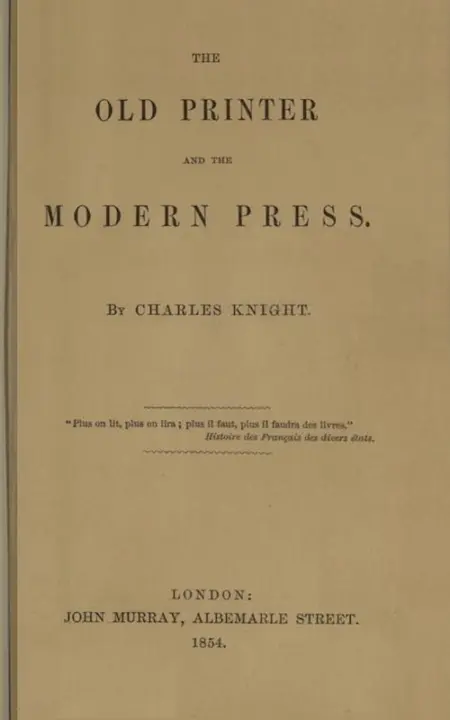
THE CLASSIC COLLECTION · 1854
"The Old Printer and the Modern Press" by Charles Knight is a historical account written in the mid-19th century. The work explores the life of William Caxton, the first English printer, highlighting his contributions to the dissemination of knowledge through the printed word. The narrative reflects on various themes, including the evolution of the English language, the cultural landscape before and after the introduction of printing, and the socio-economic changes triggered by this revolutionary technology. At the start of the narrative, the context surrounding Caxton’s early life is established, particularly focusing on the Weald of Kent where he grew up. The text discusses the linguistic environment of the time, noting the transition from French to English in education, and the scarcity of books before the advent of printing. Knight paints a vivid picture of Caxton's formative years, illustrating the societal isolation and linguistic variations in his rural upbringing. The opening portion sets the stage for understanding Caxton’s later accomplishments and the profound impact of printing on English literature, culture, and society.
Introduction adapted from the source catalogue; source summaries may be automatically generated.
Free to read · English · 88,831 words · No account needed
MAKE TIME FOR A GOOD BOOK
On by default. Untick to stop anonymous reading totals. Each page counts after 10 seconds in view. How this works.
Anonymous counting is on unless you have switched it off.
'The Book of Eneydos,' compiled from Virgil, is not a translation of Virgil's great epic, but a sort of historical narrative formed upon the course of the poet's great story. The most remarkable passage of this book is that of Caxton's preface, in which he complains of the unstedfastness of our language, and the difficulty that he found between plain, rude, and curious terms. (See page 5.) In this translation he again limits his work to a particular class of persons; as if he felt, which was probably a prejudice of his time, that the inferior members of the laity ought not to touch anything that pertained to scholastic learning. He says, "Forasmuch as this present book is not for a rude uplandish man to labour therein, nor read it, but only for a clerk and a noble gentleman that feeleth and understandeth in faits of arms, in love, and in noble chivalry: therefore, in mean between both, I have reduced and translated this said book into our English, not over rude nor curious, but in such terms as shall be understanden, by God's grace, according to my copy."
'The book called Cathon' (Cato's Morals) was destined by Caxton for a wider circulation:—"In my judgment it is the best book for to be taught to young children in schools, and also to people of every age it is full convenient if it be well understanden."
Dr. Dibdin, in his 'Typographical Antiquities,' says of Caxton, "Exclusively of the labours attached to the working of his press as a new art, our typographer contrived, though well stricken in years, to translate not fewer than five thousand closely printed folio pages. As a translator, therefore, he ranks among the most laborious, and, I would hope, not the least successful, of his tribe. The foregoing conclusion is the result of a careful enumeration of all the books translated as well as printed by him; which [the translated books], if published in the modern fashion, would extend to nearly twenty-five octavo volumes!" The exact nature of his labours seems, as might well be imagined, to have been often determined by very accidental circumstances. One noble lord requests him to produce this book, and one worshipful gentleman urges him to translate that. He says himself of his Virgil, "After divers works made, translated, and achieved, having no work in hand, I, sitting in my study whereas lay many divers pamphlets and books, happened that to my hand came a little book in French, which late was translated out of Latin by some noble clerk of France, which book is named Eneydos, made in Latin by that noble poet and great clerk Virgil." Some books, indeed, he would be determined to print by their existing popularity. Such were his two editions of Chaucer's 'Canterbury Tales' which we may be sure, from his sound criticism, he felt the necessity of promulgating to a much wider circle than had been reached by the transcribers. (See page 31.) Caxton was especially the devoted printer of Chaucer. His truly honourable conduct in venturing upon a new edition of the 'Canterbury Tales,' when he found his first was incorrect, exhibits an example in the first printer and the first publisher which the printers and publishers of all subsequent times ought to reverence and imitate. The early printers, English and foreign, were indeed a high and noble race. They did not set themselves up to be the patrons of letters; they did not dispense their dole to scholars grudgingly and thanklessly; they worked with them; they encountered with them the risks of profit and of fame; they were scholars themselves; they felt the deep responsibility of their office; they carried on the highest of all commerce in an elevated temper; they were not mere hucksters and chafferers. It was in no spirit of pride, it was in the spirit of duty, that Caxton raised a table of verses to Chaucer in Westminster Abbey. In his edition of Boetius, which he gives us to understand was translated by Master Geoffrey Chaucer, he says, "And furthermore I desire and require you, that of your charity ye would pray for the soul of the said worshipful man Geoffrey Chaucer, first translator of this said book into English, and embellisher in making the said language ornate and fair, which shall endure perpetually, and therefore he ought eternally to be remembered; of whom the body and corps lieth buried in the Abbey of Westminster, beside London, to fore the chapel of Saint Benet, by whose sepulture is written on a table, hanging on a pillar, his epitaph made by a poet-laureate, whereof the copy followeth." The writer of the Life of Chaucer, in the 'Biographia Britannica,' says, "It is very probable he lay beneath a large stone of gray marble in the pavement where the monument to Mr. Dryden now stands, which is in the front of that chapel [St. Benet's], upon the erecting of which [Dryden's monument] this stone was taken up, and sawed in pieces to made good the pavement. At least this seems best to answer the description of the place given by Caxton." There appears, according to the ancient editors of Chaucer's works, to have been two Latin lines upon his tombstone previous to the epitaph set up upon a pillar by Caxton. That epitaph was written by Stephanus Suriganius, poet-laureate of Milan. The monument of Chaucer, which still remains in the Abbey, around which the ashes of Spenser, and Beaumont, and Drayton, and Jonson, and Cowley, and Dryden, have clustered, was erected by an Oxford student in 1555. There might have been worse things preserved, and yet to be looked upon, in that Abbey, than honest old Caxton's epitaph upon him whom he calls "the worshipful father and first founder and embellisher of ornate eloquence in our English."
Your reading position is saved on this browser. Take it to another device with a library code. Reading pages adapt to text, rather than matching a printed edition.
BEHIND THE BOOK
This eBook is for the use of anyone anywhere in the United States and most other parts of the world at no cost and with almost no restrictions whatsoever. You may copy it, give it away or re-use it under the terms of the Project Gutenberg License included with this eBook or online at www.gutenberg.org. If you are not located in the United States, you will have to check the laws of the country where you are located before using this eBook. Read the source licence.
The original source file, including credits and licence, is retained by this library. Request an original-format copy at no charge. Please include the book title and Project Gutenberg identifier #59966.
KEEP YOUR CURIOSITY GOING
Cécile Tormay

Moritz Busch
John L. Ransom
Frances Wright
Cécile Tormay

Mabel Potter Daggett