THE CLASSIC COLLECTION✦An outlaw’s diary: the CommuneCLASSIC FREE BOOKS
An outlaw’s diary: the Commune
Cécile Tormay
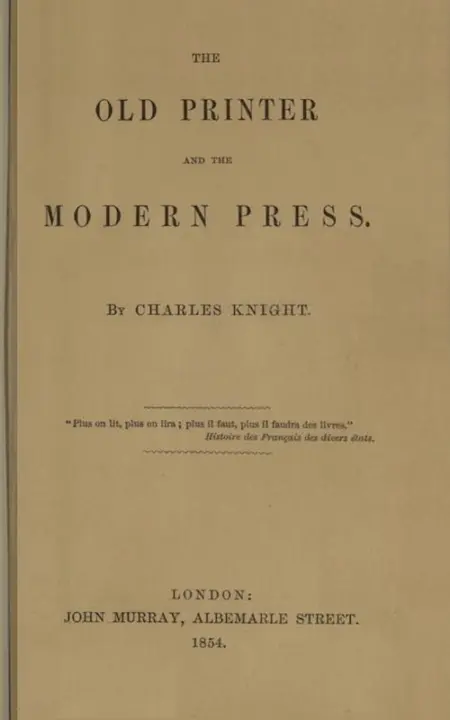
THE CLASSIC COLLECTION · 1854
"The Old Printer and the Modern Press" by Charles Knight is a historical account written in the mid-19th century. The work explores the life of William Caxton, the first English printer, highlighting his contributions to the dissemination of knowledge through the printed word. The narrative reflects on various themes, including the evolution of the English language, the cultural landscape before and after the introduction of printing, and the socio-economic changes triggered by this revolutionary technology. At the start of the narrative, the context surrounding Caxton’s early life is established, particularly focusing on the Weald of Kent where he grew up. The text discusses the linguistic environment of the time, noting the transition from French to English in education, and the scarcity of books before the advent of printing. Knight paints a vivid picture of Caxton's formative years, illustrating the societal isolation and linguistic variations in his rural upbringing. The opening portion sets the stage for understanding Caxton’s later accomplishments and the profound impact of printing on English literature, culture, and society.
Introduction adapted from the source catalogue; source summaries may be automatically generated.
Free to read · English · 88,831 words · No account needed
MAKE TIME FOR A GOOD BOOK
On by default. Untick to stop anonymous reading totals. Each page counts after 10 seconds in view. How this works.
Anonymous counting is on unless you have switched it off.
One of the most popular books of Caxton's translation must unquestionably have been the 'History of Reynard the Fox.' It is held that this work was composed in the twelfth century; and surely the author must have been a man of high genius to have constructed a fable which has been ever since popular in all countries, and delights us even to this hour. Caxton has no woodcuts to his edition, to which the book subsequently owed a portion of its attractions.
'The Subtil Histories and Fables of Esop,' translated by Caxton from the French, were printed by him in 1483, "The first year of the reign of King Richard the Third." In the first leaf there is a supposed portrait of Esop, a large rough woodcut, exhibiting him as he is described, with a great head, large visage, long jaws, sharp eyes, a short neck, curb-backed, and so forth. There is a controversy whether Richard the Third was a deformed man or not. It is held by many that it was one of the scandals put forth under his triumphant successor (which scandal Shakspere has for ever made current), that Richard was
"Cheated of feature by dissembling nature,
Deform'd, unfinish'd."
It strikes us that Caxton would scarcely have ventured, in the first year of King Richard III., to exhibit a print of a hump-backed Esop (for any print was then a rare thing), if his dread sovereign had been remarkable amongst the people for a similar defect. The conclusion of these fables of Esop has a story told by Caxton as from himself, which is a remarkable specimen of a plain narrative style, with a good deal of sly humour:—
"Now then I will finish all these fables with this tale that followeth, which a worshipful priest and a parson told me late: he said that there were dwelling at Oxenford two priests, both Masters of Arts—of whom that one was quick and could put himself forth; and that other was a good simple priest. And so it happened that the master that was pert and quick was anon promoted to a benefice or twain, and after to prebends, and for to be a dean of a great prince's chapel, supposing and weening that his fellow, the simple priest, should never be promoted, but be always an annual, or, at the most, a parish priest. So after a long time that this worshipful man, this dean, came running into a good parish with five or seven horses, like a prelate, and came into the church of the said parish, and found there this good simple man, sometime his fellow, which came and welcomed him lowly. And that other bade him 'Good morrow, Master John,' and took him slightly by the hand, and axed him where he dwelt.—And the good man said, 'In this parish.' 'How,' said he, 'are ye here a sole priest, or a parish priest?' 'Nay, Sir,' said he, 'for lack of a better, though I be not able nor worthy, I am parson and curate of this parish.' And then that other vailed [lowered] his bonnet, and said, 'Master Parson, I pray you to be not displeased; I had supposed ye had not been beneficed. But, master,' said he, 'I pray you what is this benefice worth to you a year?' 'Forsooth,' said the good simple man, 'I wot never; for I make never accompts thereof, how well I have had it four or five years.' 'And know ye not,' said he, 'what it is worth?—it should seem a good benefice.' 'No, forsooth,' said he, 'but I wot well what it shall be worth to me.' 'Why,' said he, 'what shall it be worth?' Forsooth,' said he, 'if I do my true dealing in the cure of my parishes in preaching and teaching, and do my part belonging to my cure, I shall have heaven therefore. And if their souls be lost, or any of them, by my default, I shall be punished therefore. And hereof I am sure.' And with that word the rich dean was abashed: and thought he should be the better, and take more heed to his cures and benefices than he had done. This was a good answer of a good priest and an honest. And herewith I finish this book, translated and imprinted by me, William Caxton." The moral of the fable is not obsolete.
Your reading position is saved on this browser. Take it to another device with a library code. Reading pages adapt to text, rather than matching a printed edition.
BEHIND THE BOOK
This eBook is for the use of anyone anywhere in the United States and most other parts of the world at no cost and with almost no restrictions whatsoever. You may copy it, give it away or re-use it under the terms of the Project Gutenberg License included with this eBook or online at www.gutenberg.org. If you are not located in the United States, you will have to check the laws of the country where you are located before using this eBook. Read the source licence.
The original source file, including credits and licence, is retained by this library. Request an original-format copy at no charge. Please include the book title and Project Gutenberg identifier #59966.
KEEP YOUR CURIOSITY GOING
Cécile Tormay

Moritz Busch
John L. Ransom
Frances Wright
Cécile Tormay

Mabel Potter Daggett