THE CLASSIC COLLECTION✦An outlaw’s diary: the CommuneCLASSIC FREE BOOKS
An outlaw’s diary: the Commune
Cécile Tormay
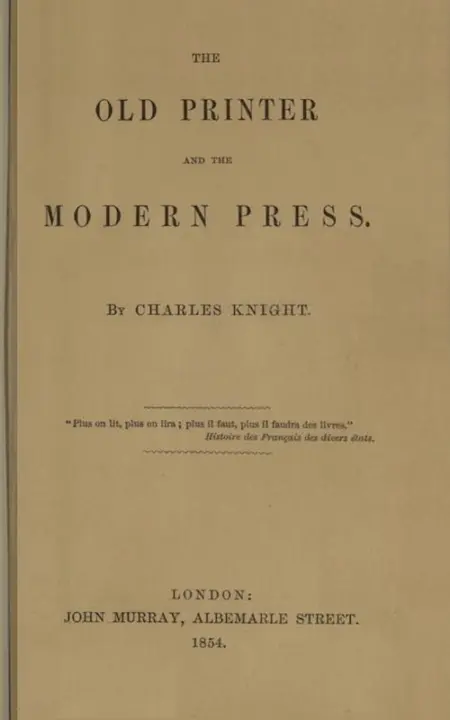
THE CLASSIC COLLECTION · 1854
"The Old Printer and the Modern Press" by Charles Knight is a historical account written in the mid-19th century. The work explores the life of William Caxton, the first English printer, highlighting his contributions to the dissemination of knowledge through the printed word. The narrative reflects on various themes, including the evolution of the English language, the cultural landscape before and after the introduction of printing, and the socio-economic changes triggered by this revolutionary technology. At the start of the narrative, the context surrounding Caxton’s early life is established, particularly focusing on the Weald of Kent where he grew up. The text discusses the linguistic environment of the time, noting the transition from French to English in education, and the scarcity of books before the advent of printing. Knight paints a vivid picture of Caxton's formative years, illustrating the societal isolation and linguistic variations in his rural upbringing. The opening portion sets the stage for understanding Caxton’s later accomplishments and the profound impact of printing on English literature, culture, and society.
Introduction adapted from the source catalogue; source summaries may be automatically generated.
Free to read · English · 88,831 words · No account needed
MAKE TIME FOR A GOOD BOOK
On by default. Untick to stop anonymous reading totals. Each page counts after 10 seconds in view. How this works.
Anonymous counting is on unless you have switched it off.
'The Book of the whole Life of Jason,' printed by Caxton in 1475, is another of these middle-age romances, founded upon the supposititious histories of Dares and Dictys.
Of 'The Game and Play of the Chess' Caxton printed two editions, which he translated himself from the French. The first was finished on the last day of March, 1474; and it is supposed to have been the first book which he printed in England. Bagford says, "Caxton's first book in the Abbey was 'The Game of Chess;' a book in those times much in use with all sorts of people, and in all likelihood first desired by the abbot, and the rest of his friends and masters." It was a book that Caxton clearly intended for the diffusion of knowledge amongst all ranks of people; for in his second edition he says, in not very complimentary phrase, "The noble clerks have written and compiled many notable works and histories," that they might come "to the knowledge and understanding of such as be ignorant, of which the number is infinite." And he adds, with still plainer speech, that, according to Solomon, "the number of fools is infinite." He says that amongst these noble clerks there was an excellent doctor of divinity in the kingdom of France, which "hath made a book of the chess moralised, which at such a time as I was resident in Bruges came into my hands."
It would seem to be an ingenious device of the reverend writer of the book of chess which Caxton translated, to associate with very correct instructions as to the mode of playing the game, such moralisations as would enable him therewith to teach the people "to understand wisdom and virtue." Caxton readily adopts the same notion. He dedicates the book to the Duke of Clarence: "Forasmuch as I have understood and known that you are inclined unto the commonweal of the king, our said sovereign lord, his nobles, lords, and common people of his noble realm of England, and that ye saw gladly the inhabitants of the same informed in good, virtuous, profitable, and honest manners." This book contains authorities, sayings, and stories, "applied unto the morality of the public weal, as well of the nobles and of the common people, after the game and play of chess;" and Caxton trusts that "other, of what estate or degree he or they stand in, may see in this little book that they govern themselves as they ought to do." This book of chess contains four treatises. The first describes the invention of the game in the time of a king of Babylon, Emsmerodach, a cruel king, the son of Nebuchadnezzar, to whom a philosopher showed the game for the purpose of exhibiting "the manners and condition of a king, of the nobles, and of the common people and their offices, and how they should be touched and drawn, and how he should amend himself and become virtuous." This is a bold fable, and takes us farther back than Sir William Jones, who says that chess was imported from the west of India, in the sixth century, and known immemorially in Hindustan by the name of Chaturanga, or the four members of an army, namely, elephants, horses, chariots, and foot-soldiers. The second treatise in Caxton's book describes, first, the office of a king: by this name the principal piece was always known. Secondly, of the queen; this name would seem to belong to the time of Caxton, for Chaucer and Lydgate call the piece Fers or Feers, a noble, a general,—hence Peer. Thirdly, of the Alphyns: this is the same as the present bishop; the French called this personage the Fou, and Rabelais calls him the Archer. Fourthly, the knight, who was always called by this name, in English and French chess. The rook, the fifth dignified piece, is from the Eastern name Ruc. Caxton goes on to inform us that the third treatise is of the offices of the common people. This treatise relates to the pawns; and a curious thing it is that the eight pawns of the board are taken by him each to represent large classes of the commonalty. The denominations of these classes somewhat vary in the two editions, but their general arrangement is the same. We have, in the first class, labourers and tillers of the earth; in the second, smiths and other workers in iron and metal; in the third, notaries, advocates, scriveners, drapers, and makers of cloth; in the fourth, merchants and changers; in the fifth, physicians, leeches, spicers, and apothecaries; in the sixth, taverners, hostelers, and victuallers; in the seventh, guards of the cities, receivers of custom, and tollers; and lastly, messengers, couriers, ribalds, and players at the dice.
Your reading position is saved on this browser. Take it to another device with a library code. Reading pages adapt to text, rather than matching a printed edition.
BEHIND THE BOOK
This eBook is for the use of anyone anywhere in the United States and most other parts of the world at no cost and with almost no restrictions whatsoever. You may copy it, give it away or re-use it under the terms of the Project Gutenberg License included with this eBook or online at www.gutenberg.org. If you are not located in the United States, you will have to check the laws of the country where you are located before using this eBook. Read the source licence.
The original source file, including credits and licence, is retained by this library. Request an original-format copy at no charge. Please include the book title and Project Gutenberg identifier #59966.
KEEP YOUR CURIOSITY GOING
Cécile Tormay

Moritz Busch
John L. Ransom
Frances Wright
Cécile Tormay

Mabel Potter Daggett