THE CLASSIC COLLECTION✦An outlaw’s diary: the CommuneCLASSIC FREE BOOKS
An outlaw’s diary: the Commune
Cécile Tormay
THE CLASSIC COLLECTION · 1854
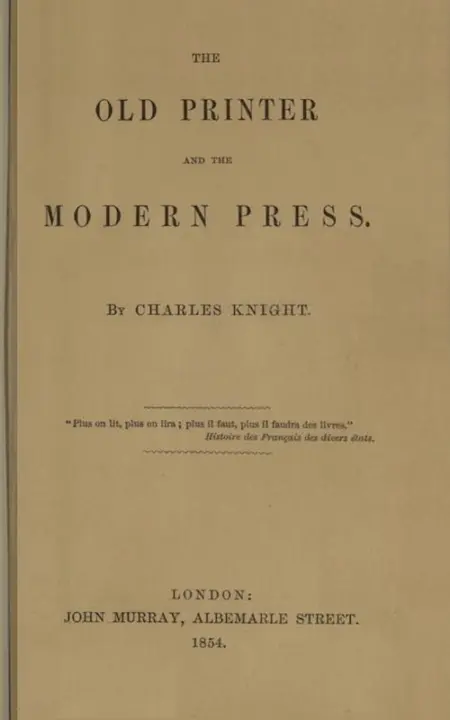
"The Old Printer and the Modern Press" by Charles Knight is a historical account written in the mid-19th century. The work explores the life of William Caxton, the first English printer, highlighting his contributions to the dissemination of knowledge through the printed word. The narrative reflects on various themes, including the evolution of the English language, the cultural landscape before and after the introduction of printing, and the socio-economic changes triggered by this revolutionary technology. At the start of the narrative, the context surrounding Caxton’s early life is established, particularly focusing on the Weald of Kent where he grew up. The text discusses the linguistic environment of the time, noting the transition from French to English in education, and the scarcity of books before the advent of printing. Knight paints a vivid picture of Caxton's formative years, illustrating the societal isolation and linguistic variations in his rural upbringing. The opening portion sets the stage for understanding Caxton’s later accomplishments and the profound impact of printing on English literature, culture, and society.
Introduction adapted from the source catalogue; source summaries may be automatically generated.
Free to read · English · 88,831 words · No account needed
MAKE TIME FOR A GOOD BOOK
On by default. Untick to stop anonymous reading totals. Each page counts after 10 seconds in view. How this works.
Anonymous counting is on unless you have switched it off.
But, in wishing the highest knowledge to be simplified and made popular, the good old printer had no thought of rendering knowledge a light and frivolous thing, to be taken up and laid down without earnestness. In his truly beautiful exposition of the uses of knowledge, contained in his prologue to the 'Mirror of the World,' he says, "Let us pray the Maker and Creator of all creatures, God Almighty, that, at the beginning of this book, it list him, of his most bounteous grace, to depart with us of the same that we may learn; and that learned, to retain; and that retained, to teach; that we may have so perfect science and knowledge of God, that we may get thereby the health of our souls, and to be partners of his glory, permanent, and without end, in heaven. Amen."
Gibbon, we think, has taken a somewhat severe view of the character of the works which were produced by the father of English printing:—"It was in the year 1474 that our first press was established in Westminster Abbey, by William Caxton: but in the choice of his authors, that liberal and industrious artist was reduced to comply with the vicious taste of his readers; to gratify the nobles with treatises on heraldry, hawking, and the game of chess, and to amuse the popular credulity with romances of fabulous knights and legends of more fabulous saints." The historian, however, notices with approbation the laudable desire which Caxton expresses to elucidate the history of his country. But his censure of the general character of the works of Caxton's press is somewhat too sweeping. It appears to us that a more just as well as a more liberal view of the use and tendency of these works is that of Thomas Warton, which we may be excused in quoting somewhat at length:—"By means of French translations, our countrymen, who understood French much better than Latin, became acquainted with many useful books which they would not otherwise have known. With such assistances, a commodious access to the classics was opened, and the knowledge of ancient literature facilitated and familiarised in England, at a much earlier period than is imagined; and at a time when little more than the productions of speculative monks and irrefragable doctors could be obtained or were studied.... When these authors, therefore, appeared in a language almost as intelligible as the English, they fell into the hands of illiterate and common readers, and contributed to sow the seeds of a national erudition, and to form a popular taste. Even the French versions of the religious, philosophical, historical, and allegorical compositions of those more enlightened Latin writers who flourished in the middle ages, had their use, till better books came into vogue: pregnant as they were with absurdities, they communicated instruction on various and new subjects, enlarged the field of information, and promoted the love of reading, by gratifying that growing literary curiosity which now began to want materials for the exercise of its operations.... These French versions enabled Caxton, our first printer, to enrich the state of letters in this country with many valuable publications. He found it no difficult task, either by himself or the help of his friends, to turn a considerable number of these pieces into English, which he printed. Ancient learning had as yet made too little progress among us to encourage this enterprising and industrious artist to publish the Roman authors in their original language: and had not the French furnished him with these materials, it is not likely that Virgil, Ovid, Cicero, and many other good writers would by the means of his press have been circulated in the English tongue so early as the close of the fifteenth century." Warton adds in a note, "It was a circumstance favourable at least to English literature, owing indeed to the general illiteracy of the times, that our first printers were so little employed on books written in the learned languages. Almost all Caxton's books are English. The multiplication of English copies multiplied English readers, and these again produced new vernacular writers. The existence of a press induced many persons to turn authors who were only qualified to write in their native tongue." Having thus given the somewhat different views of two most able and accomplished scholars, viewing as they did the same objects through different media, we shall proceed to notice some of the more remarkable characteristics of the books issued from Caxton's press, rather regarding them as illustrations of the state of knowledge and the manners of his time, than as mere bibliographical curiosities.
Your reading position is saved on this browser. Take it to another device with a library code. Reading pages adapt to text, rather than matching a printed edition.
BEHIND THE BOOK
This eBook is for the use of anyone anywhere in the United States and most other parts of the world at no cost and with almost no restrictions whatsoever. You may copy it, give it away or re-use it under the terms of the Project Gutenberg License included with this eBook or online at www.gutenberg.org. If you are not located in the United States, you will have to check the laws of the country where you are located before using this eBook. Read the source licence.
The original source file, including credits and licence, is retained by this library. Request an original-format copy at no charge. Please include the book title and Project Gutenberg identifier #59966.
KEEP YOUR CURIOSITY GOING
Cécile Tormay

Moritz Busch
John L. Ransom
Frances Wright
Cécile Tormay

Mabel Potter Daggett