THE CLASSIC COLLECTION✦An outlaw’s diary: the CommuneCLASSIC FREE BOOKS
An outlaw’s diary: the Commune
Cécile Tormay
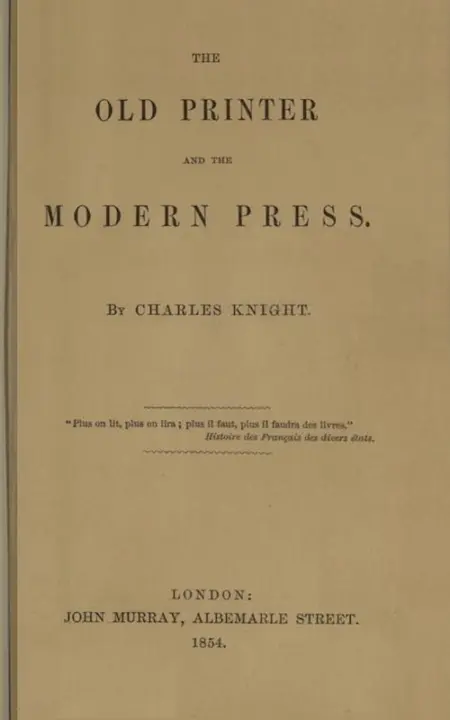
THE CLASSIC COLLECTION · 1854
"The Old Printer and the Modern Press" by Charles Knight is a historical account written in the mid-19th century. The work explores the life of William Caxton, the first English printer, highlighting his contributions to the dissemination of knowledge through the printed word. The narrative reflects on various themes, including the evolution of the English language, the cultural landscape before and after the introduction of printing, and the socio-economic changes triggered by this revolutionary technology. At the start of the narrative, the context surrounding Caxton’s early life is established, particularly focusing on the Weald of Kent where he grew up. The text discusses the linguistic environment of the time, noting the transition from French to English in education, and the scarcity of books before the advent of printing. Knight paints a vivid picture of Caxton's formative years, illustrating the societal isolation and linguistic variations in his rural upbringing. The opening portion sets the stage for understanding Caxton’s later accomplishments and the profound impact of printing on English literature, culture, and society.
Introduction adapted from the source catalogue; source summaries may be automatically generated.
Free to read · English · 88,831 words · No account needed
MAKE TIME FOR A GOOD BOOK
On by default. Untick to stop anonymous reading totals. Each page counts after 10 seconds in view. How this works.
Anonymous counting is on unless you have switched it off.
But the ancient printer had something more to do before his manufacture was complete. He was a bookbinder as well as a printer. The ancient books, manuscript as well as printed, were wonderful specimens of patient labour. The board, literally a wooden board, between which the leaves were fastened, was as thick as the panel of a door. This was covered with leather, sometimes embossed with the most ingenious devices. There were large brass nails, with ornamented heads, on the outside of this cover, with magnificent corners to the lids. In addition, there were clasps. The back was rendered solid with paste and glue, so as to last for centuries. Erasmus says of such a book, "As for Thomas Aquinas's Secunda Secundæ, no man can carry it about, much less get it into his head." An ancient woodcut shows us the binder hammering at the leaves to make them flat, and a lad sewing the leaves in a frame very like that still in use. Above are the books flying in the air in all their solid glory.
But the most difficult labour of the ancient printer, and that which would necessarily constitute the great distinction between one printer and another, was yet to come. He had to sell his books when he had manufactured them, for there was no division of the labour of publisher and printer in those days. His success would of course much depend upon the quality of his books; upon their adaptation to the nature of the demand for books; upon their accuracy; upon their approach to the beauty of the old manuscripts. But he had to incur the risk common to all copying processes, whether the thing produced be a medal or a book, of expending a large certain sum before a single copy could be produced. The process of printing, compared with that of writing, is a cheap process as ordinarily conducted; but the condition of cheapness is this,—that a sufficient number of copies of any particular book may be reckoned upon as saleable, so as to render the proportion of the first expense upon a single copy inconsiderable. If it were required even at the present time to print a single copy, or even three or four copies only, of any literary work, the cost of printing would be greater than the cost of transcribing. It is when hundreds, and especially thousands, of the same work are demanded, that the great value of the printing-press in making knowledge cheap is particularly shown. It is probable that the first printers did not take off more than two or three hundred, if so many, of their works; and, therefore, the earliest printed books must have been still dear, on account of the limited number of their readers. Caxton, as it appears by a passage in one of his books, was a cautious printer; and required something like an assurance that he should sell enough of any particular book to repay the cost of producing it. In his 'Legend of Saints' he says, "I have submysed [submitted] myself to translate into English the 'Legend of Saints,' called 'Legenda aurea' in Latin; and William, Earl of Arundel, desired me—and promised to take a reasonable quantity of them—and sent me a worshipful gentleman, promising that my said lord should during my life give and grant to me a yearly fee, that is to note, a buck in summer and a doe in winter." Caxton, with his sale of a reasonable quantity, and his summer and winter venison, was more fortunate than others of his brethren, who speculated upon a public demand for books without any guarantee from the great and wealthy. Sweynheim and Pannartz, Germans who settled in Rome, and there printed many beautiful editions of the Latin Classics, presented a petition to the Pope, in 1471, which contains the following passage:—"We were the first of the Germans who introduced this art, with vast labour and cost, into your holiness' territories, in the time of your predecessor; and encouraged by our example other printers to do the same. If you peruse the catalogue of the works printed by us, you will admire how and where we could procure a sufficient quantity of paper, or even rags, for such a number of volumes. The total of these books amounts to 12,475,—a prodigious heap,—and intolerable to us, your holiness' printers, by reason of those unsold. We are no longer able to bear the great expense of housekeeping, for want of buyers; of which there cannot be a more flagrant proof than that our house, though otherwise spacious enough, is full of quire-books, but void of every necessary of life." For some years after the invention of printing, many of the ingenious, learned, and enterprising men who devoted themselves to the new art which was to change the face of society, were ruined, because they could not sell cheaply unless they printed considerable number of a book; and there were not readers enough to take off the stock which they thus accumulated. In time, however, as the facilities for acquiring knowledge which printing afforded created many readers, the trade of printing books became one of less general risk; and dealers in literature could afford more and more to dispense with individual patronage, and rely upon the public demand.
Your reading position is saved on this browser. Take it to another device with a library code. Reading pages adapt to text, rather than matching a printed edition.
BEHIND THE BOOK
This eBook is for the use of anyone anywhere in the United States and most other parts of the world at no cost and with almost no restrictions whatsoever. You may copy it, give it away or re-use it under the terms of the Project Gutenberg License included with this eBook or online at www.gutenberg.org. If you are not located in the United States, you will have to check the laws of the country where you are located before using this eBook. Read the source licence.
The original source file, including credits and licence, is retained by this library. Request an original-format copy at no charge. Please include the book title and Project Gutenberg identifier #59966.
KEEP YOUR CURIOSITY GOING
Cécile Tormay

Moritz Busch
John L. Ransom
Frances Wright
Cécile Tormay

Mabel Potter Daggett