THE CLASSIC COLLECTION✦An outlaw’s diary: the CommuneCLASSIC FREE BOOKS
An outlaw’s diary: the Commune
Cécile Tormay
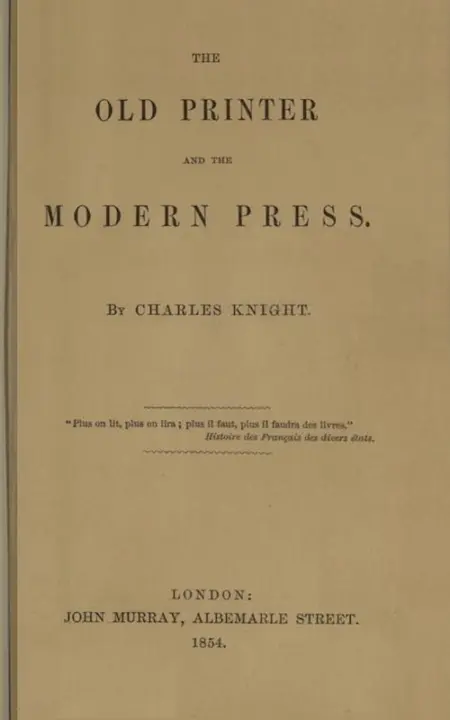
THE CLASSIC COLLECTION · 1854
"The Old Printer and the Modern Press" by Charles Knight is a historical account written in the mid-19th century. The work explores the life of William Caxton, the first English printer, highlighting his contributions to the dissemination of knowledge through the printed word. The narrative reflects on various themes, including the evolution of the English language, the cultural landscape before and after the introduction of printing, and the socio-economic changes triggered by this revolutionary technology. At the start of the narrative, the context surrounding Caxton’s early life is established, particularly focusing on the Weald of Kent where he grew up. The text discusses the linguistic environment of the time, noting the transition from French to English in education, and the scarcity of books before the advent of printing. Knight paints a vivid picture of Caxton's formative years, illustrating the societal isolation and linguistic variations in his rural upbringing. The opening portion sets the stage for understanding Caxton’s later accomplishments and the profound impact of printing on English literature, culture, and society.
Introduction adapted from the source catalogue; source summaries may be automatically generated.
Free to read · English · 88,831 words · No account needed
MAKE TIME FOR A GOOD BOOK
On by default. Untick to stop anonymous reading totals. Each page counts after 10 seconds in view. How this works.
Anonymous counting is on unless you have switched it off.
The place where Caxton learned the art of printing, and the persons of whom he first learned it, are not shown in any of his voluminous prologues and prefaces. But an extraordinary statement was published in the year 1664, by a person of the name of Richard Atkyns, who sought to prove that printing was a royal prerogative, because, as he says, the art was first brought into England at the cost of the crown. His narrative is held to be altogether a fiction; for the document upon which he rests it was never forthcoming, and no person has ever testified to the knowledge of it, except Richard Atkyns himself, who laboured hard to obtain a patent from the crown for the sole printing of law-books, upon the ground which he attempts to take of the crown having brought printing into England. "Thomas Bourchier, Archbishop of Canterbury, moved the then king, Henry VI., to use all possible means for procuring a printing-mould, for so it was then called, to be brought into this kingdom. The king, a good man, and much given to works of this nature, readily hearkened to the motion; and taking private advice how to effect this design, concluded it could not be brought about without great secrecy, and a considerable sum of money given to such person or persons as would draw off some of the workmen from Haarlem in Holland, where John Guttenberg had newly invented it, and was himself personally at work. It was resolved that less than one thousand marks would not produce the desired effect: towards which sum the said archbishop presented the king with three hundred marks. The money being now prepared, the management of the design was committed to Mr. Robert Turnour, who then was keeper of the robes to the king, and a person most in favour with him of any of his condition. Mr. Turnour took to his assistance Mr. Caxton, a citizen of good abilities, who, trading much into Holland, might be a creditable pretence, as well for his going as staying in the Low Countries. Mr. Turnour was in disguise, his beard and hair shaven quite off, but Mr. Caxton appeared known and public. They having received the sum of one thousand marks, went first to Amsterdam, then to Leyden, not daring to enter Haarlem itself; for the town was very jealous, having imprisoned and apprehended divers persons, who came from other parts for the same purpose. They stayed till they had spent the whole one thousand marks in gifts and expenses. So as the king was fain to send five hundred marks more, Mr. Turnour having written to the king that he had almost done his work, a bargain, as he said, being struck between him and two Hollanders for bringing off one of the workmen, who should sufficiently discover and teach the new art. At last, with much ado, they got off one of the under workmen, whose name was Frederick Corsells, or rather Corsellis; who late one night stole from his fellows in disguise, into a vessel prepared before for that purpose; and so the wind, favouring the design, brought him safe to London. It was not thought so prudent to set him on work at London, but by the archbishop's means, who had been Vice-chancellor and afterwards Chancellor of the University of Oxon, Corsellis was carried with a guard to Oxon, which constantly watched to prevent Corsellis from any possible escape, till he had made good his promise, in teaching how to print. So that at Oxford printing was first set up in England." This is certainly an extraordinary story, and one which upon the face of it has traces of inconsistency, if not of imposture. Richard Atkyns says that a certain worthy person "did present me with a copy of a record and manuscript in Lambeth House, heretofore in his custody, belonging to the See, and not to any particular Archbishop of Canterbury. The substance whereof was this; though I hope, for public satisfaction, the record itself in its due time will appear." The record itself did never appear, and, though diligently sought for, could never be found. But Atkyns further stated that the same most worthy person who gave him the copy of the record, trusted him with a book "printed at Oxon, A.D. 1468, which was three years before any of the recited authors [Stow and others] would allow it [printing] to be in England." He does not mention the book; but there is such a book, and it is entitled 'Expositio Sancti Ieronimi in Simbolum, ad Papam Laurentiam;' and at the end, 'Explicit Expositio, &c., Impressa Oxonie, et finita Anno Dom. MCCCCLXVIII, xvii die Decembris.' Anthony Wood repeats the story of Atkyns in his 'History of the University of Oxford;' and he adds, "And thus the mystery of printing appeared ten years sooner in the University of Oxford than at any other place in Europe, Haarlem and Mentz excepted. Not long after there were presses set up in Westminster, St. Albans, Worcester, and other monasteries of note. After this manner printing was introduced into England, by the care of Archbishop Bourchier, in the year of Christ 1464, and the third of King Edward IV." Wood's version of the story makes it a little, a very little, more credible, for it brings it nearer to the time when the newly discovered art of printing might have attracted some attention in England. But even in 1464 there were, with scarcely more than one exception, no printed books known in Europe but the first productions of the press at Mentz. The story of Caxton going to Haarlem in the time of Henry the Sixth, that is, in some year previous to 1461, must altogether be a fabrication, or a mistake. The accounts that would ascribe the invention of printing to Laurence Coster, of Haarlem, set up a legendary story that John Fust, or John Guttenberg (not the real Guttenberg, but an elder brother), stole the invention from Coster and carried it to Mentz in 1442. If Caxton, therefore, went to Haarlem in Holland, with a companion, in disguise, to learn the art of printing, he must have gone there before 1442; for the story holds that Coster was not only robbed of his secret, but of his types, and gave up printing in despair to his more fortunate spoiler. Bourchier was not Archbishop of Canterbury till 1454. We may be sure, therefore, that, wherever Caxton went to learn the art of printing at an earlier period than is generally supposed, he did not go to Haarlem in Holland. Substitute Mentz for Haarlem, and Atkyns's story is more consistent. It is by no means improbable that Henry the Sixth and Cardinal Bourchier might have seen the magnificent Latin bible, called the Mazarine bible, which was printed by Guttenberg, Schoeffer, and Fust, and is held to have appeared about 1455. Of this noble book Mr. Hallam says, "It is a very striking circumstance, that the high-minded inventors of this great art tried at the very outset so bold a flight as the printing an entire bible, and executed it with astonishing success. It was Minerva leaping on earth in her divine strength and radiant armour, ready at the moment of her nativity to subdue and destroy her enemies." The king and the archbishop might have desired that England should learn the art of executing so splendid a work as the first bible. At that period we know that Caxton was residing abroad, and he was a fit person to be selected for such a commission. But kings at that day were scarcely better supplied with money than their subjects; and if Henry the Sixth had sent to Mr. Robert Turnour or Mr. William Caxton seven hundred marks at one time and five hundred at another, the gifts must have been registered with all due formality. We have the Exchequer registers of Henry the Sixth and his great rival; and although we learn that Edward the Fourth gave Caxton twenty pounds, neither his name nor that of Mr. Tumour, nor even of the archbishop, is associated with any bounty of Henry the Sixth. We may, therefore, safely conclude, with Dr. Conyers Middleton, with regard to all this story, that "Mr. Atkyns, a bold vain man, might be the inventor of it, having an interest in imposing upon the world, to confirm his argument that printing was of the prerogative royal, in opposition to the stationers; against whom he was engaged in expensive lawsuits, in defence of the king's patents, under which he claimed some exclusive powers of printing." The date of 1468 on the Oxford book is reasonably concluded to have been a typographical error. There are niceties in the printing of that book which did not belong to the earliest stages of the art; and the same type and manner of printing are seen in Oxford books printed immediately after 1478. The probability therefore is, that an X was omitted in the Roman numerals.
Your reading position is saved on this browser. Take it to another device with a library code. Reading pages adapt to text, rather than matching a printed edition.
BEHIND THE BOOK
This eBook is for the use of anyone anywhere in the United States and most other parts of the world at no cost and with almost no restrictions whatsoever. You may copy it, give it away or re-use it under the terms of the Project Gutenberg License included with this eBook or online at www.gutenberg.org. If you are not located in the United States, you will have to check the laws of the country where you are located before using this eBook. Read the source licence.
The original source file, including credits and licence, is retained by this library. Request an original-format copy at no charge. Please include the book title and Project Gutenberg identifier #59966.
KEEP YOUR CURIOSITY GOING
Cécile Tormay

Moritz Busch
John L. Ransom
Frances Wright
Cécile Tormay

Mabel Potter Daggett