THE CLASSIC COLLECTION✦An outlaw’s diary: the CommuneCLASSIC FREE BOOKS
An outlaw’s diary: the Commune
Cécile Tormay
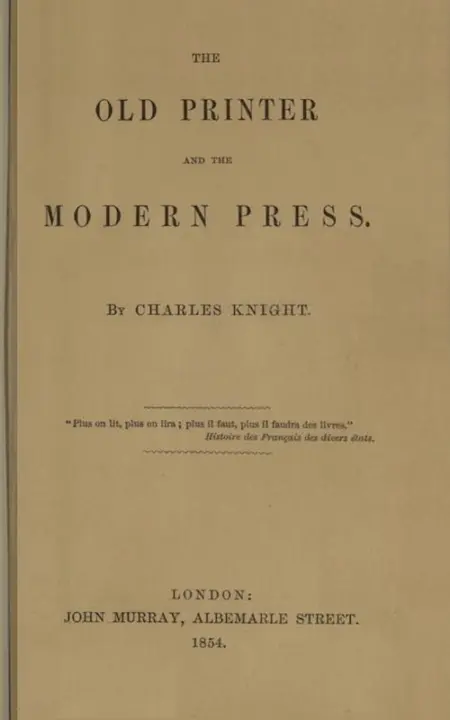
THE CLASSIC COLLECTION · 1854
"The Old Printer and the Modern Press" by Charles Knight is a historical account written in the mid-19th century. The work explores the life of William Caxton, the first English printer, highlighting his contributions to the dissemination of knowledge through the printed word. The narrative reflects on various themes, including the evolution of the English language, the cultural landscape before and after the introduction of printing, and the socio-economic changes triggered by this revolutionary technology. At the start of the narrative, the context surrounding Caxton’s early life is established, particularly focusing on the Weald of Kent where he grew up. The text discusses the linguistic environment of the time, noting the transition from French to English in education, and the scarcity of books before the advent of printing. Knight paints a vivid picture of Caxton's formative years, illustrating the societal isolation and linguistic variations in his rural upbringing. The opening portion sets the stage for understanding Caxton’s later accomplishments and the profound impact of printing on English literature, culture, and society.
Introduction adapted from the source catalogue; source summaries may be automatically generated.
Free to read · English · 88,831 words · No account needed
MAKE TIME FOR A GOOD BOOK
On by default. Untick to stop anonymous reading totals. Each page counts after 10 seconds in view. How this works.
Anonymous counting is on unless you have switched it off.
Upon looking around upon all the various phases of Cheap Literature which now present themselves in these kingdoms, we cannot shut our eyes to the fact that, in proportion as the number of readers has increased, the desire of the mass of the population has been rather for passing amusement than solid instruction. There is one very obvious reason for this. The people of this country work harder than any other people, not only from the absolute necessity of the competition around them, but through the energy of their race. It cannot, therefore, in the nature of things, be expected that much of the reading of all classes should be other than for amusement. Further, when we consider how recent has been the training for any reading amongst a large proportion of those who have become readers, we can scarcely look for a great amount of serious application in their short leisure after a hard working-day. The entertainment which is now presented to all, whether it be in the shape of a shilling novel or a penny journal, is not debasing; it may enfeeble the intellect, but it does not taint it. How are we to deal with this universal desire for amusement? Not, we think, by any direct efforts at its counteraction, either by individuals or societies. We have before us three volumes, just completed, of a most excellent penny weekly publication of 'The Society for Promoting Christian Knowledge,' entitled 'The Home Friend.' It is cheap, even by comparison with the cheapest of the class. It consists of twenty-four octavo pages, and is excellently printed on superior paper. The old patronising style of such works is given up. It deals with grave subjects in an agreeable spirit. In the preface to the first volume, the editor rejoices that the Society is enabled to publish a work attainable by "the tenant of the lowliest cottage, which a century ago could only be purchased by the opulent few." But it is not a matter of congratulation that this work, like others professing the same aims, has not had any great success, from the absolute want of buyers. It was thought that the members of the Society could have commanded a great weekly circulation amongst their neighbours. The average sale never went beyond 12,000. What, then, is to be the course of the real friends of popular instruction? We think it is, to let the existing cheap literature purify itself. We have got beyond the scurrilous stage—the indecent stage—the profane stage—the seditious stage. Let us hope that the frivolous stage, in which we are now to some extent abiding, will in time pass on to a higher taste, and a sounder mental discipline. "Confidence," said Chatham, "is a plant of slow growth." So is taste; so is a love of knowledge for its own sake. Let us make real instruction as attractive as we can; but let us have no compromises under the pretence of gilding the pill. Study is study, and amusement is amusement. Let the people learn, and learn they will, in time; but let us abandon all the old, childish attempts of cheating them into learning. The circle of those who are attaining sound knowledge is steadily widening. Already, as the circle has widened, the means of acquiring information have been offered to "the masses," and even to "the needy," at a rate of cheapness quite unequalled by any previous attempts to make sound knowledge popular. We now especially allude to 'The Penny Cyclopædia'—a work of which the literature and engravings alone cost the publisher, as he has recorded, the large sum of 42,000l. Those who affect to believe that nothing has been done for the cheapening of books, should recollect that, before the existence of this Cyclopædia, no great work of reference of this nature could be obtained under 40l. But 'The Penny Cyclopædia,' large as was its sale, was not profitable; it involved an enormous loss. The writer, in his 'Struggles of a Book,' has stated that the paper-duty operated as a burthen upon 'The Penny Cyclopædia' to the extent of 32,000l. He adds,—"Had that sum of 32,000l. been actually saved to me, I should not have been a pound richer by the publication of 'The Penny Cyclopædia.' But with the saving I should not have been to that amount poorer." Compared with the vast outlay, 'The Penny Cyclopædia' was set at too low a price for the probable demand. The class of buyers for instruction was not large enough to carry off 40,000 copies, which would have yielded adequate profit. The very word "Penny" was then repulsive, and implied something low, as apprehended by the rich vulgar. Moreover, the book occupied eleven years in its issue, and its sale fell from 50,000 at the beginning to less than 20,000 in the end. No work that occupied more than four or five years in its completion was ever successful in this country. In the publication of 'The English Cyclopædia,' which is founded upon 'The Penny Cyclopædia,' a more prudent course has been adopted. The new book is issued in four divisions, which will form four separate Cyclopædias of Geography, Natural History, Sciences, and Biography, each of which will be completed in little more than two years from its commencement. Comparing the two books—'The Penny' and 'The English'—we can readily see the vast augmentations of knowledge during twenty years that render the complete re-modelling of such a work absolutely necessary. In every branch of exact knowledge this re-modelling has become indispensable; and upon other works of instruction many earnest labourers are so engaged. Publishers cannot now afford to let their books, especially their educational books, remain without improvement. It is thus that, in spite of the tendency to light reading, the supply of real knowledge is kept up. Those who find an ally of knowledge in the purer and more ennobling fiction, such as our literature, past and present, abundantly supplies, are gradually brought into the extending circle of earnest readers. The great region beyond is still little cultivated; but even there the subsoil-plough has been at work, and there is some grain amidst the weeds. The weeds cannot be rooted out by any sudden husbandry.
Your reading position is saved on this browser. Take it to another device with a library code. Reading pages adapt to text, rather than matching a printed edition.
BEHIND THE BOOK
This eBook is for the use of anyone anywhere in the United States and most other parts of the world at no cost and with almost no restrictions whatsoever. You may copy it, give it away or re-use it under the terms of the Project Gutenberg License included with this eBook or online at www.gutenberg.org. If you are not located in the United States, you will have to check the laws of the country where you are located before using this eBook. Read the source licence.
The original source file, including credits and licence, is retained by this library. Request an original-format copy at no charge. Please include the book title and Project Gutenberg identifier #59966.
KEEP YOUR CURIOSITY GOING
Cécile Tormay

Moritz Busch
John L. Ransom
Frances Wright
Cécile Tormay

Mabel Potter Daggett