THE CLASSIC COLLECTION✦An outlaw’s diary: the CommuneCLASSIC FREE BOOKS
An outlaw’s diary: the Commune
Cécile Tormay
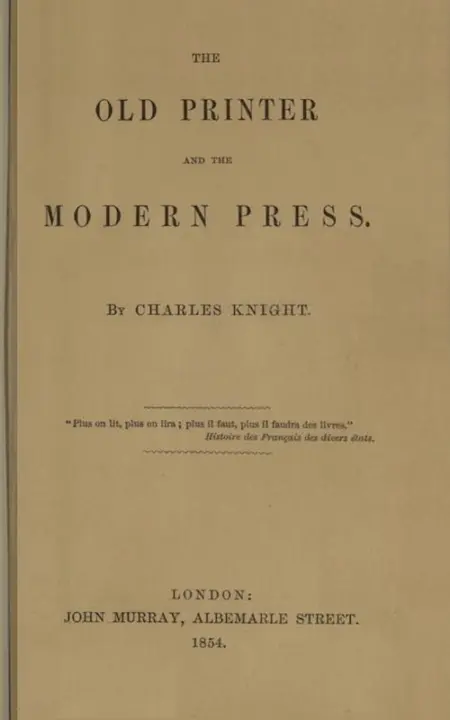
THE CLASSIC COLLECTION · 1854
"The Old Printer and the Modern Press" by Charles Knight is a historical account written in the mid-19th century. The work explores the life of William Caxton, the first English printer, highlighting his contributions to the dissemination of knowledge through the printed word. The narrative reflects on various themes, including the evolution of the English language, the cultural landscape before and after the introduction of printing, and the socio-economic changes triggered by this revolutionary technology. At the start of the narrative, the context surrounding Caxton’s early life is established, particularly focusing on the Weald of Kent where he grew up. The text discusses the linguistic environment of the time, noting the transition from French to English in education, and the scarcity of books before the advent of printing. Knight paints a vivid picture of Caxton's formative years, illustrating the societal isolation and linguistic variations in his rural upbringing. The opening portion sets the stage for understanding Caxton’s later accomplishments and the profound impact of printing on English literature, culture, and society.
Introduction adapted from the source catalogue; source summaries may be automatically generated.
Free to read · English · 88,831 words · No account needed
MAKE TIME FOR A GOOD BOOK
On by default. Untick to stop anonymous reading totals. Each page counts after 10 seconds in view. How this works.
Anonymous counting is on unless you have switched it off.
We have abstracted from the Official Return the number of stamps used annually by papers published in great cities and towns, especially the large marts of commerce and manufactures:—
Towns. Number of separate Aggregate annual papers. sale.
Birmingham 3 871,000 Bristol 4 596,075 Cambridge 2 216,500 Carlisle 2 263,500 Derby 4 249,700 Doncaster 2 178,500 Exeter 3 398,315 Hereford 2 278,000 Hull 2 347,000 Leeds 3 1,107,875 Leicester 4 240,500 Liverpool 8 1,702,588 Manchester 3 1,741,300 Newcastle 4 684,542 Norwich 3 419,950 Nottingham 3 324,000 Oxford 3 252,000 Plymouth 4 309,500 Preston 3 469,500 Sheffield 3 580,950 Stamford 1 571,826 Stafford 1 384,000 Sunderland 4 191,142 Wolverhampton 3 181,500 Worcester 3 320,052 York 3 465,200 — ——————— 80 13,245,015
The altered tone and ability of newspapers would open too wide a subject to be here dwelt upon in detail. One of the weekly threepenny papers has attained an enormous sale—a sale of 4½ millions annually—by discarding what was offensive to public morals, under the management of a man of letters who has a reputation to maintain. The Satirists and Paul Prys are gone. The extension of the mental labourers for newspapers, in proportion to the extension of the demand, has followed the same course as that of every other production of the press, from the days of the first printers. At the beginning of the present century the local newspapers "had no editorial comments whatever,"[36] and scarcely an original paragraph. The conductors of our 500 provincial journals are now watching for every particle of news in their own districts; reporting public meetings; waiting for electric telegraphs; pondering upon grave questions of social economy; and, to the best of their judgment, fairly representing the course of events. How much of this intelligent and honourable spirit they owe to the London Newspaper Press is not for us to decide. We believe the newspaper influence upon the people to be for good, because the Newspaper Press is National. A witness, giving evidence before the Select Committee on Newspaper Stamps, 1851, said, "If the Committee were to look at 'The Weekly Dispatch' twenty years ago, its general character was very much worse than it is now. Then it was a so-called radical, almost a blasphemous, scurrilous, and contemptible paper, but with an enormous circulation. Now other papers have so much improved, that 'The Weekly Dispatch' has been compelled, in its own defence, very materially to change its tone." But what improved the "other papers," and compelled them to seek honest means of "an enormous circulation"? We answer—The advanced intelligence of the people. Books had begun their own work in the career of public enlightenment. Now, newspapers and books are working together for the same object. It is desired by some to make newspapers supersede books, by abolishing the stamp, and thus converting all popular literature into news. We have no faith in the process. An American told the Committee on Stamps that "the only knowledge which the working-classes would appreciate is contained in newspapers; they address themselves much more to politics than to science or literature." The witness had his own country in his mind, where the assertion is to some extent true. But in the American newspapers, almost universally, there is something more than "politics." All over the Union the newspapers are filled, week by week, by the piracy of modern English literature, especially of English fiction. Whether the "working classes" read the politics, and neglect the literature, maybe doubted. If politics are independent of science and literature, the study is worth little. It is degrading. We doubt if this disposition, carried to excess, will make a wise people, or a happy people. The opinion of an American is worth little upon such a question in England. There is no parallel in the condition of the people of the United States. The geographical position, and the separate constitutions of individual states, necessarily demand many newspapers. Thus the newspapers of the United States, even with their large circulation, are essentially local. The English papers, we repeat, are national. The papers of the capital are the papers of the empire. They chiefly, with their wonderful organization, supply the material for the twenty-seven millions of these islands, and the other millions of our race spread over the habitable globe in our colonies, to learn, to consider, to know their rights, to perform their duties. Could this unequalled instrument of knowledge be kept efficiently at work, while every petty printer of every parish was ready to make a venture for a thousand penny subscribers to his Argus or his Luminary, without incurring any of the prodigious cost of a London daily morning paper? If the time should come when the land should be filled with penny newspapers, it would be the same with newspapers as it is now with the weekly unstamped sheets. Quantity, not quality, would be the criterion of excellence. The lower grade of literary labourers would be multiplied tenfold. Unscrupulous employers would rise up on every side, who would go for the "immondices" if decency failed; and for disorder if tranquillity were growing unprofitable. The rich would be set against the poor, and the poor against the rich. Those who now organise strikes by their eloquence would work more effectually with their pen; and employers would not be without their organs to defend harshness and oppression. Sects would denounce each other in weekly journals, to be sold by the pew-opener; and the Snoreum Vestry would enter upon a wordy war with their neighbours of Muggleton. Let us "study to be quiet."
Your reading position is saved on this browser. Take it to another device with a library code. Reading pages adapt to text, rather than matching a printed edition.
BEHIND THE BOOK
This eBook is for the use of anyone anywhere in the United States and most other parts of the world at no cost and with almost no restrictions whatsoever. You may copy it, give it away or re-use it under the terms of the Project Gutenberg License included with this eBook or online at www.gutenberg.org. If you are not located in the United States, you will have to check the laws of the country where you are located before using this eBook. Read the source licence.
The original source file, including credits and licence, is retained by this library. Request an original-format copy at no charge. Please include the book title and Project Gutenberg identifier #59966.
KEEP YOUR CURIOSITY GOING
Cécile Tormay

Moritz Busch
John L. Ransom
Frances Wright
Cécile Tormay

Mabel Potter Daggett