THE CLASSIC COLLECTION✦An outlaw’s diary: the CommuneCLASSIC FREE BOOKS
An outlaw’s diary: the Commune
Cécile Tormay
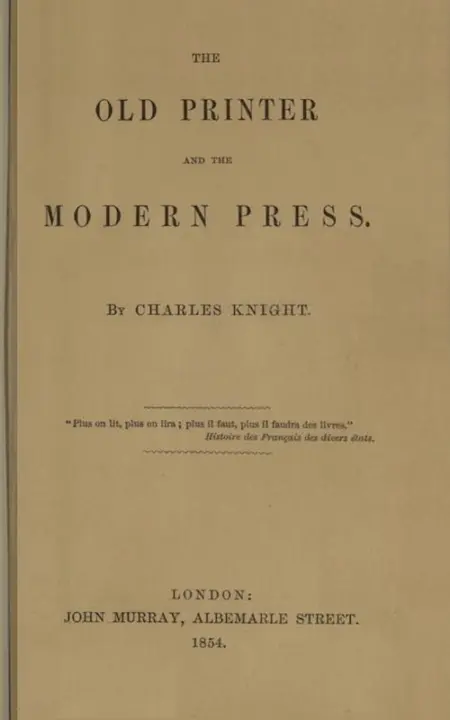
THE CLASSIC COLLECTION · 1854
"The Old Printer and the Modern Press" by Charles Knight is a historical account written in the mid-19th century. The work explores the life of William Caxton, the first English printer, highlighting his contributions to the dissemination of knowledge through the printed word. The narrative reflects on various themes, including the evolution of the English language, the cultural landscape before and after the introduction of printing, and the socio-economic changes triggered by this revolutionary technology. At the start of the narrative, the context surrounding Caxton’s early life is established, particularly focusing on the Weald of Kent where he grew up. The text discusses the linguistic environment of the time, noting the transition from French to English in education, and the scarcity of books before the advent of printing. Knight paints a vivid picture of Caxton's formative years, illustrating the societal isolation and linguistic variations in his rural upbringing. The opening portion sets the stage for understanding Caxton’s later accomplishments and the profound impact of printing on English literature, culture, and society.
Introduction adapted from the source catalogue; source summaries may be automatically generated.
Free to read · English · 88,831 words · No account needed
MAKE TIME FOR A GOOD BOOK
On by default. Untick to stop anonymous reading totals. Each page counts after 10 seconds in view. How this works.
Anonymous counting is on unless you have switched it off.
The insuperable obstacle to a successful competition with the existing class of penny periodicals is their pre-eminence in external cheapness. They were all founded upon the principle of attraction by low price alone. They employed the meanest "slaves of the lamp" in their production. Sheets came out double the size of any other penny sheet, badly printed on the thinnest paper, but nevertheless they were the largest sheets; their roots were thus planted in the popular earth. Some who bought them turned away from their filth and their folly; others welcomed these qualities. Gradually the sense of the better class of artisans operated, whilst they continued their offences, to reduce their number of customers. They changed their style; they became decent, but they remained stupid. The weeds were kept down, though not rooted out, in that garden: a few gaudy flowers were planted; fruit there was little. They have maintained their hold, by their external cheapness, against any attempt to produce a higher literature, with better paper and print. They have beaten almost every competitor who has sought to address the same class of buyers with something higher, intrinsically as cheap, but not so cheap to the eye. The unequal war is still being waged.
In June, 1846, the last number of 'The Penny Magazine' was published. Mr. Knight, who had been its editor from the commencement, in 1832, thus writes in his concluding 'Address to the Reader,' after stating that there then were published 14 three-halfpenny and penny miscellanies, and 37 weekly sheets, forming separate books:—"It is from this competition that the 'Penny Magazine' now withdraws itself. Its editor most earnestly wishes success to those who are keeping on their course with honesty and ability.... He rejoices that there are many in the field, and some who have come at the eleventh hour, who deserve the wages of zealous and faithful labourers. But there are others who are carrying out the principle of cheap weekly sheets to the disgrace of the system, and who appear to have got some considerable hold upon the less informed of the working people, and especially upon the young. There are manufactories in London whence hundreds of reams of vile paper and printing issue weekly; where large bodies of children are employed to arrange types, at the wages of shirt-makers, from copy furnished by the most ignorant, at the wages of scavengers. In truth, such writers, if they deserve the name of writers, are scavengers. All the garbage that belongs to the history of crime and misery is raked together, to diffuse a moral miasma through the land, in the shape of the most vulgar and brutal fiction." This is a curious and instructive record. 'The Penny Magazine,' popular as it once was, to the extent of a sale of 200,000, could not contend with a cheapness that was wholly regardless of quality; and it could not hold its place amidst this dangerous excitement. The editor had his hands fettered by the necessity of keeping up the purely instructive character of that journal. Without a large supply of fiction it necessarily ceased to be popular. A French writer, who laments over the "immondices" of the literature of Paris in 1840, calls for romances "appropriés par une imagination souple et brillante au goût des classes laborieuses;" and he suggests the principle upon which such works should be founded, viz. "L'étude des mœurs populaires, entreprise par un esprit pénétrant, et dirigée vers un but philosophique."[34] The "immondices" have for the most part vanished from our English penny literature. The host of penny Newgate novels, whether known as 'The Convict,' 'The Feast of Blood,' 'The Murder at the Old Jewry,' 'Claude Duval,' 'The Hangman's Daughter,' and so forth, may continue to be sold; but, as far as we can trace, there are no novelties in this once popular literature of the gallows. Abominations, called 'Mysteries' and 'Castles,' still lurk in dark corners; but the bulk of single Penny Novels, and the novels which "drag their slow length along" in penny journals, are marvellously changed. The most prudish regard to decency presides over every sentence and syllable. William the Conqueror has lost the brief ignoble title by which the old Saxons designated their oppressor, through a special interdict of the proprietor of one of these papers; and a lady of doubtful character must be mentioned by no more rugged name than that of a belle amie, which may be understood or not. But the "études des mœurs populaires," and the "but philosophique," have not yet entered into the minds of the conductors of these elaborate works. Their scenes are invariably laid in the lord's palace or the right honourable's mansion; marriages are made at St. George's, Hanover Square, and the diamonds are bought at Storr and Mortimer's. If a young lady, who has the slight misfortune to be connected by the filial tie with a convicted felon, has a quarrel with her juvenile lover, she immediately rushes to the arms of an ancient baronet, who conducts her the next morning to the altar of his parish church. Boileau said of Mademoiselle Scudery, that she would never let her heroine get out of a house till she had taken an inventory of all the furniture. So, for the bewilderment of those who read these weekly novels by the one glimmering candle upon the deal table, their sick ladies recline in easy chairs, "astral" lamps diffuse their rich glow upon crimson curtains, and aromatic perfumes fill the air from pastiles burning in miniature castles of gilded porcelain. The style of these productions is magnificent: with golden zones on the summits of the mountains, and roseate tints edging the canopy of heaven; plants drooping with voluptuous languor, and shining insects skimming the air, as if borne on the wings of ardent passion. In all this we are speaking au pied de la lettre. Johnson described three sorts of unnatural style—the bombastic, the affected, and the weak. Most of these performances unite the three qualities, and are equally satisfactory to the "love of imbecility," which Johnson thought was to be found in many. We have only seen one penny journal which places its incidents, and somewhat adapts its language, in consonance with the habits of the classes which these works seek to interest. In 'The Leisure Hour,' issued by the Religious Tract Society, we have an Australian story, with 'Sydney by Gaslight.' We are now amongst convicts, and hear drunken shouts come out from miserable huts. The success of this publication is considerable. Perhaps those who really understand such matters may say of the writer of these laudable attempts to imitate the homely style, something akin to what the great Pierce Egan said of a fashionable novelist twenty years ago—"Ah! he's very clever, but uncommon superficial in slang." Nevertheless, it is satisfactory to find that a mean has been sought, in the quarter where we might least have expected it, between the representations of humble and even of low life which are corrupting, and those pretended pictures of society which exhibit no life at all. In the number of 'The Leisure Hour' for February 16, 1854, there is a clever woodcut of a night auction at Sydney, which is as suggestive of a congregation of real vulgar sellers and bidders, with the necessary accompaniments of gin and tobacco, as might be connected with any of the exciting scenes of 'Life in London' at any period. The pictures of the penny sheets which the masses now greedily buy are quite genteel. This is something to reflect upon. Some of the members of the Tract Society may think that "Chaos is come again." We do not. This sort of subject will be attractive to the better portion of male readers amongst the artisans, and especially amongst the very large number who belong to "temperance societies;" but for the girls, who devour the novels of the other penny journals, certainly not. Those who have been watching the workings of the penny literature are unanimous in their conviction that very few men read these mawkish and unnatural fictions. The readers for the most part belong, in point of cultivation, to the same class of females, who, half a century ago, gave up their whole leisure—if they did not neglect every domestic duty—for the ghosts and the elopements of 'The Minerva Press.' The intelligence of the readers is the same, however widened the attraction.
Your reading position is saved on this browser. Take it to another device with a library code. Reading pages adapt to text, rather than matching a printed edition.
BEHIND THE BOOK
This eBook is for the use of anyone anywhere in the United States and most other parts of the world at no cost and with almost no restrictions whatsoever. You may copy it, give it away or re-use it under the terms of the Project Gutenberg License included with this eBook or online at www.gutenberg.org. If you are not located in the United States, you will have to check the laws of the country where you are located before using this eBook. Read the source licence.
The original source file, including credits and licence, is retained by this library. Request an original-format copy at no charge. Please include the book title and Project Gutenberg identifier #59966.
KEEP YOUR CURIOSITY GOING
Cécile Tormay

Moritz Busch
John L. Ransom
Frances Wright
Cécile Tormay

Mabel Potter Daggett