THE CLASSIC COLLECTION✦An outlaw’s diary: the CommuneCLASSIC FREE BOOKS
An outlaw’s diary: the Commune
Cécile Tormay
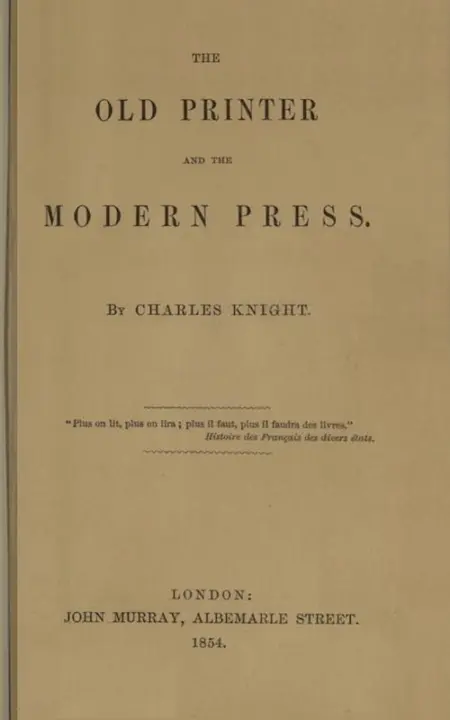
THE CLASSIC COLLECTION · 1854
"The Old Printer and the Modern Press" by Charles Knight is a historical account written in the mid-19th century. The work explores the life of William Caxton, the first English printer, highlighting his contributions to the dissemination of knowledge through the printed word. The narrative reflects on various themes, including the evolution of the English language, the cultural landscape before and after the introduction of printing, and the socio-economic changes triggered by this revolutionary technology. At the start of the narrative, the context surrounding Caxton’s early life is established, particularly focusing on the Weald of Kent where he grew up. The text discusses the linguistic environment of the time, noting the transition from French to English in education, and the scarcity of books before the advent of printing. Knight paints a vivid picture of Caxton's formative years, illustrating the societal isolation and linguistic variations in his rural upbringing. The opening portion sets the stage for understanding Caxton’s later accomplishments and the profound impact of printing on English literature, culture, and society.
Introduction adapted from the source catalogue; source summaries may be automatically generated.
Free to read · English · 88,831 words · No account needed
MAKE TIME FOR A GOOD BOOK
On by default. Untick to stop anonymous reading totals. Each page counts after 10 seconds in view. How this works.
Anonymous counting is on unless you have switched it off.
"He hath this charge upon me laid,
And bad me do my business,
That to his high worthiness
Some new thing I should book,
That he himself it might look,
After the form of my writing."
Chaucer and Gower lived some time before the period of Caxton's youth in London, But there was a poet very popular in his day, whom he can scarcely have avoided having seen playing a conspicuous part in the high city festivals. This was John Lydgate, monk of Bury, who thus describes himself—
"I am a monk by my profession,
Of Bury, called John Lydgate by my name,
And wear a habit of perfection,
Although my life agree not with the same."
Thomas Warton has thus exhibited the nature of his genius: "No poet seems to have possessed a greater versatility of talents. He moves with equal ease in every mode of composition. His hymns and his ballads have the same degree of merit: and whether his subject be the life of a hermit or a hero, of Saint Austin or Guy Earl of Warwick, ludicrous or legendary, religious or romantic, a history or an allegory, he writes with facility. His transitions were rapid from works of the most serious and laborious kind to sallies of levity and pieces of popular entertainment. His muse was of universal access, and he was not only the poet of his monastery, but of the world in general. If a disguising was intended by the company of goldsmiths, a mask before his majesty at Eltham, a May game for the sheriffs and aldermen of London, a mumming before the lord mayor, a procession of pageants from the creation for the festival of Corpus Christi, or a carol for a coronation, Lydgate was consulted and gave the poetry." A fine illuminated drawing in one of Lydgate's manuscripts, now in the British Museum, represents him presenting a book to the Earl of Salisbury. Such a presentation may be regarded as the first publication of a new work. The royal or noble person at whose command it was written bestowed some rich gift upon the author, which would be his sole pecuniary recompence, unless he received some advantage from the transcribers, for the copies which they multiplied. Doubtful as the rewards of authorship may be when the multiplication of copies by the press enables each reader to contribute a small acknowledgment of the benefit which he receives, the literary condition must have been far worse when the poet, humbly kneeling before some mighty man, as Lydgate does in the picture, might have been dismissed with contumely, or his present received with a low appreciation of the labour and the knowledge required to produce it. The fame, however, of a popular writer reached his ears in a far more direct and flattering manner than belongs to the literary honours of modern days. There can be little doubt that the narrative poems of Chaucer and Gower and Lydgate were familiar to the people through the recitations of the minstrels. An agreeable writer on the Rise and Progress of English Poetry, Mr. George Ellis, says, "Chaucer, in his address to his Troilus and Cressida, tells us it was intended to be read 'or elles sung,' which must relate to the chanting recitation of the minstrels, and a considerable part of our old poetry is simply addressed to an audience, without any mention of readers. That our English minstrels at any time united all the talents of the profession, and were at once poets and reciters and musicians, is extremely doubtful; but that they excited and directed the efforts of their contemporary poets to a particular species of composition, is as evident as that a body of actors must influence the exertions of theatrical writers. They were, at a time when reading and writing were rare accomplishments, the principal medium of communication between authors and the public; and their memory in some measure supplied the deficiency of manuscripts, and probably preserved much of our early literature till the invention of printing." We may thus learn, that, although the number of those was very few whose minds by reading could be lifted out of the grovelling thoughts and petty cares of every-day life, yet that the compositions of learned and accomplished men, who still hold a high rank in our literature, might be familiar to the people through the agency of a numerous body of singers or reciters. There has been a good deal of controversy about the exact definition of the minstrel character—whether the minstrels were themselves poets and romance-writers, or the depositaries of the writings of others and of the traditional literature of past generations. Ritson, a writer upon this subject, says, "that there were individuals formerly who made it their business to wander up and down the country chanting romances, and singing songs and ballads to the harp, fiddle, or more humble and less artificial instruments, cannot be doubted." They were a very numerous body a century before Chaucer; and most indefatigable in the prosecution of their trade. There is a writ or declaration of Edward the Second, which recites the evil of idle persons, under colour of minstrelsy, being received in other men's houses to meat and drink; and then goes on to direct that to the houses of great people no more than three or four minstrels of honour should come at the most in one day, "and to the houses of meaner men that none come unless he be desired, and such as shall come to hold themselves contented with meat and drink, and with such courtesy as the master of the house will show unto them of his own goodwill, without their asking of anything." Nothing can more clearly exhibit the general demand for the services of this body of men; for the very regulation as to the nature of their reward shows clearly that they were accustomed to require liberal payment, approaching perhaps to extortion; and then comes in the State to say that they shall not have a free market for their labour. They struggled on, sometimes prosperous and sometimes depressed, according to the condition of the country, till the invention of printing came to make popular literature always present in a man's house. The book of ballads or romances, which was then to be bought, was contented to abide there without any "meat and drink." In the words of Richard de Bury, whom we quoted in the first chapter, books "are the masters who instruct us without rods, without hard words and anger, without clothes and money. If you approach them, they are not asleep; if investigating you interrogate them, they conceal nothing; if you mistake them, they never grumble; if you are ignorant, they cannot laugh at you." One of the later ministrels, to whom is ascribed the preservation, and by some the composition, of the old ballad of Chevy Chase, thus humbles himself in a most unpoetical and undignified manner to those who fed him for his services:—
Your reading position is saved on this browser. Take it to another device with a library code. Reading pages adapt to text, rather than matching a printed edition.
BEHIND THE BOOK
This eBook is for the use of anyone anywhere in the United States and most other parts of the world at no cost and with almost no restrictions whatsoever. You may copy it, give it away or re-use it under the terms of the Project Gutenberg License included with this eBook or online at www.gutenberg.org. If you are not located in the United States, you will have to check the laws of the country where you are located before using this eBook. Read the source licence.
The original source file, including credits and licence, is retained by this library. Request an original-format copy at no charge. Please include the book title and Project Gutenberg identifier #59966.
KEEP YOUR CURIOSITY GOING
Cécile Tormay

Moritz Busch
John L. Ransom
Frances Wright
Cécile Tormay

Mabel Potter Daggett