THE CLASSIC COLLECTION✦An outlaw’s diary: the CommuneCLASSIC FREE BOOKS
An outlaw’s diary: the Commune
Cécile Tormay
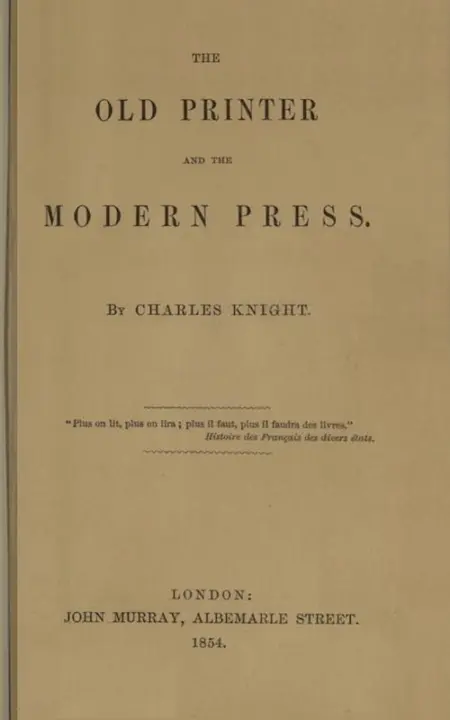
THE CLASSIC COLLECTION · 1854
"The Old Printer and the Modern Press" by Charles Knight is a historical account written in the mid-19th century. The work explores the life of William Caxton, the first English printer, highlighting his contributions to the dissemination of knowledge through the printed word. The narrative reflects on various themes, including the evolution of the English language, the cultural landscape before and after the introduction of printing, and the socio-economic changes triggered by this revolutionary technology. At the start of the narrative, the context surrounding Caxton’s early life is established, particularly focusing on the Weald of Kent where he grew up. The text discusses the linguistic environment of the time, noting the transition from French to English in education, and the scarcity of books before the advent of printing. Knight paints a vivid picture of Caxton's formative years, illustrating the societal isolation and linguistic variations in his rural upbringing. The opening portion sets the stage for understanding Caxton’s later accomplishments and the profound impact of printing on English literature, culture, and society.
Introduction adapted from the source catalogue; source summaries may be automatically generated.
Free to read · English · 88,831 words · No account needed
MAKE TIME FOR A GOOD BOOK
On by default. Untick to stop anonymous reading totals. Each page counts after 10 seconds in view. How this works.
Anonymous counting is on unless you have switched it off.
But in one point Mr. Carey is right. He shows us, upon representations which we cannot doubt, that the works of popular authors, citizens of the United States, and so protected as copyright, are sold in much larger numbers than similar works in our own country, however cheap. How is this? The American people are much more universally readers than the English people. They are better educated. They have a Government that considers it a duty to educate the young without distinction, and to afford the adult every means of intellectual improvement. The American Government has created a reading nation. Our Government has created a people that rush to low casinos in the towns, and to sottish beer-shops in the country. The American Government accords all honour to them who have laboured in the enlightenment of the masses. Our Government wholly passes over every such claim to recognition. It is of little consequence, in the end, what Cabinets or Parliaments do for the advance of education, or the encouragement of men of letters. But it is somewhat unwise, to say the least of it, to provoke, by neglect and by injury, comparison with a nation that cultivates the same language under different institutions, and that can proclaim, in its energetic youth, that it has raised up an intelligent people out of the great mental inheritance to which our rulers have been faithless.
By injury? it will be said. The British Government may ignore letters, undervalue writers, barter away its patronage upon ignorance and incapacity—but assuredly it cannot attempt to inflict direct injury upon literature and learning? And yet it does all this. The sale of school-books in the United States has reached an almost fabulous extent. Families have been raised to affluence by the enormous circulation of a Spelling-book or a Dictionary. A successful Grammar is a fortune. He who can produce sensible and amusing Reading-Lessons is better paid than a Secretary of State. Does the Government bestow any gratuities upon such services? Certainly not. But it does not discourage and annihilate them. It does not, as our Government does, interfere with competition by attempting to regulate prices. It does not do the silly thing which M. Louis Blanc wished to do in France for "the organization of literary labour." It has established no manufactory of school-books, produced cheaply, by the tax-payers helping the production. It has no Board of Commissioners, as we have, "to supply the National Schools in Ireland, and the public generally, with works in harmony with an improved system of education, cheap in price and superior in execution."[33] We ask, what possible right has the State to produce such books, and sell them in the open literary markets of this country, to the injury of all who produce similar books by the fair workings of capital and labour? School-books were formerly too dear; but as schools multiplied, cheaper books than the old standard works came into the market, and many took root and flourished. Much of this property has been destroyed by the Government operation; which is not confined to 'Reading Lessons,' but embraces 'Biographical Sketches of Poets'—'Selections from the Poets'—'Epitome of Geographical Knowledge'—'Grammar,' 'Arithmetic,' 'Geometry,' 'Mensuration,' 'Agriculture,' 'Maps.' The compilers of these books and maps are salaried state-servants; the books are printed at the lowest contract; the usual trade allowances are withheld; profit does not enter into price. A book of 17½ sheets demy, or 420 pages, bound in cloth, is sold for sevenpence, as we learn from the Commissioners' Catalogue. This is exactly the cost price for the paper, machine-work, and binding, in the very cheapest market. There is nothing for trade-management, and not one fraction for copyright. Commercial competition is impossible. We say, this is a fraudulent cheapness. All cheapness in books is fraudulent which sets aside a payment for literary labour. This is the cheapness of piracies, whether here or in the United States. It is a cheapness that, if carried out, as it might be by a Government, would degrade literature to the lowest condition, annihilating all invention and improvement. Once concede the principle that the State has a right to produce educational books, except for the supply of schools paid by the State—and even then the policy is very doubtful—and there is no individual literary enterprise that may not be paralyzed and destroyed by this new agency. In England, the only commercial undertaking of the State is that of the Post Office. It is conducted with a profit; it is conducted with a precision and cheapness which really leave few things to be amended. There are especial reasons why the conveyance of letters through the whole civilized world should be the work of the State. No company, no individual, could grapple with such a gigantic task. But is there any other branch of commercial enterprise which the State could undertake with the slightest benefit—without most serious injury? If the end sought is to employ labour to a profit, individual enterprise will accomplish that end far better than the State. If the object is to employ labour that shall be unprofitable, who is to supply the deficiency in the funds that have called into activity the profitable labour? There would indeed be the equality of employments, but it would be the equality of universal poverty. The skilled and the unskilled would be reduced to the same level. There would be no prizes in the social wheel;—the blanks would be something worse than the mere absence of superfluities.
Your reading position is saved on this browser. Take it to another device with a library code. Reading pages adapt to text, rather than matching a printed edition.
BEHIND THE BOOK
This eBook is for the use of anyone anywhere in the United States and most other parts of the world at no cost and with almost no restrictions whatsoever. You may copy it, give it away or re-use it under the terms of the Project Gutenberg License included with this eBook or online at www.gutenberg.org. If you are not located in the United States, you will have to check the laws of the country where you are located before using this eBook. Read the source licence.
The original source file, including credits and licence, is retained by this library. Request an original-format copy at no charge. Please include the book title and Project Gutenberg identifier #59966.
KEEP YOUR CURIOSITY GOING
Cécile Tormay

Moritz Busch
John L. Ransom
Frances Wright
Cécile Tormay

Mabel Potter Daggett