THE CLASSIC COLLECTION✦An outlaw’s diary: the CommuneCLASSIC FREE BOOKS
An outlaw’s diary: the Commune
Cécile Tormay
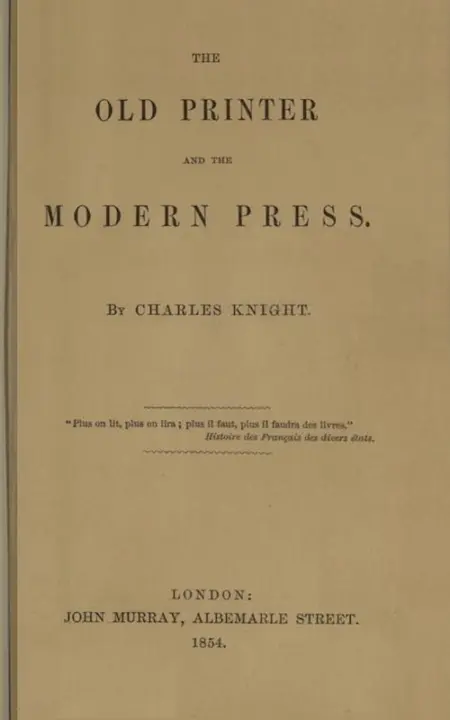
THE CLASSIC COLLECTION · 1854
"The Old Printer and the Modern Press" by Charles Knight is a historical account written in the mid-19th century. The work explores the life of William Caxton, the first English printer, highlighting his contributions to the dissemination of knowledge through the printed word. The narrative reflects on various themes, including the evolution of the English language, the cultural landscape before and after the introduction of printing, and the socio-economic changes triggered by this revolutionary technology. At the start of the narrative, the context surrounding Caxton’s early life is established, particularly focusing on the Weald of Kent where he grew up. The text discusses the linguistic environment of the time, noting the transition from French to English in education, and the scarcity of books before the advent of printing. Knight paints a vivid picture of Caxton's formative years, illustrating the societal isolation and linguistic variations in his rural upbringing. The opening portion sets the stage for understanding Caxton’s later accomplishments and the profound impact of printing on English literature, culture, and society.
Introduction adapted from the source catalogue; source summaries may be automatically generated.
Free to read · English · 88,831 words · No account needed
MAKE TIME FOR A GOOD BOOK
On by default. Untick to stop anonymous reading totals. Each page counts after 10 seconds in view. How this works.
Anonymous counting is on unless you have switched it off.
The modern epoch of cheap literature may be held to have commenced, however partially, in 1827, when Constable issued his 'Miscellany,' and the Society for the Diffusion of Useful Knowledge their 'Library of Useful Knowledge.' In a few years followed 'The Library of Entertaining Knowledge,' Mr. Murray's 'Family Library,' and Lardner's 'Cabinet Cyclopædia.' These books were properly published under a tentative system. Not one of them rushed to that extreme cheapness which is indicated by quantity alone. They each had to feel their way to a demand proportioned to the expense of their production. That production was necessarily expensive. The cheapness consisted in the employment of the best writers to produce books of original merit at a price that was essentially low, by comparison with the ordinary rate at which books for the few were sold. Though Constable, in his grand style, talked of millions of buyers, he charged his little volumes 3s. 6d. each. He was right. The millions were not ready to buy such books at a shilling, nor even at sixpence. They are not ready now. 'The Library of Useful Knowledge' was charged at the rate of 3d. a sheet. Taking mere quantity of paper and printing into account, some of the penny journals of the present day are six times as cheap. 'The Library of Entertaining Knowledge' was 4s. 6d. a volume. The copyright of each volume ordinarily cost 200l., and the woodcuts as much, and even more. 'The Family Library,' at 5s., was, no doubt, equally costly. The same costliness applies to Lardner's 'Cyclopædia,' published at 6s. In these new undertakings, conceived in a totally different spirit from anything which had preceded them, there were large expenses which have been surprisingly reduced by scientific discovery and extended competition at the present day. There were about twenty woodcutters in London in 1827, who were real artists, paid at artists' prices. Woodcutting is now a manufacture. Paper, then, paid the high rate of duty, and was 50 per cent. dearer. Steam-printing was not universal, and was only applied to common works. Each of these series was offered to the very numerous body of those who, having become better educated than the same classes in a previous generation, were desirous of real improvement. They had a certain success, but a variable one. Every experiment of this sort has shown that such collections of separate and independent works cannot rely upon a sale as a series. They come to be bought, each work by itself, according to its attractions for individual purchasers. Thence all those irregularities of sale, and consequent accumulations of stock, which press heavily upon the profits of those volumes which are successful. The republication of the 'Waverley Novels' in 5s. volumes was an exception to this rule. They constituted an integral work. Their sale was vast, although the total cost was 12l. Scott and his publisher saw the immense field that was before them, in giving their books to the world at a price that would carry them into thousands of households, instead of limiting them to the circulating libraries. They originally appeared in seventy-four volumes, at an aggregate cost of 34l. 10s. Had they remained in their original form, and at their first price, those heroic efforts which lifted a mountain of debt off the shoulders of that great man who, perhaps, more than all men, might have claimed the motto which Burke said should be his—"Nitor in adversum"—those labours which wore him out, would not have been successful. Neither would the success have come so soon had the later publication in twenty-five volumes for 5l. been tried in the first instance. If the 'Waverley Novels' go through new phases of cheapness, it will be because there is now a larger public to buy; and because the first natural price for all works of extraordinary merit, that of authorship, has been already paid largely and liberally. The question of price is then mainly reduced to a question of paper and print. But miserable would it be for a nation whose "chiefest glory is its authors," at a time when the nature of that glory is properly understood, if a passion for premature cheapness, to be measured by mere quantity, were to possess the minds of the people, and to be the expression of the "Vox populi." There was a much larger public always ready to purchase these enchanting fictions than have been, at any time during the last quarter of a century, ready for the purchase of books of information, however agreeably presented. We doubt whether the Family Libraries, and the Libraries of Entertaining Knowledge, and the Cabinet Cyclopædias, would have sold better at the time of their publication, if they had been produced at half the original price. The experiment was tried, when the number of readers was largely increased, in 'Knight's Weekly Volume'—a series published at one-third the price of Constable's 'Miscellany.' The majority of books in that series were, for the most part, of intrinsic merit; many also carrying the recommendation of popular names as their authors. "Why Mr. Knight did not profit largely by the speculation is a problem yet to be solved," says the writer of a recent paper on 'Literature for the People.' The solution is, that the people did not sufficiently buy them. So far from twenty thousand copies being sold of many volumes, as asserted, there were not twenty volumes, out of the hundred and forty, that reached a sale of ten thousand, and the average sale was scarcely five thousand. They were not cheap enough for the humble, who looked to mere quantity. They were too cheap for the genteel, who were then taught to think that a cheap book must necessarily be a bad book. It is impossible not to remember that, even ten years ago, the majority of publishers, and many of their supporters in the public journals, hated cheap books. The 'Weekly Volumes' were welcomed very generally by those who were anxious for the enlightenment of the people. Societies were set on foot for their circulation. But all experience has shown that no associations for recommending books, and forcing their sale, can be successful. The people, of every grade, will choose for themselves. It is useless to urge an adult, whether male or female, to buy a solid book when an exciting one is longed for. It is worse than useless to give books of improvement away to the poor. They always suspect the motive. Very wisely did a witness before the "Select Committee on Newspaper Stamps," 1851, say, "There are classes which you cannot reach, unless you go to them with something which is the nearest thing to what they want." If they want fiction, they will not look at science or history. At the time of the issue of 'The Weekly Volume,' the sale of books at railway stations was unknown; and if it had been known, they scarcely presented sufficient attractions for the travelling readers for amusement. They were published also in too quick succession. It was a plausible theory of the editor, that, if good books, extremely cheap, were issued rapidly enough to form a little library, many such libraries would be formed. Those who have to deal with 'Literature for the People' must bear in mind that time as well as money has to be economised by those who of necessity must labour hard either by hand or head. What may be called furniture books may be bought by the luxurious, to put upon their shelves, and looked at when wanted. The earnest workers buy few books that they are not desirous to read, and to read at once. They bought such a book in 1830, to the extent of 50,000 copies. 'The Results of Machinery,' written by the author of this volume, was addressed to great human interests. It was not professedly amusing; but it was the first attempt to take Political Economy out of its hard and logical track. It is now recorded, as a wonderful instance of the application of cheapness to a dry subject, that Mr. M'Culloch's 'Essay on the Rate of Wages,' is republished at a shilling. It is in no spirit of self-laudation that we presume to think that the vaunted cheapness of 1854 had some previous examples.
Your reading position is saved on this browser. Take it to another device with a library code. Reading pages adapt to text, rather than matching a printed edition.
BEHIND THE BOOK
This eBook is for the use of anyone anywhere in the United States and most other parts of the world at no cost and with almost no restrictions whatsoever. You may copy it, give it away or re-use it under the terms of the Project Gutenberg License included with this eBook or online at www.gutenberg.org. If you are not located in the United States, you will have to check the laws of the country where you are located before using this eBook. Read the source licence.
The original source file, including credits and licence, is retained by this library. Request an original-format copy at no charge. Please include the book title and Project Gutenberg identifier #59966.
KEEP YOUR CURIOSITY GOING
Cécile Tormay

Moritz Busch
John L. Ransom
Frances Wright
Cécile Tormay

Mabel Potter Daggett