THE CLASSIC COLLECTION✦An outlaw’s diary: the CommuneCLASSIC FREE BOOKS
An outlaw’s diary: the Commune
Cécile Tormay
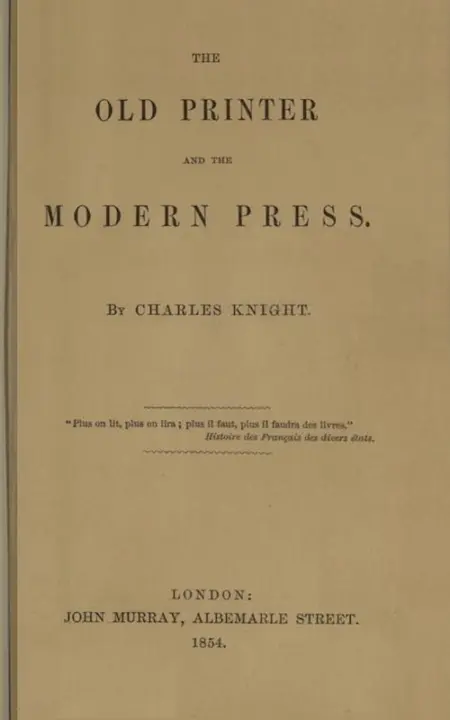
THE CLASSIC COLLECTION · 1854
"The Old Printer and the Modern Press" by Charles Knight is a historical account written in the mid-19th century. The work explores the life of William Caxton, the first English printer, highlighting his contributions to the dissemination of knowledge through the printed word. The narrative reflects on various themes, including the evolution of the English language, the cultural landscape before and after the introduction of printing, and the socio-economic changes triggered by this revolutionary technology. At the start of the narrative, the context surrounding Caxton’s early life is established, particularly focusing on the Weald of Kent where he grew up. The text discusses the linguistic environment of the time, noting the transition from French to English in education, and the scarcity of books before the advent of printing. Knight paints a vivid picture of Caxton's formative years, illustrating the societal isolation and linguistic variations in his rural upbringing. The opening portion sets the stage for understanding Caxton’s later accomplishments and the profound impact of printing on English literature, culture, and society.
Introduction adapted from the source catalogue; source summaries may be automatically generated.
Free to read · English · 88,831 words · No account needed
MAKE TIME FOR A GOOD BOOK
On by default. Untick to stop anonymous reading totals. Each page counts after 10 seconds in view. How this works.
Anonymous counting is on unless you have switched it off.
In the books of the Brewers' Company, which, like all other records, were for the most part in Norman French, there is a curious entry in the reign of Henry V., which records a great change in the habits of the people. The entry is in Latin, and is thus translated: "Whereas our mother-tongue, to wit, the English language, hath in modern days begun to be honourably enlarged and adorned, for that our most excellent lord King Henry the Fifth hath in his letters missive, and divers affairs touching his own person, more willingly chosen to declare the secrets of his will; and for the better understanding of his people hath, with a diligent mind, procured the common idiom (setting aside others) to be commended by the exercise of writing; and there are many of our craft of brewers who have the knowledge of writing and reading in the said English idiom, but in others, to wit, the Latin and French, before these times used, they do not in any wise understand; for which causes, with many others, it being considered how that the greater part of the lords and trusty commons have begun to make their matters to be noted down in our mother-tongue, so we also in our craft, following in some manner their steps, have decreed in future to commit to memory the needful things which concern us, as appeareth in the following."
The assertion of the Brewers' Company, in the reign of Henry V., that "the English language hath in modern days begun to be honourably enlarged and adorned," rested, we apprehend, upon broader foundations than the "letters missive" of the king in the common idiom. Great writers had arisen in our native tongue, with whose productions the nobler and wealthier classes at any rate were familiar. The very greatest of these,—the greatest name even now in our literature, with one exception,—must have furnished employment to hundreds of transcribers. The poems of Geoffrey Chaucer were familiar to all well-educated men, however scanty was the supply of copies and dear their cost. That Caxton himself was acquainted in his youth with these great works we cannot have a doubt. When it became his fortunate lot to multiply editions of the Canterbury Tales, and to render them accessible to a much larger class of the people than in the days when he himself first knew the solace and the delight of literature, he applied himself to the task with all the earnestness of an early love. In his preface to the second edition of the Canterbury Tales he thus delivers himself, with more than common enthusiasm: "Great thanks, laud, and honour ought to be given unto the clerks, poets, and historiographs that have written many noble books of wisdom of the lives, passions, and miracles of holy saints, of histories, of noble and famous acts and faits [deeds], and of the chronicles sith [since] the beginning of the creation of the world unto this present time; by which we are daily informed and have knowledge of many things, of whom we should not have known if they had not left to us their monuments written. Amongst whom, and in especial before all other, we ought to give a singular laud unto that noble and great philosopher Geoffrey Chaucer, the which, for his ornate writing in our tongue, may well have the name of a laureat poet. For before that he, by his labour, embellished, ornated, and made fair our English, in this royaume [kingdom], was had rude speech and incongrue [incongruous], as yet it appeareth by old books, which at this day ought not to have place nor be compared among nor to his beauteous volumes and ornate writings, of whom he made many books and treatises of many a noble history, as well in metre as in rhyme and prose; and them so craftily made, that he comprehended his matters in short, quick, and high sentences; eschewing prolixity, casting away the chaff of superfluity, and shewing the picked grain of sentence, uttered by crafty and sugared eloquence." Again, in his edition of Chaucer's 'Book of Fame' he says, "Which work, as me seemeth, is craftily made, and worthy to be written and known: for he toucheth in it right great wisdom and subtle understanding; and so in all his works he excelleth in mine opinion all other writers in our English; for he writeth no void words, but all his matter is full of high and quick sentence, to whom ought to be given laud and praising for his noble making and writing. For of him all other have borrowed sith, and taken in all their well saying and writing." There is another passage in the second edition of the Canterbury Tales which we quote here, not for the purpose of showing Caxton's honourable character as a printer, for that belongs to a subsequent period, but to point out that manuscripts of Chaucer were in private hands, varying indeed in their text, as books must have varied that were produced by different transcribers, but still keeping up the fame of the poet, and highly valued by their possessors: "Of which book so incorrect was one brought to me six year passed, which I supposed had been very true and correct, and according to the same I did imprint a certain number of them, which anon were sold to many and divers gentlemen: of whom one gentleman came to me, and said that this book was not according in many places unto the book that Geoffrey Chaucer had made. To whom I answered, that I had made it according to my copy, and by me was nothing added nor diminished. Then he said he knew a book which his father had and much loved, that was very true, and according unto his own first book by him made; and said more, if I would imprint it again, he would get me the same book for a copy. How be it, he wist well his father would not gladly part from it; to whom I said, in case that he could get me such a book true and correct, that I would once endeavour me to imprint it again, for to satisfy the author: whereas before by ignorance I erred in hurting and defaming his book in divers places, in setting in some things that he never said nor made, and leaving out many things that he made which are requisite to be set in. And thus we fell at accord; and he full gently got me of his father the said book, and delivered it to me, by which I have corrected my book."
Your reading position is saved on this browser. Take it to another device with a library code. Reading pages adapt to text, rather than matching a printed edition.
BEHIND THE BOOK
This eBook is for the use of anyone anywhere in the United States and most other parts of the world at no cost and with almost no restrictions whatsoever. You may copy it, give it away or re-use it under the terms of the Project Gutenberg License included with this eBook or online at www.gutenberg.org. If you are not located in the United States, you will have to check the laws of the country where you are located before using this eBook. Read the source licence.
The original source file, including credits and licence, is retained by this library. Request an original-format copy at no charge. Please include the book title and Project Gutenberg identifier #59966.
KEEP YOUR CURIOSITY GOING
Cécile Tormay

Moritz Busch
John L. Ransom
Frances Wright
Cécile Tormay

Mabel Potter Daggett