THE CLASSIC COLLECTION✦An outlaw’s diary: the CommuneCLASSIC FREE BOOKS
An outlaw’s diary: the Commune
Cécile Tormay
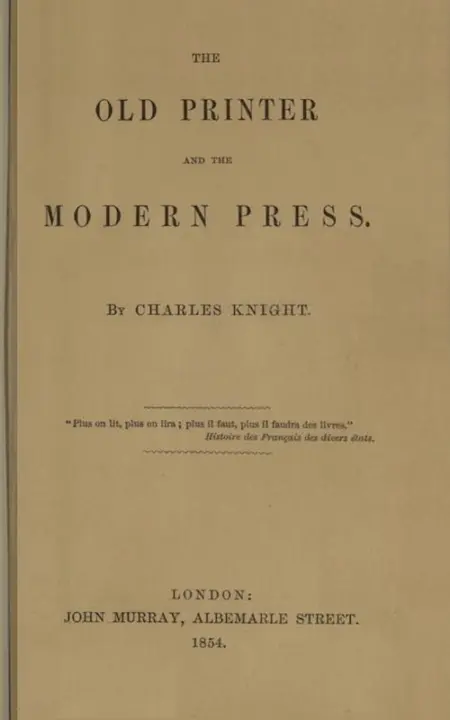
THE CLASSIC COLLECTION · 1854
"The Old Printer and the Modern Press" by Charles Knight is a historical account written in the mid-19th century. The work explores the life of William Caxton, the first English printer, highlighting his contributions to the dissemination of knowledge through the printed word. The narrative reflects on various themes, including the evolution of the English language, the cultural landscape before and after the introduction of printing, and the socio-economic changes triggered by this revolutionary technology. At the start of the narrative, the context surrounding Caxton’s early life is established, particularly focusing on the Weald of Kent where he grew up. The text discusses the linguistic environment of the time, noting the transition from French to English in education, and the scarcity of books before the advent of printing. Knight paints a vivid picture of Caxton's formative years, illustrating the societal isolation and linguistic variations in his rural upbringing. The opening portion sets the stage for understanding Caxton’s later accomplishments and the profound impact of printing on English literature, culture, and society.
Introduction adapted from the source catalogue; source summaries may be automatically generated.
Free to read · English · 88,831 words · No account needed
MAKE TIME FOR A GOOD BOOK
On by default. Untick to stop anonymous reading totals. Each page counts after 10 seconds in view. How this works.
Anonymous counting is on unless you have switched it off.
The Circulating Library—what a revolution was that in popular literature! How this new plant appeared above the earth, where it first budded, where it bore its early fruit—how it grew into a great tree, like that in the old title to Lilly's Grammar, where the apples of knowledge are being gathered by little climbing-boys—would be difficult to trace and to record. There it was—this great economiser of individual outlay for books—in most market-towns at the beginning of the century. The universal adoption of the name is the best proof of the common recognition of the idea. It changed the habits of the old country booksellers. It found them other occupation than keeping a stall in the market-place, as did their worthy forefathers. They dealt no longer in tracts and single sermons. It sent the chap-books into the villages. It made the 'Seven Champions of Christendom' and 'The Wise Masters of Greece' vulgar. It created a new literature of fiction. It banished 'Robinson Crusoe' to the kitchen, and 'The Arabian Nights' to the nursery. It built up great printing-houses in Leadenhall-street; and held out high rewards for rapid composition, at the rate of five pounds per volume, to decayed governesses who had seen the world, and bank-clerks of an imaginative turn of mind. These could produce a wilderness of Italian bandits, with unlimited wealth and beauty, who had won the hearts of credulous countesses, and only surrendered to the hangman when whole armies came out to take them. These could unveil all the mysterious luxuries of great mansions in Grosvenor-square, or of sumptuous hotels in Bond-street. There was ever and anon a "bright particular star" in the Milky Way of popular fiction. But the circulating library went on its own course, whether the empyrean of romance were dim or brilliant. "What have you got new?" was the universal question put to the guardian of the treasures of this recently-discovered world of letters. When the bower-maid of the luxurious fair one, who lolled upon the sofa through a long summer's day, as Gray did when he was deep in Crébillon, came to "change" the book, great sometimes was the perplexity. It was not a difficult task to "change," but the newness was puzzling. The lady and the neat-handed Phillis pursued their studies simultaneously. They did not like "poetry;" they did not like "letters." 'Sir Charles Grandison' was as old and as tiresome as 'Pamela.' 'Tom Jones,' and 'Peregrine Pickle;' they wondered why they were allowed to remain in the catalogue. They had read 'Cœlebs in search of a Wife'—the charming book—but they did not want it again. Perhaps, suggested the bookseller's apprentice, 'The Monk' might do once more. And so the circulating library went on, slow and struggling, till, about 1814, the unlucky desire for "something new" brought down to the little greasy collection, whose delusive numbers of volumes ranged from 1 to 3250, a new novel, with the somewhat unpromising title of 'Waverley, or 'tis Sixty Years since.' At first, the lady upon the sofa, and the counsellor of her studies, could not endure it, for it was full of horrid Scotch. It was often "at home," as the phrase went, for six months of its probation; when, somehow, it was discovered that a new book of wonderful talent had come out of the North. Another and another came, and in a few years the old circulating library was ruined. The Burneys, and Edgeworths, and Radcliffes, and Godwins, and Holcrofts, who had mixed with much lower company upon the librarian's shelves, still held a place. But the Winters in London and Winters in Bath, the Midnight Bells, the Nuns, and the Watch-Towers, retired from business. There was then a new epoch in the circulating-library life. The literature of travels and memoirs timidly claimed a place by the side of the fashionable novel, which asserted its dignity by raising its price to a guinea and a half. The old legitimate stupidity, which did very well before the trade was disturbed, would no longer "circulate." But the names of the producers of the higher fiction were not "Legion." "Something new" must still be had. To meet the market, every variety of west-end authorship was experimented upon. The number to be printed could be calculated with tolerable exactness, according to the reputation of the writer,—and this calculation regulated the payment of copyright, from fifty pounds, and five hundred printed, to the man without a name, up to fifteen hundred pounds, and an impression of three thousand, to "the glass of fashion." But in this department of the commerce of literature,—as it will be in the end with every branch upon which the growth of popular intelligence is operating,—the rubbish is perishable, has perished; the good endureth.
Your reading position is saved on this browser. Take it to another device with a library code. Reading pages adapt to text, rather than matching a printed edition.
BEHIND THE BOOK
This eBook is for the use of anyone anywhere in the United States and most other parts of the world at no cost and with almost no restrictions whatsoever. You may copy it, give it away or re-use it under the terms of the Project Gutenberg License included with this eBook or online at www.gutenberg.org. If you are not located in the United States, you will have to check the laws of the country where you are located before using this eBook. Read the source licence.
The original source file, including credits and licence, is retained by this library. Request an original-format copy at no charge. Please include the book title and Project Gutenberg identifier #59966.
KEEP YOUR CURIOSITY GOING
Cécile Tormay

Moritz Busch
John L. Ransom
Frances Wright
Cécile Tormay

Mabel Potter Daggett