THE CLASSIC COLLECTION✦An outlaw’s diary: the CommuneCLASSIC FREE BOOKS
An outlaw’s diary: the Commune
Cécile Tormay
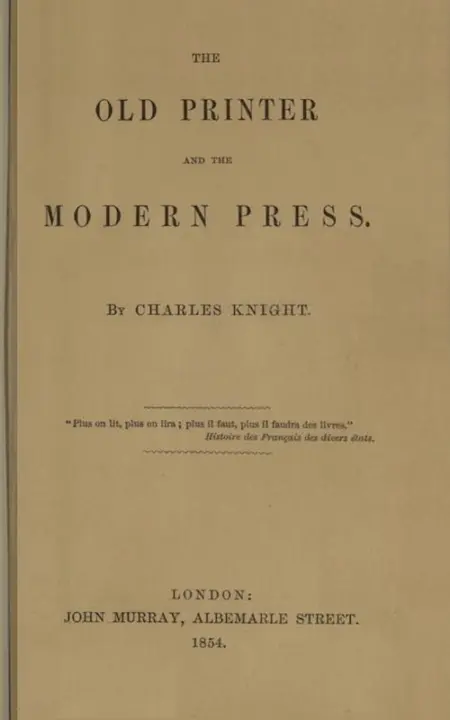
THE CLASSIC COLLECTION · 1854
"The Old Printer and the Modern Press" by Charles Knight is a historical account written in the mid-19th century. The work explores the life of William Caxton, the first English printer, highlighting his contributions to the dissemination of knowledge through the printed word. The narrative reflects on various themes, including the evolution of the English language, the cultural landscape before and after the introduction of printing, and the socio-economic changes triggered by this revolutionary technology. At the start of the narrative, the context surrounding Caxton’s early life is established, particularly focusing on the Weald of Kent where he grew up. The text discusses the linguistic environment of the time, noting the transition from French to English in education, and the scarcity of books before the advent of printing. Knight paints a vivid picture of Caxton's formative years, illustrating the societal isolation and linguistic variations in his rural upbringing. The opening portion sets the stage for understanding Caxton’s later accomplishments and the profound impact of printing on English literature, culture, and society.
Introduction adapted from the source catalogue; source summaries may be automatically generated.
Free to read · English · 88,831 words · No account needed
MAKE TIME FOR A GOOD BOOK
On by default. Untick to stop anonymous reading totals. Each page counts after 10 seconds in view. How this works.
Anonymous counting is on unless you have switched it off.
The prices of books do not appear to have much increased at the beginning of the reign of George III. In some cases their moderation is remarkable. We have seen how small was the demand for the first volume of Hume's 'History' in 1754. We have a number of 'The Gazetteer and New Daily Advertiser' at hand, May 9, 1764; and there we learn, from an advertisement, what a change ten years had produced. A new edition of the third and fourth volumes, in quarto, is advertised at 1l. 5s.; but "the proprietor, at the desire of many who wish to be possessed of this valuable and esteemed history, is induced to a monthly publication, which will not exceed eight volumes." These volumes were 5s. each. It is manifest that the bookseller had found a new class to address when he issued the monthly volumes. Hume says, "Notwithstanding the variety of winds and seasons to which my writings had been exposed, they had still been making such advances that the copy-money given me by the booksellers much exceeded anything formerly known in England." He had complained of the neglect of the "considerable for rank or letters." His publisher saw that a history with such charms of style—so freed from tedious quotations from state-papers and statutes—so unlike the great folios of Carte and Rapin—was a book for a new race of readers. Coleridge humorously enough says—"Poets and philosophers, rendered diffident by their very number, addressed themselves to 'learned readers;' then, aimed to conciliate the graces of 'the candid reader;' till, the critic still rising as the author sank, the amateurs of literature collectively were erected into a municipality of judges, and addressed as 'the Town.' And now, finally, all men being supposed to read, and all readers able to judge, the multitudinous 'Public,' shaped into personal unity by the magic of abstraction, sits nominal despot on the throne of criticism."[28] There is a great truth beneath the sarcasm. The enduring patronage of the public was beginning when Andrew Millar was bold enough to publish Hume's History in monthly five-shilling volumes. But there are still many evidences that the commerce of books at that period, and subsequently, did not contemplate the existence of a large class of buyers, beyond those who were at ease in their fortunes. In that farrago of sense and absurdity, 'The Life of James Lackington, the present Bookseller, Finsbury-square, London, written by himself' (1791), there is a remarkable disclosure of the mode in which books were prevented being sold cheaply, after the original demand had been satisfied:—"When first invited to these trade-sales, I was very much surprised to learn that it was common for such as purchased remainders to destroy one-half or three-fourths of such books, and to charge the full publication price, or nearly that, for such as they kept on hand. And there was a kind of standing order amongst the trade that, in case any one was known to sell articles under the publication price, such a person was to be excluded from trade-sales—so blind were copyright holders to their own interest." In the same manner, it is within the memory of many living persons that there was an invariable high price for fish in London, because the wholesale dealers at Billingsgate always destroyed a portion of what came to market, if the supply were above the average. The dealers in fish had not recognised the existence of a class who would buy for their suppers what the rich had not taken for their dinners; and knew not that the stalls of Tottenham Court Road had as many customers ready for a low price as the shops of Charing Cross for a high price. The fishmongers had not discovered that the price charged to the evening customers had no effect of lowering that of the morning. Nor had the booksellers discovered that there were essentially two, if not more, classes of customers for books—those who would have the dearest and the newest, and those who were content to wait till the gloss of novelty had passed off, and good works became accessible to them, either in cheaper reprints, or "remainders" reduced in price. But books and fish have one material difference. Good books are not impaired in value when they are cheapened. Their character, which has been established by the first demand, creates a second and a larger demand. Lackington destroyed no books that were worth saving, but sold them as he best could. We have no quarrel with his self-commendation when he says, "I could almost be vain enough to assert that I have thereby been highly instrumental in diffusing that general desire for reading now so prevalent among the inferior orders of society."
Your reading position is saved on this browser. Take it to another device with a library code. Reading pages adapt to text, rather than matching a printed edition.
BEHIND THE BOOK
This eBook is for the use of anyone anywhere in the United States and most other parts of the world at no cost and with almost no restrictions whatsoever. You may copy it, give it away or re-use it under the terms of the Project Gutenberg License included with this eBook or online at www.gutenberg.org. If you are not located in the United States, you will have to check the laws of the country where you are located before using this eBook. Read the source licence.
The original source file, including credits and licence, is retained by this library. Request an original-format copy at no charge. Please include the book title and Project Gutenberg identifier #59966.
KEEP YOUR CURIOSITY GOING
Cécile Tormay

Moritz Busch
John L. Ransom
Frances Wright
Cécile Tormay

Mabel Potter Daggett