THE CLASSIC COLLECTION✦The ocean wireless boys of the iceberg patrolCLASSIC FREE BOOKS
The ocean wireless boys of the iceberg patrol
John Henry Goldfrap
THE CLASSIC COLLECTION · 1914
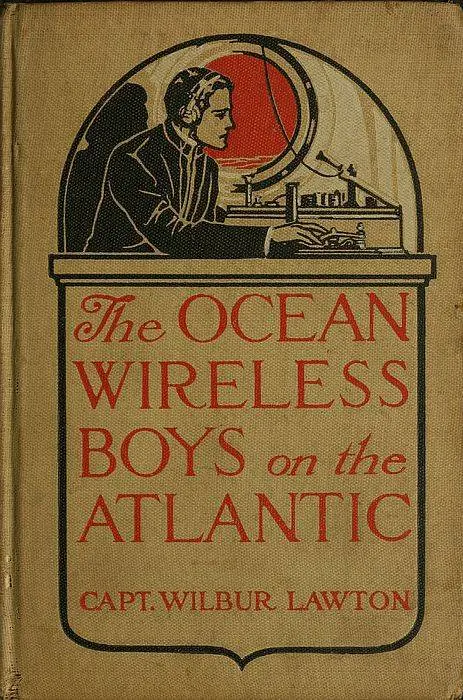
"The Ocean Wireless Boys on the Atlantic" by Captain Wilbur Lawton is a young adult adventure novel written in the early 20th century. The story follows Jack Ready, a determined sixteen-year-old who aspires to be a wireless operator. Faced with numerous rejections, Jack's life takes a thrilling turn when he bravely rescues a drowning girl, which leads to a chance at his dream job aboard a cargo ship. At the start of the novel, readers are introduced to Jack, who is disheartened by his unsuccessful search for work in wireless telegraphy. As he walks near the docks, an emergency arises when a young girl falls overboard, prompting Jack to dive in and rescue her. This heroic act earns him the admiration of the girl's influential father, ship-owner Jacob Jukes. However, Jack chooses to remain humble and declines a reward, believing his actions were simply the right thing to do. Shortly after, he learns that he has secured a position on the Titan Line's tanker, the Ajax, beginning his journey in the thrilling world of maritime adventures and challenges across the Atlantic.
Introduction adapted from the source catalogue; source summaries may be automatically generated.
Free to read · English · 46,772 words · No account needed
MAKE TIME FOR A GOOD BOOK
On by default. Untick to stop anonymous reading totals. Each page counts after 10 seconds in view. How this works.
Anonymous counting is on unless you have switched it off.
“Good for him!” cried Jack, surprised into what was almost a cheer. “But,” he added grudgingly, “he took long enough about it.”
“Suppose you go ahead and attend to your end of the job and let the skipper manage his,” rejoined Raynor, in a quiet voice; and Jack, with a very red pair of ears, set himself down to the key.
The young third engineer was off watch, so he took a seat on the edge of Jack’s bunk and watched the lad manipulating the key with deft, certain fingers.
Crack-ger-ack-ack-ack! Crack-ger-ack-ack-ack! whined the spark as the boy alternately depressed and released the sending key. Then he switched over to “listen in.”
But no answering sounds beat against his ears. The signal had, apparently, fallen still-born on the wings of the storm. This went on for some fifteen minutes and then Jack gave up for a time.
“Nothing in our field or else my waves are too weak,” he explained to young Raynor, who listened with interest.
“I don’t understand what your wireless gibberish means,” he laughed, “but if you’ll teach me, I’ll learn some day.”
“Sure you will,” said Jack cheerfully; “it’s as easy as rolling off a
log.”
“Yes, when you know how,” rejoined Raynor.
They sat silently for a time, while Jack again tried to raise some other ship, but without success.
“Looks as if the ocean must be empty just about here,” he commented.
“Would you be bound to get in touch with another ship if there was one within range of your instrument?” asked young Raynor presently.
“Not necessarily. There might be a dozen things that would interfere.”
“The storm, for instance?”
“Not that cause any more than another. There’s a lot that is mysterious about the wireless waves. Even to-day, nobody knows all about them. Sometimes, for no apparent cause, they will work better than at other times.”
“On a fine day I suppose they work best.”
Jack shook his head.
“On the contrary, at night and on foggy days, the Hertzian waves are sometimes most powerful. All things being equal, though, they work better over the sea than the land.”
“What is the longest distance a message has ever been sent by wireless?” was young Raynor’s next question.
“The last one I heard of was seven thousand miles. At that distance a ship off the coast of Brazil heard a call from Caltano, Italy. Think of that! That message had traveled across Italy, over the Mediterranean, slap across the northwestern part of Africa, and then went whanging across the Atlantic to a spot south of the Equator!”
Your reading position is saved on this browser. Take it to another device with a library code. Reading pages adapt to text, rather than matching a printed edition.
John Henry Goldfrap
John Henry Goldfrap
John Henry Goldfrap
John Henry Goldfrap
BEHIND THE BOOK
This eBook is for the use of anyone anywhere in the United States and most other parts of the world at no cost and with almost no restrictions whatsoever. You may copy it, give it away or re-use it under the terms of the Project Gutenberg License included with this eBook or online at www.gutenberg.org. If you are not located in the United States, you will have to check the laws of the country where you are located before using this eBook. Read the source licence.
The original source file, including credits and licence, is retained by this library. Request an original-format copy at no charge. Please include the book title and Project Gutenberg identifier #48955.
KEEP YOUR CURIOSITY GOING
Coulson Kernahan

Maurice Baring
Frances Wright
Cécile Tormay

Frederic Jesup Stimson

W. H. P. (William Henry Pope) Jarvis