
Last letters from the living dead man
David Patterson (Spirit) Hatch
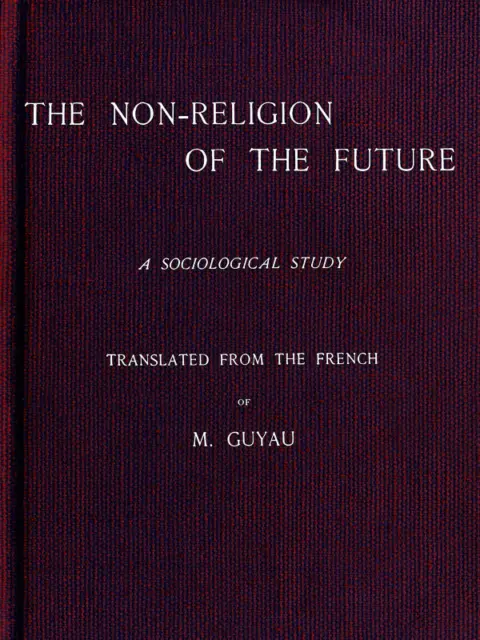
THE CLASSIC COLLECTION · 1897
"The Non-religion of the Future: A Sociological Study" by Jean-Marie Guyau is a sociological study written in the late 19th century. The work examines the evolution of religious belief and the rise of a state of "non-religion" as a potential future for humanity, arguing against the permanence of dogmatic religions. Guyau explores the interplay between religion, aesthetics, and morals, suggesting that as society progresses, religious forms may dissolve, giving way to a more individualistic and rational approach to existence. The opening of the book introduces the central thesis that religion has originated and evolved through sociological rather than metaphysical processes. Guyau discusses various definitions of religion and emphasizes that the essence of all religious conceptions is the social bond between humanity and a cosmic society. He critiques both traditional and modern interpretations of religion, positing that all forms have evolved from primitive social understandings. The text sets the stage for a deeper exploration of how these religious roots may lead to a future where non-religious or rational frameworks fulfill humanity's social and moral needs, moving beyond mere dogma and myth.
Introduction adapted from the source catalogue; source summaries may be automatically generated.
Free to read · English · 214,102 words · No account needed
MAKE TIME FOR A GOOD BOOK
On by default. Untick to stop anonymous reading totals. Each page counts after 10 seconds in view. How this works.
Anonymous counting is on unless you have switched it off.
Before the earliest developments of science, primitive man found himself, as a result of his imagination, in a state of domesticity in the world, analogous to that to which he had himself reduced certain animals; and this state exerted a profound influence upon the character of such animals, deprived them of certain capacities and endowed them, in turn, with others. Some of them—certain birds, for example—become under domestication almost incapable of finding and providing themselves with their necessary food. More intelligent animals like the dog, who might in a case of absolute necessity rely upon himself for indispensables, contract nevertheless a habit of subjection to man which creates a corresponding need: my dog is not at ease except when he knows that I am near; if anything causes me to go away, he is restless and nervous; in the presence of danger he runs between my legs, instead of taking refuge in flight, which would be the primitive instinct. Thus every animal which knows itself to be watched and protected in the details of its life by a superior being, necessarily loses its primitive independence, and if its primitive independence should be once more restored, it would be unhappy, would experience an ill-defined fear, a vague sentiment of enfeeblement. Just so in the case of primitive and uncultivated man: once he is habituated to the protection of the gods, this protection becomes for him a veritable need; if he is deprived of it, he falls into a state of inexpressible discomfiture and inquietude. Add that, in this case, he will soon provide himself with a substitute; to escape from the intolerable solitude which doubt creates within him, he will take refuge in his gods or his fetiches, under the influence of a sentiment identical with that which sends the dog to take refuge between the legs of his master. To attain some idea of the force of such a sentiment among primitive human beings, one must remember that the surveillance of the gods is much more extended and more scrupulous even than that of man over domestic animals, or of a master over his slaves. Primitive man feels his god or his genii at his side at every step, in all the circumstances of life; he is accustomed to being never alone, to the presence of someone by him keeping step with him; he believes that every word that he says and every act that he does is witnessed and judged. No domestic animal is accustomed to so high a degree of subjection; he knows perfectly that our protection is not always efficacious and that we are sometimes mistaken about him, that we caress him when he ought to be punished, etc. Cats, for instance, know that man cannot see in the dark: one evening a white cat made ready to commit an abominable misdemeanour within two steps of me, not suspecting that its colour would betray it to an attentive eye, even in the obscurity. Primitive men sometimes practised an analogous cunning in regard to their gods; they did not yet believe in the complete sovereignty, in the absolute ubiquity, of Providence. But by a process of logical development, Providence is ultimately believed to extend to everything, to envelop one’s whole life; the fear of God becomes to man a perpetual prohibition against his passions, a hope in God’s aid his perpetual recourse. Religion and science possess this much in common, that they result in enveloping us equally in a network of necessities; but what distinguishes science is that it makes us acquainted with the real order and causes of phenomena, and by that fact permits us to modify that order at will; by showing us the fact and nature of our dependence, science supplies us with the means of conquering a comparative independence. In religion, on the contrary, the mythical and miraculous element introduces an unforeseen factor, the divine will, a special providence, into the midst of events, and by that fact deceives one as to the true means of modifying the real course of things. The instant one believes one’s self to be dependent upon Jupiter or Allah, one ascribes a greater efficacy to propitiation than to action; and it follows that the greater one perceives one’s dependence to be the more completely one believes one’s self to be without defence against it; the more complete the submission is to God, the more complete one’s resulting submission becomes to the established fact. The feeling of an imaginary dependence upon supernatural beings thus increases the general dependence of man in relation to nature. Thus understood, the notion of a special providence, of a divine tutelage, has resulted in the protracted maintenance of the human soul in a state of genuine minority; and this state of minority, in its turn, has rendered the existence and surveillance of divine protectors a necessity. When, therefore, the believer refuses an offer of emancipation from the dependence which he has voluntarily accepted, the reason is that he feels a vague sentiment of his own insufficiency, of his irremediably belated coming of age; he is a child, who does not dare stray far from the paternal roof; he does not possess the courage to walk alone. The child who should show a precocious independence, and should early learn to go its own road, would not improbably become simply dissipated; his precocity might well be depravity in disguise. Similarly in history, the irreligious, the sceptics, the atheists, have been frequently spoiled children, precocious in the bad sense; their freedom of spirit was only a high form of mischief. The human race, like the individual, long needed surveillance and tutelage; so long as it experienced this need it leaned inevitably upon a belief in a providence external to itself and to the universe, capable of interfering in the course of things, and of modifying the general laws of nature by particular acts of volition. Subsequently, by the progress of science, Providence has been deprived day by day of some of its special and miraculous powers, of its supernatural prerogatives. By the evolution of human thought piety has been transformed; it tends to-day to regard as an object of filial affection what was formerly an object of terror, of deprecation, of propitiation. Science, enveloping Providence in a network of inflexible laws, is day by day reducing it to a state of immobility and, so to speak, paralyzing it. Providence is becoming like an old man whom age has rendered incapable of movement—who but for our aid could not raise a hand or foot, who lives with our assistance, and who, nevertheless, is only the more beloved, as if his existence became to us more precious in proportion to its uselessness.
Your reading position is saved on this browser. Take it to another device with a library code. Reading pages adapt to text, rather than matching a printed edition.
BEHIND THE BOOK
This eBook is for the use of anyone anywhere in the United States and most other parts of the world at no cost and with almost no restrictions whatsoever. You may copy it, give it away or re-use it under the terms of the Project Gutenberg License included with this eBook or online at www.gutenberg.org. If you are not located in the United States, you will have to check the laws of the country where you are located before using this eBook. Read the source licence.
The original source file, including credits and licence, is retained by this library. Request an original-format copy at no charge. Please include the book title and Project Gutenberg identifier #47421.
KEEP YOUR CURIOSITY GOING
David Patterson (Spirit) Hatch

David Patterson (Spirit) Hatch

David Patterson (Spirit) Hatch
Coulson Kernahan

Ralph Waldo Emerson
Frances Wright