
Last letters from the living dead man
David Patterson (Spirit) Hatch
THE CLASSIC COLLECTION · 1897
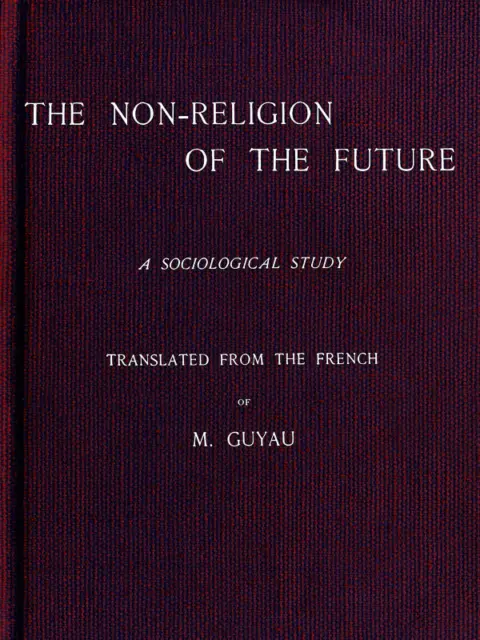
"The Non-religion of the Future: A Sociological Study" by Jean-Marie Guyau is a sociological study written in the late 19th century. The work examines the evolution of religious belief and the rise of a state of "non-religion" as a potential future for humanity, arguing against the permanence of dogmatic religions. Guyau explores the interplay between religion, aesthetics, and morals, suggesting that as society progresses, religious forms may dissolve, giving way to a more individualistic and rational approach to existence. The opening of the book introduces the central thesis that religion has originated and evolved through sociological rather than metaphysical processes. Guyau discusses various definitions of religion and emphasizes that the essence of all religious conceptions is the social bond between humanity and a cosmic society. He critiques both traditional and modern interpretations of religion, positing that all forms have evolved from primitive social understandings. The text sets the stage for a deeper exploration of how these religious roots may lead to a future where non-religious or rational frameworks fulfill humanity's social and moral needs, moving beyond mere dogma and myth.
Introduction adapted from the source catalogue; source summaries may be automatically generated.
Free to read · English · 214,102 words · No account needed
MAKE TIME FOR A GOOD BOOK
On by default. Untick to stop anonymous reading totals. Each page counts after 10 seconds in view. How this works.
Anonymous counting is on unless you have switched it off.
[Sidenote: A late phenomenon.]
Before the need for mystical belief can occur to one, one must have been reared in an atmosphere of faith, or else in an atmosphere of doubt; and both these states of mind are equally unknown to the earlier and simpler races of humanity. Or, more accurately, they are perfectly acquainted with faith, but it is the naïve faith of eye and ear; they possess the perfect confidence that every sentient being has in his five senses, and in all that there is nothing religious properly so-called. I remember the astonishment I felt in my infancy when I first saw the words doubt and faith; it was in some verses, and the poet was singing, with much eloquence, all the horrors of doubt. I perfectly understood what it was to doubt a fact, or to believe in it, but I bothered my head in vain to discover what one meant by doubt simply: What was there so terrible about being in doubt on matters with which one was insufficiently acquainted? The word faith was equally unintelligible to me, for I had as yet no conception of believing in anything except what was certain. The case of primitive man is exactly the same. He no more experiences a mystical need to believe than he experiences a mystical need to get drunk before having tasted wine. Religious sentiment does not make its appearance in him suddenly, does not simply step out on the stage. There are no lacunæ in the human soul, it is a prey to invincible continuity. Such a sentiment must come gradually by a slow adaptation of the spirit to the inexact ideas supplied to one by the senses. Man, imagining himself to live in the bosom of a society of gods, inevitably accommodates himself to so novel a habitat. Every society, human or divine, creates the individual member in its own image; draft the labourer for a soldier, let the villager become a citizen, they acquire of necessity new gestures and sentiments which, upon their return to their former habitat, they once more in a measure lose. The case is inevitably the same for mankind and religion. As the most sociable of beings, man is also the most readily subject to the influence of those with whom he lives or believes himself to live. The gods, whom we create more or less in our own image, thereupon, by an inevitable reaction, return the compliment. A religious instinct, such as M. Renan describes, is in a large part the work of this sort of reaction and of education; if it possesses profound roots in our being, the reason is that it was planted in us in our infancy, that it speaks to us with the voice of our childhood, and takes us back to our earliest years; often a word, a thought with which we have been struck at some former time, without, however, having understood it, unexpectedly reawakens in us, reverberates in our memory; it is but an echo, and it appeals to us as if it were a voice. The rôle played by heredity in the formation of one’s character has been noticeably exaggerated; the influence of education is at the present day not estimated at its full value.[18] Even among animals, instinct amounts to little without education. A bird, no doubt, does not actually need to see an egg laid to acquit itself with “devotion” of that new function; but when it is a question of building the nest, the case is not so simple: birds reared in a cage, who have never seen a nest, are often at a loss what to do; instinct whispers indeed to them still, but its voice is no longer clear, no definite image of the ideal nest presents itself to their eyes. Nature’s “devotion” is at fault. Add that these instincts, so “mysterious” in M. Renan’s opinion, act on the individual by means of a somewhat gross mechanism, and that it suffices to tamper with the mechanism, to excite the instinct or to suspend it. To transform, for example, a capon into a setting hen, it suffices simply to pluck the feathers off the belly; it then squats upon eggs—or upon pebbles—with pleasure. Really there is mystery enough in nature without going out of one’s way to add to it; it is not philosophic to trace everything back to instinct, and then presently to regard these instincts as unconscious intentions, and in these intentions to see the proof of a plan, and in this plan the proof of a god. With a logic so accommodating as that, M. Renan might well find in the religious instinct a peremptory demonstration of the existence of God.
Your reading position is saved on this browser. Take it to another device with a library code. Reading pages adapt to text, rather than matching a printed edition.
BEHIND THE BOOK
This eBook is for the use of anyone anywhere in the United States and most other parts of the world at no cost and with almost no restrictions whatsoever. You may copy it, give it away or re-use it under the terms of the Project Gutenberg License included with this eBook or online at www.gutenberg.org. If you are not located in the United States, you will have to check the laws of the country where you are located before using this eBook. Read the source licence.
The original source file, including credits and licence, is retained by this library. Request an original-format copy at no charge. Please include the book title and Project Gutenberg identifier #47421.
KEEP YOUR CURIOSITY GOING
David Patterson (Spirit) Hatch

David Patterson (Spirit) Hatch

David Patterson (Spirit) Hatch
Coulson Kernahan

Ralph Waldo Emerson
Frances Wright