
Last letters from the living dead man
David Patterson (Spirit) Hatch
THE CLASSIC COLLECTION · 1897
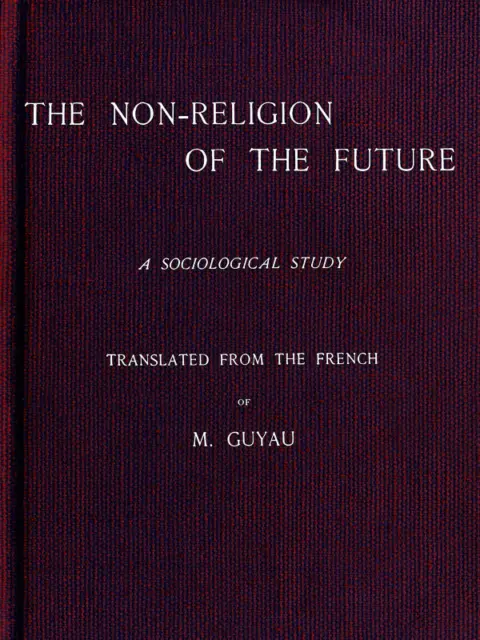
"The Non-religion of the Future: A Sociological Study" by Jean-Marie Guyau is a sociological study written in the late 19th century. The work examines the evolution of religious belief and the rise of a state of "non-religion" as a potential future for humanity, arguing against the permanence of dogmatic religions. Guyau explores the interplay between religion, aesthetics, and morals, suggesting that as society progresses, religious forms may dissolve, giving way to a more individualistic and rational approach to existence. The opening of the book introduces the central thesis that religion has originated and evolved through sociological rather than metaphysical processes. Guyau discusses various definitions of religion and emphasizes that the essence of all religious conceptions is the social bond between humanity and a cosmic society. He critiques both traditional and modern interpretations of religion, positing that all forms have evolved from primitive social understandings. The text sets the stage for a deeper exploration of how these religious roots may lead to a future where non-religious or rational frameworks fulfill humanity's social and moral needs, moving beyond mere dogma and myth.
Introduction adapted from the source catalogue; source summaries may be automatically generated.
Free to read · English · 214,102 words · No account needed
MAKE TIME FOR A GOOD BOOK
On by default. Untick to stop anonymous reading totals. Each page counts after 10 seconds in view. How this works.
Anonymous counting is on unless you have switched it off.
It is evident that the problem of the origin of religion, in the new form in which it presents itself to-day, is quite as grave as ever it was; formerly the question was whether religion is revealed or natural; to-day the question is whether religion is or is not true—whether it is or is not the product of an intellectual error, of a sort of inevitable optical illusion which it is the business of science to explain and to correct; whether, in effect, the god of mythical and symbolical religion is not simply a magnified idol.
[Sidenote: The positivist theory no longer in possession of the field.]
The positivist theory of religion seemed some years ago close upon its ultimate triumph.[10] Many had accepted it, but without having fully perceived all of its consequences. At the present moment it is, on the contrary, strongly contested. New elements have been introduced into the problem and the whole question must be gone over again. Max Müller in especial has made what might be almost called a desperate effort to make out a case for the objectivity and essential rationality of religion, which had both been compromised by positivism.[11] From a different point of view Herbert Spencer also, in his “Sociology,” has criticised theories which regard fetichism or naturism as the principle of religion.
[10] We find it adopted or almost so even by spiritualists, like M. Vacherot, La religion, Paris, 1869.
[11] See Origin and Development of Religion, by F. Max
Müller, M. A.
[Sidenote: Max Müller’s theory.]
According to Max Müller some notion of divinity, in especial in the form of a notion of the infinite, must have preceded the conception of God. Gods are simply subsequent personifications of this great innate idea; our ancestors kneeled in worship long before they possessed a name for Him before whom they were kneeling. Even at the present day we recognize in the last resort the vanity of all the titles of the unknown God whom we must adore really in silence. Religion, which is responsible for the origin of the gods of history, may therefore well survive them. We say religion; for in effect, according to Max Müller, all religions amount in the end to one, since they may all be traced back through the long course of their development to a single original conception, that namely of the infinite, which from the very beginning was present in the mind of man. This universal conception, however, Max Müller does not regard as in any sense mystical or innate, in the old acceptation of that word. He willingly adopts the axiom: Nihil in fide quod non antea fuerit in sensu.[12] But in his opinion some perception of the infinite is logically involved in a perception of the finite, and this conception of infinity, with its basis at once in sense and reason, is the true foundation of religion. Given the five senses of a savage, Max Müller undertakes to make him sensible of or at least experience some presentiment of the infinite, make him desire it, feel some aspiration toward it. Take the sense of sight for example: “Man sees, he sees to a certain point; and then his eyesight breaks down. But exactly where his eyesight breaks down there presses upon him, whether he likes it or not, the perception of the unlimited or the infinite.” “It may be said,” he adds, “that this is not perception in the ordinary sense of the word. No more it is, but still less is it mere reasoning.” “If it seems too bold to say that man actually sees the invisible, let us say that he suffers from the invisible, and the invisible is only a special name for the infinite.” Man not only necessarily divines the infinite as existing beyond the limits of the finite, and as it were enveloping it; he perceives it within the limits of the finite, and as it were penetrating it; the infinite divisibility of matter is manifest to the senses, the fact that science seems to demand the existence of an irreducible atom as a necessary postulate to the contrary notwithstanding. And what is true of space is equally true of time, applies equally to quality and quantity. “Beyond, behind, beneath, and within the finite, the infinite is always present to our senses. It presses upon us, it grows upon us from every side. What we call finite in space and time, in form and word, is nothing but a veil or net which we ourselves have thrown over the infinite.” And let it not be objected that primitive languages supply no means of expressing the idea of infinity, of the beyond, which is given in every finite sensation. Do the languages of antiquity supply a means of designating the infinite shades and variety of colour? Democritus was acquainted with but four colours: black, white, red, and yellow. Shall we say, therefore, that the ancients did not perceive the blue of heaven? The sky was as blue for them as it is for us, but they had not yet established a conventional designation for the sensation it afforded them. And similarly in the case of the infinite for the primitive man; it existed for him although he had not as yet invented a name for it. Well, what is this infinite, in the last resort, but the object to which every religion addresses itself? A religious being is essentially one who is not satisfied with such and such a finite sensation; who looks everywhere for the beyond—looks for it in life, in death, in nature, in himself. To be divinely aware of a vague somewhat that one cannot quite understand, to feel a veneration for it and then to endeavour to fit it with a name, to call to it stammeringly, these are the beginnings of every system of religious worship. The religion of the infinite comprehends and precedes all others, and since the infinite itself is given in sensation, it follows that “Religion is simply another development of sensuous perception, quite as much as reason is.”[13]
Your reading position is saved on this browser. Take it to another device with a library code. Reading pages adapt to text, rather than matching a printed edition.
BEHIND THE BOOK
This eBook is for the use of anyone anywhere in the United States and most other parts of the world at no cost and with almost no restrictions whatsoever. You may copy it, give it away or re-use it under the terms of the Project Gutenberg License included with this eBook or online at www.gutenberg.org. If you are not located in the United States, you will have to check the laws of the country where you are located before using this eBook. Read the source licence.
The original source file, including credits and licence, is retained by this library. Request an original-format copy at no charge. Please include the book title and Project Gutenberg identifier #47421.
KEEP YOUR CURIOSITY GOING
David Patterson (Spirit) Hatch

David Patterson (Spirit) Hatch

David Patterson (Spirit) Hatch
Coulson Kernahan

Ralph Waldo Emerson
Frances Wright