
Last letters from the living dead man
David Patterson (Spirit) Hatch
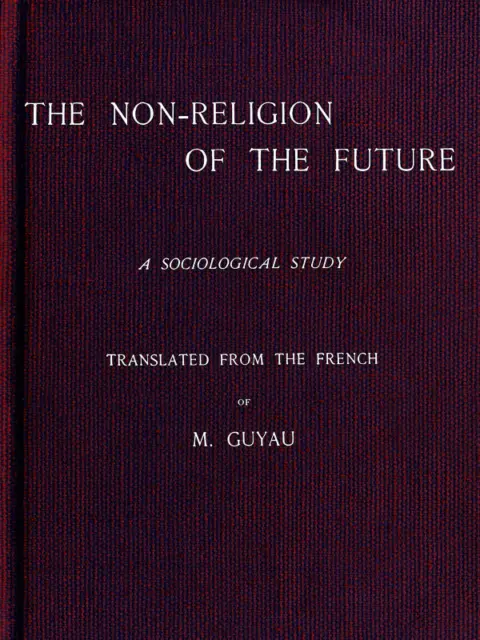
THE CLASSIC COLLECTION · 1897
"The Non-religion of the Future: A Sociological Study" by Jean-Marie Guyau is a sociological study written in the late 19th century. The work examines the evolution of religious belief and the rise of a state of "non-religion" as a potential future for humanity, arguing against the permanence of dogmatic religions. Guyau explores the interplay between religion, aesthetics, and morals, suggesting that as society progresses, religious forms may dissolve, giving way to a more individualistic and rational approach to existence. The opening of the book introduces the central thesis that religion has originated and evolved through sociological rather than metaphysical processes. Guyau discusses various definitions of religion and emphasizes that the essence of all religious conceptions is the social bond between humanity and a cosmic society. He critiques both traditional and modern interpretations of religion, positing that all forms have evolved from primitive social understandings. The text sets the stage for a deeper exploration of how these religious roots may lead to a future where non-religious or rational frameworks fulfill humanity's social and moral needs, moving beyond mere dogma and myth.
Introduction adapted from the source catalogue; source summaries may be automatically generated.
Free to read · English · 214,102 words · No account needed
MAKE TIME FOR A GOOD BOOK
On by default. Untick to stop anonymous reading totals. Each page counts after 10 seconds in view. How this works.
Anonymous counting is on unless you have switched it off.
To maintain the necessity of the idea of sanction in moral instruction and propagandism, the following argument has been employed. Baudelaire, it is said, in the last days of his intellectual life, sketched a great drama, destined to astonish the partisans of middle-class morality. The hero of the drama, stripping himself of vulgar prejudice, was to commit one after another, and with an equal success, the crimes which are supposed to be the most terrible—was to kill his father, to dishonour his brother, to violate his sister and his mother, to betray his country, and finally, his work in the world accomplished, in possession of fortune and reputation, was to retire to some charming site, under some soft sky, and to exclaim with all the tranquillity in the world: “Let us now enjoy in peace the fruits of our crime.” What reply could you make, it is asked, to such a man and to those who might be tempted to imitate him, if you had not at hand the menaces of religion and the prospect of future punishment? How could you disturb the criminal’s promised joy?
[Sidenote: His life punishes itself.]
Let us consider first in what the criminal’s promised joy can consist. Baudelaire’s hero is naturally incapable of appreciating the pleasures of the hearth; a man who has killed his father can find little delight in the birth of a son. He is equally incapable of appreciating a love of science for science’s sake, for the man who could love science for science’s sake would never be tempted to become a great criminal, and as for pure æsthetic pleasures, moral delicacy and æsthetic delicacy in general go hand in hand; it is not probable that a being incapable of remorse and insensitive to all the shades and varieties of the moral life would be apt to be sensible of all the shades and varieties of beauty and of æsthetic enjoyment. The capacity for a sincere admiration of the beautiful corresponds always to a possibility of strong repugnances to the ugly, and repugnance for the ugly is scarcely conceivable apart from a repugnance for what is ugly in immorality. It is true that Byron depicted certain satanic heroes accomplishing the blackest of crimes without any loss to their elegance, to their good manners, to their high spirit and courage, but his heroes, not to raise the question of their possibility in real life, are extremely unhappy; they, like Byron himself and his disciples, are the victims of a refined remorse, distaste of life, misanthropy; the only art that lies within their range is pessimistic art, which but aggravates their malady. Their æsthetic joys are veritable agonies. Or if, Byron and Byronism apart, one keeps close to the truth, one may well doubt whether true æsthetic pleasures are more within the reach of a genuine criminal than of an educated butcher’s boy. His pleasure would be confined to the monotonous round of wine, women, and play; and he could not take wine with a light heart, for men talk under the influence of wine; and he must play but little, for men ruin themselves at play; so that there remains nothing but women who constitute, as a matter of fact, the habitual consolation of criminals. In all times police have looked for criminals, and found them, the day after their offence in places of ill-repute. Very well, the defence of society apart, we see no reason for depriving the poor wretches of the restricted joys that remain to them. It would be doing too much honour to Baudelaire’s hero to give him an immortality in the next life, simply as a means of making him pay dearer than he has already done in this for the few kisses that he has purchased with his blood-stained gold. He suffers enough as it is, the only additional suffering that could be wished for him is that of remorse, but remorse is a sign of superiority. Real criminals, temperamental criminals, those who are the victims of what is known as moral insanity, are absolutely ignorant of remorse, because they are perfectly adapted to crime; they are made for the immoral environment in which they live, and live at ease, and experience no desire for a change. To perceive that a door is low, one’s stature must be great. If Lady Macbeth’s hand had been rude and her eye dull, she never would have desired to wash off the drop of blood. To suffer is to pass beyond the bounds of one’s environment; the criminal who experiences remorse has strayed less far from the human type than the one who does not feel remorse. The first may become a man once more, the second is incapable of crossing the line of demarcation which separates man and beast, for he is incapable of perceiving it; he is walled in with his crime, and is a brute or a madman.
Your reading position is saved on this browser. Take it to another device with a library code. Reading pages adapt to text, rather than matching a printed edition.
BEHIND THE BOOK
This eBook is for the use of anyone anywhere in the United States and most other parts of the world at no cost and with almost no restrictions whatsoever. You may copy it, give it away or re-use it under the terms of the Project Gutenberg License included with this eBook or online at www.gutenberg.org. If you are not located in the United States, you will have to check the laws of the country where you are located before using this eBook. Read the source licence.
The original source file, including credits and licence, is retained by this library. Request an original-format copy at no charge. Please include the book title and Project Gutenberg identifier #47421.
KEEP YOUR CURIOSITY GOING
David Patterson (Spirit) Hatch

David Patterson (Spirit) Hatch

David Patterson (Spirit) Hatch
Coulson Kernahan

Ralph Waldo Emerson
Frances Wright