
Last letters from the living dead man
David Patterson (Spirit) Hatch
THE CLASSIC COLLECTION · 1897
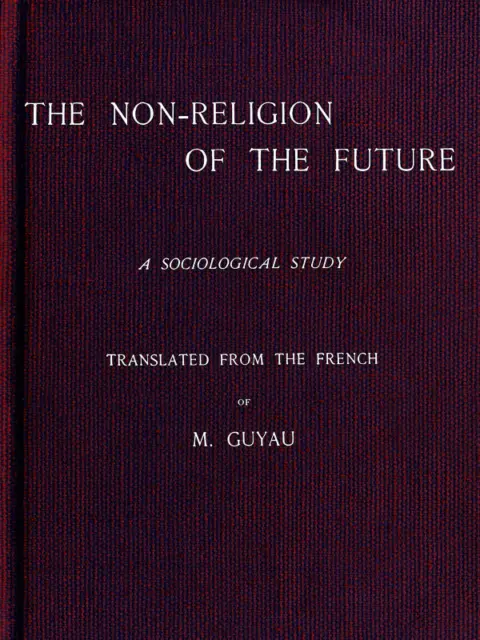
"The Non-religion of the Future: A Sociological Study" by Jean-Marie Guyau is a sociological study written in the late 19th century. The work examines the evolution of religious belief and the rise of a state of "non-religion" as a potential future for humanity, arguing against the permanence of dogmatic religions. Guyau explores the interplay between religion, aesthetics, and morals, suggesting that as society progresses, religious forms may dissolve, giving way to a more individualistic and rational approach to existence. The opening of the book introduces the central thesis that religion has originated and evolved through sociological rather than metaphysical processes. Guyau discusses various definitions of religion and emphasizes that the essence of all religious conceptions is the social bond between humanity and a cosmic society. He critiques both traditional and modern interpretations of religion, positing that all forms have evolved from primitive social understandings. The text sets the stage for a deeper exploration of how these religious roots may lead to a future where non-religious or rational frameworks fulfill humanity's social and moral needs, moving beyond mere dogma and myth.
Introduction adapted from the source catalogue; source summaries may be automatically generated.
Free to read · English · 214,102 words · No account needed
MAKE TIME FOR A GOOD BOOK
On by default. Untick to stop anonymous reading totals. Each page counts after 10 seconds in view. How this works.
Anonymous counting is on unless you have switched it off.
If it be so, what must one think of the doubts, as to the future of France, which seem to be entertained in certain quarters? Those who regard religion as the condition sine qua non of life and of superiority in the struggle for existence among nations, must naturally consider France as in danger of disappearing. But is this criterion of national vitality admissible?
[Sidenote: Matthew Arnold’s theory.]
We find ourselves here once more in the presence of Mr. Matthew Arnold. In his judgment, the modern world has been made what it is by the influence of two peoples, the Greeks and the Jews, representing respectively two distinct and almost opposed ideas, which are contending with each other for the possession of the modern mind. For Greece—the brilliant, but in spite of its subtlety of spirit, somewhat superficial Greece—art and science fill the measure of life. For the Hebrews life might be summed up in one word, justice. And by justice must not be understood a rigid respect for the rights of others, but a willingness to renounce one’s own interest, one’s own pleasure, a self-effacement in the presence of the eternal law of sacrifice personified in Javeh. Greece and Judea are dead; Greece faithful to the last moment to its belief in the all-sufficiency of art and science, Judea faithless at the last moment to its belief in the all-sufficiency of justice, and falling by reason of that very infidelity. Mr. Matthew Arnold finds the two nations symbolized in an Old Testament story. It was before the birth of Isaac, the veritable inheritor of the divine promise, who was humble but elect. Abraham looked upon his first son Ishmael, who was young, vigorous, brilliant, and daring, and implored God: “Oh, that Ishmael might live before Thee!” But it could not be. Greece, the Ishmael among nations, has perished. Later the Renaissance appeared as its successor; the Renaissance was full of vitality, of future; the dream, the sombre nightmare had passed away, there was to be no more religious asceticism, we were to return to nature. The Renaissance held in horror the tonsured and hooded Dark Ages, whose spirit was renouncement and mortification. For the Renaissance itself the ideal was fulness of life, growth of the individual, the free and joyous satisfaction of all our instincts, of art and science; Rabelais was the personification of it. Alas! the Renaissance fell, as Greece fell, and the natural successor of the Renaissance, in Mr. Matthew Arnold’s judgment, is George Fox, the first Quaker, the open contemner of arts and sciences. Finally, in our days, a people in Europe has taken up the succession; the modern Greece, dear to the enlightenment of all nations, the friend of art and science, is France. How often, and with what ardour, has this prayer in its favour been raised to God in heaven: “Oh, that Ishmael might live before Thee!” France is the average sensual man, and Paris is his city, and who of us does not feel himself attracted? The French possess this element of superiority over the Renaissance, that they are more balanced than other peoples, and though France has aimed to liberate mankind and to enfranchise them from the austere rule of sacrifice, she has not conceived man as a monster, nor liberty as a species of madness. Her ideas are formulated in a system of education which lies in the regular, complete, and harmonious development of all the faculties. Accordingly the French ideal does not shock other nations, it seduces them; France is for them the land of tact, of measure, of good sense, of logic. We aim in perfect confidence at developing the whole human being without violence to any part of it. It is in this ideal that we have found our famous gospel of the rights of man. The rights of man consist simply in a systematization of Greek and French ideas, in a consecration of the supremacy of self, as against abnegation and religious sacrifice. In France, Mr. Matthew Arnold says, the desires of the flesh, and current ideas, are mistaken for the rights of man. While we are pursuing one ideal, other peoples, more tightly chained to Hebraism, continue to cultivate that justice which is founded on renouncement. From time to time they look with envy out of their own austere and dull life, and with admiration upon the French ideal which is so positive, so clear, so satisfying; they are half inclined at times to make a trial of it. France has exerted a charm on the entire world. Everyone at some period or other of his life has thirsted for the French ideal, has desired to make a trial of it. The French wear the guise of the people to whom has been intrusted the beautiful, the charming ideal of the future, and other nations cry: “Oh, that Ishmael might live before Thee!” And Ishmael seems to grow more and more brilliant each day, seems certain of success, is on the point of making the conquest of the world. But at this moment a disaster occurs, the Crisis, the Biblical judgment arrives at the moment of triumph; behold the judgment of the world! The world, in Mr. Matthew Arnold’s opinion, was judged in 1870: the Prussians were Javeh’s substitute. And once more Ishmael, the spirit of Greece, the spirit of the Renaissance, the spirit of France, free-thought, and free conduct were conquered by Israel, by the spirit of the Bible, by the spirit of the Middle Ages. A brilliant but superficial civilization was crushed beneath the weight of the barbarous and unyielding asceticism of a more or less naïve faith. Javeh is even in the present century the god of battles, and woe to the individuals who do not believe, with the ancient Jew, that abnegation constitutes three-fourths of life, and that art and science together barely fill the other fourth.
Your reading position is saved on this browser. Take it to another device with a library code. Reading pages adapt to text, rather than matching a printed edition.
BEHIND THE BOOK
This eBook is for the use of anyone anywhere in the United States and most other parts of the world at no cost and with almost no restrictions whatsoever. You may copy it, give it away or re-use it under the terms of the Project Gutenberg License included with this eBook or online at www.gutenberg.org. If you are not located in the United States, you will have to check the laws of the country where you are located before using this eBook. Read the source licence.
The original source file, including credits and licence, is retained by this library. Request an original-format copy at no charge. Please include the book title and Project Gutenberg identifier #47421.
KEEP YOUR CURIOSITY GOING
David Patterson (Spirit) Hatch

David Patterson (Spirit) Hatch

David Patterson (Spirit) Hatch
Coulson Kernahan

Ralph Waldo Emerson
Frances Wright