
Last letters from the living dead man
David Patterson (Spirit) Hatch
THE CLASSIC COLLECTION · 1897
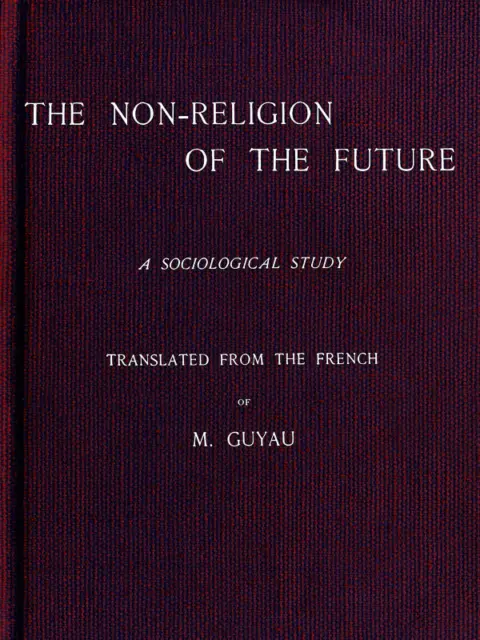
"The Non-religion of the Future: A Sociological Study" by Jean-Marie Guyau is a sociological study written in the late 19th century. The work examines the evolution of religious belief and the rise of a state of "non-religion" as a potential future for humanity, arguing against the permanence of dogmatic religions. Guyau explores the interplay between religion, aesthetics, and morals, suggesting that as society progresses, religious forms may dissolve, giving way to a more individualistic and rational approach to existence. The opening of the book introduces the central thesis that religion has originated and evolved through sociological rather than metaphysical processes. Guyau discusses various definitions of religion and emphasizes that the essence of all religious conceptions is the social bond between humanity and a cosmic society. He critiques both traditional and modern interpretations of religion, positing that all forms have evolved from primitive social understandings. The text sets the stage for a deeper exploration of how these religious roots may lead to a future where non-religious or rational frameworks fulfill humanity's social and moral needs, moving beyond mere dogma and myth.
Introduction adapted from the source catalogue; source summaries may be automatically generated.
Free to read · English · 214,102 words · No account needed
MAKE TIME FOR A GOOD BOOK
On by default. Untick to stop anonymous reading totals. Each page counts after 10 seconds in view. How this works.
Anonymous counting is on unless you have switched it off.
It has been said that, if the French Revolution was put down before it had produced all of the results which were expected of it, the reason was that it was undertaken, not in the name of a liberal religion, but in antagonism to all religion. The nation rose as a body against Catholicism, but it had nothing to offer in its stead; it was an effort in the void and resulted necessarily in a fall. To address such a reproach to the Revolution, is precisely to fail to recognize its distinguishing peculiarity. Theretofore religion had usually been involved in the political discussions of men; the English Revolution, for example, was in part religious. And when an uprising was, as it happened, wholly religious, its purpose was to pull down one cult and set up another; the aid of a new God had to be called in to expel the old; but for Jesus or some other unknown divinity, Jupiter would still have been enthroned on Olympus. Also the result of these religious revolutions was easy to predict; at the end of a certain number of years some new cult was bound to carry the day, to intrench itself, and to become quite as intolerant as its predecessor; and the revolution was achieved—that is to say, everything was practically in the same state that it was before. A determinate end, close at hand, had been pursued and attained; a little chapter in the history of the universe had been written, and one was ready to close it with a period and to say that was all. What drives the historian to despair in the case of the French Revolution, is precisely the impossibility of writing a peroration, of reaching a final stop, of saying, “That is all.” The great fermentation persists, and passes on from generation to generation. “The French Revolution has come to nothing,” it is said; but the reason is perhaps simply that it has not miscarried. The French Revolution is still in its earliest stages; if we are still unable to say where it is leading us, we may at least affirm with confidence that it is leading us somewhere. It is precisely the incertitude and the remoteness of their aim that constitute the nobility of certain enterprises; if one wants something very big, one must be resigned to want something a little vague. One must be resigned also to a settled discontent with everything that is offered one as a substitute for the fleeing ideal that constitutes one’s aim. Never to be satisfied—behold a comparatively unknown state of mind in many parts of the world! Some thousands of years ago there were a number of revolutions in China, which brought forth results so precise and so incontestable that they have come down in a state of absolute preservation to the present day. Is China the ideal of those who wish a people to achieve once for all a state of satisfaction, of stable equilibrium, of established environment, of unalterable outline and form? Certainly the bent of the French mind is precisely the opposite of that of the Chinese. Horror of routine, of tradition, of the established fact in the face of reason, is an attribute that we possess to a fault. To carry reason into politics, into law, into religion was precisely the aim of the French Revolution. It is no easy thing, it is even futile, to attempt to introduce simultaneously logic and light into everything; one makes mistakes, one reasons ill, one has one’s days of weakness, one succumbs to concordats and empires. In spite, however, of so many temporary divergences from the straight path, it is already easy to recognize the direction toward which the Revolution tends, and to affirm that this direction is not religious. The French Revolution affords an example, for the first time in the world, of a liberal movement disassociated from religion. To wish, with Quinet, that the Revolution should become Protestant is simply not to understand it. Republican in the sphere of politics, the Revolution tends to enfranchise man, in the sphere of thought also, from every species of religious domination, and of uniform and irrational dogmatic belief. The Revolution did not achieve this end at the first attempt; it was guilty even of imitating the intolerance of the Catholics; therein lay its prime fault, its great crime; we suffer from it still. But the remedy does not consist in adopting a new religion, which would simply be a disguised return to the past.
Your reading position is saved on this browser. Take it to another device with a library code. Reading pages adapt to text, rather than matching a printed edition.
BEHIND THE BOOK
This eBook is for the use of anyone anywhere in the United States and most other parts of the world at no cost and with almost no restrictions whatsoever. You may copy it, give it away or re-use it under the terms of the Project Gutenberg License included with this eBook or online at www.gutenberg.org. If you are not located in the United States, you will have to check the laws of the country where you are located before using this eBook. Read the source licence.
The original source file, including credits and licence, is retained by this library. Request an original-format copy at no charge. Please include the book title and Project Gutenberg identifier #47421.
KEEP YOUR CURIOSITY GOING
David Patterson (Spirit) Hatch

David Patterson (Spirit) Hatch

David Patterson (Spirit) Hatch
Coulson Kernahan

Ralph Waldo Emerson
Frances Wright