
Last letters from the living dead man
David Patterson (Spirit) Hatch
THE CLASSIC COLLECTION · 1897
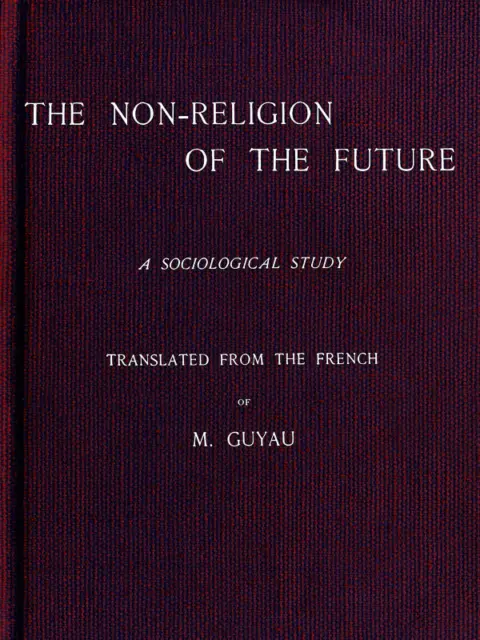
"The Non-religion of the Future: A Sociological Study" by Jean-Marie Guyau is a sociological study written in the late 19th century. The work examines the evolution of religious belief and the rise of a state of "non-religion" as a potential future for humanity, arguing against the permanence of dogmatic religions. Guyau explores the interplay between religion, aesthetics, and morals, suggesting that as society progresses, religious forms may dissolve, giving way to a more individualistic and rational approach to existence. The opening of the book introduces the central thesis that religion has originated and evolved through sociological rather than metaphysical processes. Guyau discusses various definitions of religion and emphasizes that the essence of all religious conceptions is the social bond between humanity and a cosmic society. He critiques both traditional and modern interpretations of religion, positing that all forms have evolved from primitive social understandings. The text sets the stage for a deeper exploration of how these religious roots may lead to a future where non-religious or rational frameworks fulfill humanity's social and moral needs, moving beyond mere dogma and myth.
Introduction adapted from the source catalogue; source summaries may be automatically generated.
Free to read · English · 214,102 words · No account needed
MAKE TIME FOR A GOOD BOOK
On by default. Untick to stop anonymous reading totals. Each page counts after 10 seconds in view. How this works.
Anonymous counting is on unless you have switched it off.
[Sidenote: Religion the creature of circumstance.]
Similarly with the other moral and social virtues which are alleged to be inseparable from religion. In all times humanity has found a certain average of vice, as of virtue, necessary. Religions themselves have always been obliged to give way before certain prevalent habits and passions. If we had been living at the time of the Reformation, we should have heard Catholic priests maintaining, with all the seriousness in the world, that, but for Catholic dogmas and the authority of the Pope, society would dissolve and perish. Happily experience has proved that these dogmas and that authority are not indispensable to social life; the conscience of mankind has attained its majority and no longer needs the services of a guardian. The day will come, no doubt, when Frenchmen will no more feel an inclination to enter into a house of stone and invoke God to the sound of a hymn than an Englishman or a German experiences to-day an inclination to kneel before a priest and confess to him.
III. Is Protestantism a necessary transition stage between religion
and free-thought?
[Sidenote: Dependence of Catholicism on power.]
Over and above free-thinkers, properly so called, there exists in every country a class of men who understand perfectly the defects in the religions in force about them, but have not the power of mind necessary to lift them above revealed dogma generally, and every form of external cult and rite. They begin accordingly to dabble in the religions of neighbouring peoples. A religion which is not in force in one’s immediate neighbourhood always possesses the advantage of being seen from a distance. At a distance its faults are scarcely distinguishable, and the imagination freely endows it with all excellent qualities. How many things and persons gain thus by aloofness! When one has seen one’s ideal, it is sometimes good not to approach it too near if one is to preserve one’s reverence for it. A number of Englishmen, indignant at the aridity of the hard and blind fanaticism of the extreme Protestants, cast envious glances across the Channel, where a religion seems to reign that is more friendly to art,—at once more æsthetic and more mystical, capable of affording a completer satisfaction to certain human needs. Among those who are thus favourable to a properly understood Catholicism may be cited Matthew Arnold and Cardinal Newman; and one might even add the Queen of England herself. In France, as might be expected, quite the opposite disposition obtains. Wearied of the Catholic Church and of its intolerance, we should gladly escape its dominion: compared with the objections against Catholicism which assail our eyes, the objections against Protestantism appear to us as trifling. And the same notion has occurred simultaneously to a number of distinguished Frenchmen: why should France remain Catholic, at least in name? Why should not France adopt the religion of the more robust people who have recently vanquished her; the religion of Germany, of England, of the United States, of all the young, strong, and active nations? Why not begin again the labour interrupted by the massacre of St. Bartholomew and the Edict of Nantes? Even if one should not succeed in converting the masses, it would suffice, according to the partisans of Protestantism, to propagate the new religion among the élite of the population very sensibly to modify the general course of our government, of our national spirit, even of our laws. The laws regulating the relations of Church and State would promptly be corrected; they would be reconstructed so as to offer protection to the development of the Protestant religion, as they at this moment do in a thousand ways to the outworn religion of Catholicism. Ultimately Protestantism would be declared to be the national religion of France; the religion, in other words, toward which she ought to endeavour to move, and which constitutes her real ideal, her sole hope of the future, the sole means open to Latin nations to escape death, and to outlive, in some sense, themselves. Add that, in the judgment of the authors of this hypothesis, the Protestant religion, once fairly entered in the lists against Catholicism, must inevitably and speedily win the day; the iron pot would make short work of the earthen pot. The partisans of Protestantism invoke history in support of their conclusions; Protestantism was vanquished among us by force, and not by persuasion; its defeat is therefore not definitive. Wherever Catholicism has not employed violence, persecution, and crime to maintain itself, it has always succumbed; its only tenable argument has been to put its opponents to death; to-day this comfortable method of backing the syllogism by the sword is out of date, and Catholicism is condemned the instant it is attacked. It contains, moreover, an essential and irremediable vice, auricular confession. By the confessional it excites the open or secret hostility of every husband and every father, who sees the priest interposing between him and his wife, between him and his children. The confessor is a supernumerary in every family; a member who has neither the same interests nor the same ideas, and who, nevertheless, is perfectly informed of everything the other members do, and can, in a thousand ways, oppose their projects, and, at the moment when they least expect it, bar their path. When one takes into consideration the mute state of war which so often exists between the married man and the Catholic priest; when one analyzes the other causes of dissolution which are working in Catholicism; when one considers, for example, that the dogma of infallibility is simply inacceptable to anyone whose conscience is not absolutely distorted, one must admit that the project of Protestantizing France, how strange soever it may seem at first glance, is worthy of serious attention.
Your reading position is saved on this browser. Take it to another device with a library code. Reading pages adapt to text, rather than matching a printed edition.
BEHIND THE BOOK
This eBook is for the use of anyone anywhere in the United States and most other parts of the world at no cost and with almost no restrictions whatsoever. You may copy it, give it away or re-use it under the terms of the Project Gutenberg License included with this eBook or online at www.gutenberg.org. If you are not located in the United States, you will have to check the laws of the country where you are located before using this eBook. Read the source licence.
The original source file, including credits and licence, is retained by this library. Request an original-format copy at no charge. Please include the book title and Project Gutenberg identifier #47421.
KEEP YOUR CURIOSITY GOING
David Patterson (Spirit) Hatch

David Patterson (Spirit) Hatch

David Patterson (Spirit) Hatch
Coulson Kernahan

Ralph Waldo Emerson
Frances Wright