
Last letters from the living dead man
David Patterson (Spirit) Hatch
THE CLASSIC COLLECTION · 1897
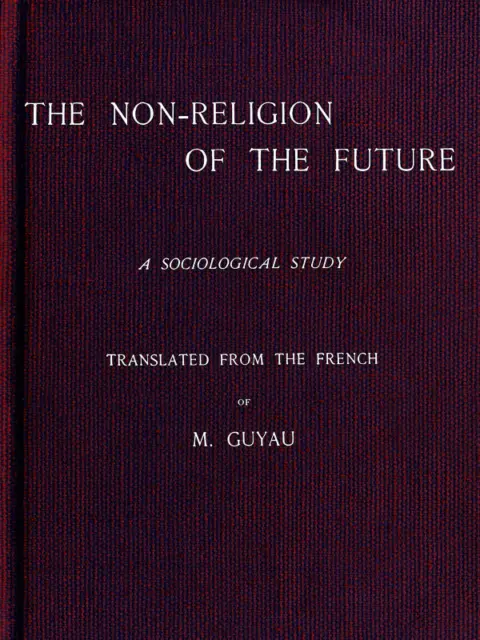
"The Non-religion of the Future: A Sociological Study" by Jean-Marie Guyau is a sociological study written in the late 19th century. The work examines the evolution of religious belief and the rise of a state of "non-religion" as a potential future for humanity, arguing against the permanence of dogmatic religions. Guyau explores the interplay between religion, aesthetics, and morals, suggesting that as society progresses, religious forms may dissolve, giving way to a more individualistic and rational approach to existence. The opening of the book introduces the central thesis that religion has originated and evolved through sociological rather than metaphysical processes. Guyau discusses various definitions of religion and emphasizes that the essence of all religious conceptions is the social bond between humanity and a cosmic society. He critiques both traditional and modern interpretations of religion, positing that all forms have evolved from primitive social understandings. The text sets the stage for a deeper exploration of how these religious roots may lead to a future where non-religious or rational frameworks fulfill humanity's social and moral needs, moving beyond mere dogma and myth.
Introduction adapted from the source catalogue; source summaries may be automatically generated.
Free to read · English · 214,102 words · No account needed
MAKE TIME FOR A GOOD BOOK
On by default. Untick to stop anonymous reading totals. Each page counts after 10 seconds in view. How this works.
Anonymous counting is on unless you have switched it off.
“Christianity,” Guizot said, “is a necessity for mankind; it is a school of reverence.” No doubt; but less so perhaps than Hindu religions, which go the length of proposing the absolute division of mankind into castes as an object for reverence; however contrary it may be to the natural sentiments of mankind and the operation of social laws. Assuredly no society can subsist if its members neither respect nor reverence what is respectable and venerable; respect is decidedly an indispensable element in national life; the fact is one which we too easily forget in France; but society is barred from progress if one respects what is not respectable, and progress is a condition of life for a society. Tell me what you respect, and I will tell you what you are. The progress of human reverence for objects ever higher and more high is symbolic of all other kinds of progress achieved by the human mind.
[Sidenote: Christianity quite the opposite of a defence against
communism.]
But for religion, say the Guizot school, the property-question would sweep away the masses of the people; it is the Church which holds them in check. If there is a property-question, let us not seek to ignore it; let us labour sincerely and actively at its solution. Qui trompe-t-on ici? Is God simply a means of saving the capitalist? More than that, the property-question is not one which is more intimately bound up to-day with religion than with free-thought. Christianity, which implicitly contains within it the principles of communism, is itself responsible for spreading ideas among the people which have inevitably germinated in the course of the great intellectual germination which distinguishes the present epoch. M. de Laveleye, one of the defenders of liberal Christianity, confesses as much. It was well known that among the first Christians all property was held in common, and that communism was the immediate consequence of baptism.[74] “We hold everything in common except our women,” Tertullian and St. Justin say; “we share everything.”[75] It is well known with what vehemence the Fathers of the Church have attacked the right of private property. “The earth,” says St. Ambrose, “was given to the rich and poor in common. Why, oh, ye rich! should ye arrogate to yourselves alone the ownership of it?” “Nature created rights in common, usurpation has created private rights.” “Wealth is always the product of robbery,” says St. Jerome. “The rich man is a robber,” says St. Basil. “Iniquity is the basis of private property,” says St. Clement. “The rich man is a brigand,” says St. Chrysostom. Bossuet himself cries, in a sermon on the distribution of the necessities of life: “The murmurs of the poor are just: why this inequality of condition?” And, in the sermon on the eminent dignity of the poor: “The politics of Jesus are directly opposed to those of this century.” And finally Pascal, summing up in an illustration all the socialistic ideas which compose the bulk of Christian doctrine: “‘That dog is mine,’ say these poor children; ‘that place there is my place in the sun.’ Behold the beginning and the type of the usurpation of the earth.” When “these poor children” are men, they do not always view the usurpation of the earth with resignation; from the Middle Ages down they have, from time to time, risen in revolt and there have been resulting massacres. Men like Pastoureaux and Jacques in France and Wat Tyler in England, the anabaptists and John of Leyden in Germany, are examples of what we mean. But, these great explosions of popular clamour once at an end, the Christian priest had always at his disposal, to subdue the crowd, a robust doctrine of compensation in heaven for one’s sufferings on earth; all the beatitudes are summed up in “Blessed are the poor, for they shall see God.” In our days, owing to the progress of the natural sciences, anything like certitude on the subject of compensation in heaven has disappeared; even the Christian, less sure of Paradise, aspires to see the justice and compensations of heaven realized in this world. The most durable element in Christianity is, therefore, less the check that it imposes upon the masses than the contempt for the established order with which it inspires them. Religion is nowadays obliged to call in social science to aid it in its struggle against socialism. The true principle of private property as of social authority cannot be religious; it lies essentially in the sentiment of the rights of other people and in an increasingly scientific acquaintance with the conditions of social and political life.
Your reading position is saved on this browser. Take it to another device with a library code. Reading pages adapt to text, rather than matching a printed edition.
BEHIND THE BOOK
This eBook is for the use of anyone anywhere in the United States and most other parts of the world at no cost and with almost no restrictions whatsoever. You may copy it, give it away or re-use it under the terms of the Project Gutenberg License included with this eBook or online at www.gutenberg.org. If you are not located in the United States, you will have to check the laws of the country where you are located before using this eBook. Read the source licence.
The original source file, including credits and licence, is retained by this library. Request an original-format copy at no charge. Please include the book title and Project Gutenberg identifier #47421.
KEEP YOUR CURIOSITY GOING
David Patterson (Spirit) Hatch

David Patterson (Spirit) Hatch

David Patterson (Spirit) Hatch
Coulson Kernahan

Ralph Waldo Emerson
Frances Wright