
Last letters from the living dead man
David Patterson (Spirit) Hatch
THE CLASSIC COLLECTION · 1897
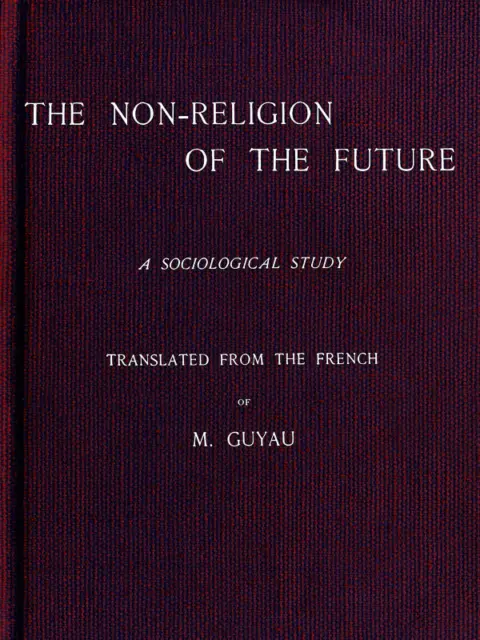
"The Non-religion of the Future: A Sociological Study" by Jean-Marie Guyau is a sociological study written in the late 19th century. The work examines the evolution of religious belief and the rise of a state of "non-religion" as a potential future for humanity, arguing against the permanence of dogmatic religions. Guyau explores the interplay between religion, aesthetics, and morals, suggesting that as society progresses, religious forms may dissolve, giving way to a more individualistic and rational approach to existence. The opening of the book introduces the central thesis that religion has originated and evolved through sociological rather than metaphysical processes. Guyau discusses various definitions of religion and emphasizes that the essence of all religious conceptions is the social bond between humanity and a cosmic society. He critiques both traditional and modern interpretations of religion, positing that all forms have evolved from primitive social understandings. The text sets the stage for a deeper exploration of how these religious roots may lead to a future where non-religious or rational frameworks fulfill humanity's social and moral needs, moving beyond mere dogma and myth.
Introduction adapted from the source catalogue; source summaries may be automatically generated.
Free to read · English · 214,102 words · No account needed
MAKE TIME FOR A GOOD BOOK
On by default. Untick to stop anonymous reading totals. Each page counts after 10 seconds in view. How this works.
Anonymous counting is on unless you have switched it off.
[Sidenote: Buddhism more deeply symbolic than Christianity.]
For the rest, if one persists in seeking in the sacred books of by-gone ages for the expression of primitive morality, it is not in the Bible, but rather in the Hindu books that a literary or philosophical interpretation will find the most extraordinary example of moral symbolism. The entire world appears to the Buddhist as the realization of the moral law, since in his opinion beings take rank in the universe according to their virtues or vices, mount or descend on the ladder of life according to their moral elevation or abasement. Buddhism is in certain respects an effort to find in morals a theory of the universe.
[Sidenote: Dependence of religion upon morality.]
In spite of the partial lapses from logical consistency that have been here pointed out in the theory of moral symbolism, there is one conclusion that is logically insisted on in the books just examined, and in especial Mr. Arnold’s book, namely: that the solidest support of every religion is a more or less imperfect system of morals; that the power of Christianity, as of Buddhism, has lain in its moral injunctions, and that if one suppressed this moral injunction there would nothing remain of the two great “universal” religions brought forth by human intelligence. Religion serves, so to speak, as an envelope for morality; it protects morality against the period of its ultimate development and efflorescence, but when once moral beliefs have gained strength enough they tend to protrude from this envelope, like a flower bursting out of the bud. Some years ago what was at that time called Independent Morality was much discussed; the defenders of religion maintained that the fate of morality is intimately bound up with it—that if morality were separated from religion it must decline. They were perhaps right in pointing out the intimate connection between morality and religion, but they were mistaken in maintaining that it is the former that is dependent; it would be truer to say the precise opposite, that it is religion that depends upon morality, that the latter is the principal and the former the subordinate. The Ecclesiast says somewhere, “He hath set the world in their heart.” It is for that reason that man should first look into his own heart, and should first of all believe in himself. Religious faith might more or less logically issue out of moral faith, but could not produce the moral faith, and if it should go counter to the moral faith it would condemn itself. The religious spirit cannot therefore accommodate itself to the new order of things except by abandoning, in the first place, all the dogmas of a liberal faith, and then all the symbols of a more enlightened faith and holding fast by the fundamental principle which constitutes the life of religion and dominates its historical evolution; that is to say, the moral sentiment of Protestantism in spite of all its contradictions has really introduced into the world a new principle; it is this, that conscience is its own judge, that individual initiative should be substituted for objective authority.[61] Such a principle includes as a logical consequence not only the suppression of real dogmas and of mysteries, but also that of precise and determinate symbols; of everything, in a word, which proposes to impose itself upon the conscience as a ready-made truth. Protestantism unwittingly contained in its own bosom the germ of the negation of every positive religion that does not address itself exclusively and directly to private judgment, to the moral sense of the individual. In our days no one is willing to believe simply what he is told to believe; he must accept it independently: he believes that the danger of private judgment is only apparent, and that in the intellectual world, as in the world of civil liberty, it is out of liberty that all authority worthy of respect takes its rise. The revolution which tends thus to replace a religious faith, founded on the authority of texts and symbols, by a moral faith founded upon the right of private judgment recalls the revolution accomplished three centuries ago by Descartes, who substituted evidence and reasoning for authority. Humanity is increasingly anxious to reason out its own beliefs, to see with its own eyes. The truth is no longer exclusively locked up in temples; it addresses itself to everybody, communicates with everybody, gives everybody the right to act. In the cult of scientific truth everyone, as in the early days of Christianity, is capable of officiating in his turn; there are no seats reserved in the sanctuary, there is no jealous God, or rather the temples of truth are those which each of us rears in his own heart—temples which are no more truly Christian than Hebrew or Buddhist. The absorption of religion into morality is one with the dissolution of all positive and determinate religion, of all traditional symbolism and of all dogmatism. Faith, said Heraclitus profoundly, is a sacred malady, ἱερὰ νόσος. For us moderns it is no longer a sacred malady, and it is one from which all of us wish to be delivered and cured.
Your reading position is saved on this browser. Take it to another device with a library code. Reading pages adapt to text, rather than matching a printed edition.
BEHIND THE BOOK
This eBook is for the use of anyone anywhere in the United States and most other parts of the world at no cost and with almost no restrictions whatsoever. You may copy it, give it away or re-use it under the terms of the Project Gutenberg License included with this eBook or online at www.gutenberg.org. If you are not located in the United States, you will have to check the laws of the country where you are located before using this eBook. Read the source licence.
The original source file, including credits and licence, is retained by this library. Request an original-format copy at no charge. Please include the book title and Project Gutenberg identifier #47421.
KEEP YOUR CURIOSITY GOING
David Patterson (Spirit) Hatch

David Patterson (Spirit) Hatch

David Patterson (Spirit) Hatch
Coulson Kernahan

Ralph Waldo Emerson
Frances Wright