
Last letters from the living dead man
David Patterson (Spirit) Hatch
THE CLASSIC COLLECTION · 1897
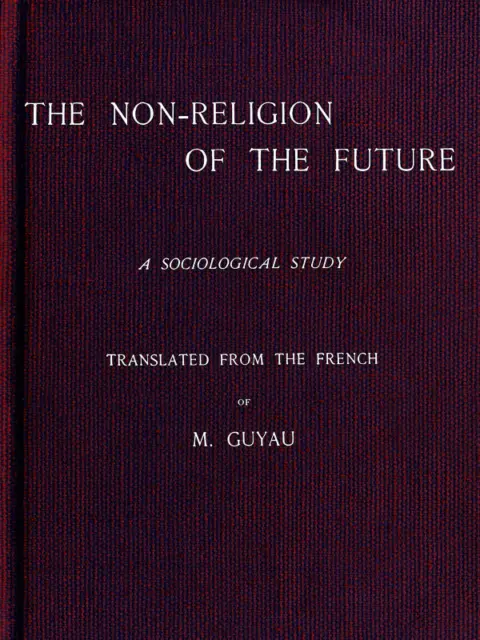
"The Non-religion of the Future: A Sociological Study" by Jean-Marie Guyau is a sociological study written in the late 19th century. The work examines the evolution of religious belief and the rise of a state of "non-religion" as a potential future for humanity, arguing against the permanence of dogmatic religions. Guyau explores the interplay between religion, aesthetics, and morals, suggesting that as society progresses, religious forms may dissolve, giving way to a more individualistic and rational approach to existence. The opening of the book introduces the central thesis that religion has originated and evolved through sociological rather than metaphysical processes. Guyau discusses various definitions of religion and emphasizes that the essence of all religious conceptions is the social bond between humanity and a cosmic society. He critiques both traditional and modern interpretations of religion, positing that all forms have evolved from primitive social understandings. The text sets the stage for a deeper exploration of how these religious roots may lead to a future where non-religious or rational frameworks fulfill humanity's social and moral needs, moving beyond mere dogma and myth.
Introduction adapted from the source catalogue; source summaries may be automatically generated.
Free to read · English · 214,102 words · No account needed
MAKE TIME FOR A GOOD BOOK
On by default. Untick to stop anonymous reading totals. Each page counts after 10 seconds in view. How this works.
Anonymous counting is on unless you have switched it off.
[Sidenote: Inference from reality of the sign to reality of the thing signified the essence of faith in revelation.]
In effect, blind confidence in a word, in a sign—precipitate induction from which one infers from the reality of the sign to the reality of the thing signified: a second induction to the effect that any doctrine relatively elevated, from the social and moral point of view, and put forth by men one respects, is probably true, even if it be in many points irrational—these are the principal elements of the primitive faith in revelation. And this faith, in all its crudity, exists at the present day. It wins its way through the eyes and ears; therein lies its power. It is much less mystical than we are inclined to fancy; it is incarnate in its monuments, its temples, its books; it walks about and breathes in the person of its priests, its saints, its gods; we cannot look about us without realizing its existence in one form or another. It has been of great service to human thought, in spite of its pitfalls, thus to have been able to express itself, to fashion objects in its own image, to penetrate marble and stone, to provide that it shall itself be borne back in upon us from without. How can one doubt what is visible and tangible?
[Sidenote: Results in “credo quia ineptum.”]
Faith in testimony and authority leads to faith in sacred texts and in the very letter of these texts. This is what one means by literal faith. It exists still in our day, among many civilized people. It constitutes the basis of the Catholicism of the masses. “In order to silence restless spirits,” said the council of Trent, “it is decreed that no one may, in the interpretation of the Scriptures, ... deviate from the construction sanctioned by the Church, to seek for a supposedly more exact rendering.” Faith lies thus in a renunciation of thought, an abdication of liberty; imposes upon itself a rule not of logic but of morals, and subjects itself to dogmas as to immutable principles. It restricts intelligence beforehand to precise limits, and imposes a general direction on it, with instructions not to swerve from it. It is at this point that faith comes really to be opposed to scientific belief for which in the beginning it was a substitute. According to the council of the Vatican, those who have faith do not believe “because of the intrinsic truth of the things revealed,” but “because of the divine authority that revealed them.” If you reason with a person of that stamp, he will listen, understand, and follow you—but only to a certain point; there he stops, and nothing in the world can make him go beyond. Or rather from that point he will declare himself inexpugnable, and will assure you that you have absolutely no hold on him; and in effect, no scientific or philosophical reason could turn him from his belief, since he places the object of his faith in a sphere superior to reason, and makes his faith an affair of “conscience.” Nothing can force a man to think rightly when he does not propose rectitude of thought to himself as a supreme aim, and nothing can oblige him to follow the dictates of reason to the bitter end, if he believes that the instant he calls certain dogmas and certain authorities in question he is committing a sin. Thus, faith gives a certain sacred and inviolable character to what it sanctions,—converts it into a sacred ark that one may not touch without sacrilege or danger, neither may one look at it too closely nor touch it with one’s fingers, even to lend it support now and then when it seems ready to fall. Free-thought and science never consider a thing as true except provisionally, and so long as it is not seriously doubted by someone. Dogmatic faith, on the contrary, affirms as true not only the things that are uncontested, but those which, according to it, are conclusively presumed, and therefore above discussion. It follows that, if reasons for belief diminish, faith must be none the less strong. It was this that Pascal endeavoured to demonstrate. In effect, the less a belief seems rational to our finite minds, the more merit there is in lending credence to “divine authority.” It would be too simple to believe no more than what one sees or what sounds probable to one; to affirm the improbable, to believe in what seems incredible, is much more meritorious. Our courage rises in proportion as our intelligence becomes humble; the more absurd one is the greater one is—credo quia ineptum; the more difficult the task, the greater the merit. The strength of our faith is estimated, in the mysticism of Pascal, by the weakness of its “reasons.” The ideal, on this theory, would be to possess no more than the metaphysical minimum of reason for belief, the weakest conceivable of motives, a mere nothing; that is to say, one should be attached to the supreme object of one’s faith by the slenderest of bonds. The Albigensian priests, the parfaits, wear a simple white cord around their waists as an emblem of their vow; all mankind wears this cord, and it is in reality more solid and often heavier than any chain.
Your reading position is saved on this browser. Take it to another device with a library code. Reading pages adapt to text, rather than matching a printed edition.
BEHIND THE BOOK
This eBook is for the use of anyone anywhere in the United States and most other parts of the world at no cost and with almost no restrictions whatsoever. You may copy it, give it away or re-use it under the terms of the Project Gutenberg License included with this eBook or online at www.gutenberg.org. If you are not located in the United States, you will have to check the laws of the country where you are located before using this eBook. Read the source licence.
The original source file, including credits and licence, is retained by this library. Request an original-format copy at no charge. Please include the book title and Project Gutenberg identifier #47421.
KEEP YOUR CURIOSITY GOING
David Patterson (Spirit) Hatch

David Patterson (Spirit) Hatch

David Patterson (Spirit) Hatch
Coulson Kernahan

Ralph Waldo Emerson
Frances Wright