
Under Sail
Felix Riesenberg
THE CLASSIC COLLECTION · 1918
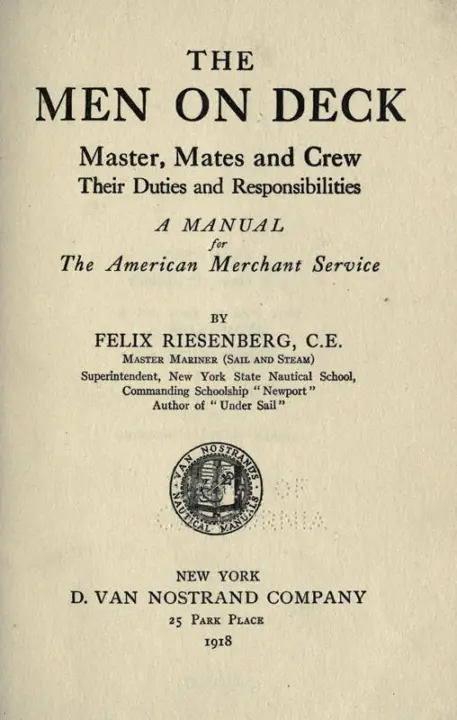
"The Men on Deck: Master, Mates and Crew, Their Duties and Responsibilities" by Felix Riesenberg is a manual for the American Merchant Service, likely written in the early 20th century. This informative work aims to clarify the roles and responsibilities of the various members of a ship's deck department, transitioning from the age of sail to the era of steam and steel. The book outlines the expectations and duties of seafarers, particularly focusing on the captain and his crew, thereby addressing the complexities of modern maritime operations. The opening of the book provides a comprehensive overview of the significant transitions within maritime practices, emphasizing the shift from traditional sailing vessels to steam-powered ships. It discusses the intricacies and responsibilities of the Master Mariner, who bears ultimate accountability for navigation, cargo safety, crew management, and adherence to maritime law. Riesenberg underscores the importance of proper training and knowledge within both the captain and crew, stressing that clarity in responsibilities is essential to maintaining order and discipline at sea in an increasingly complex environment. This introduction sets the stage for a detailed exploration of the maritime duties expected of various crew members, which continues throughout the manual.
Introduction adapted from the source catalogue; source summaries may be automatically generated.
Free to read · English · 104,758 words · No account needed
MAKE TIME FOR A GOOD BOOK
On by default. Untick to stop anonymous reading totals. Each page counts after 10 seconds in view. How this works.
Anonymous counting is on unless you have switched it off.
+Entering Dry Dock.+ When a vessel is about to enter a dry dock the heads of the various departments should be notified in time, and should be informed of the probable length of stay in the dock.
Also notify U. S. Local Inspectors that vessel will go in dock and
bottom can be examined.
All refuse should be put ashore, and provision made for taking care of any that may accumulate while on the dock.
See that necessary lines, fenders, ladders, etc., are handy.
Prepare to do the work that is necessary on board ship, and best done while the vessel is dry, viz.,
Paint scuppers; hose reels.
Range cables on floor of dock, overhaul same.
Clean and paint or bitumastic the chain lockers.
Have windlass overhauled.
Paint funnels; cargo booms, king posts, etc.
Paint and overhaul boats.
As the crew of a merchantman is not any too large, only work that can be thoroughly done while in dock should be attempted.
+Blue Prints.+ The blue prints of the docking plan should be delivered to the dock master. All assistance should be rendered to the dock master, and his instructions carefully complied with.
If entering a graving dock, men will be needed to handle the wale shores.
If entering a floating dock the vessel will rest squarely upon her
bottom.
Straight stemmed vessels can best be placed on an absolutely level keel by swinging a hand lead over the stem; the Chief Mate should see to this.
All closets, drains, and drip pipes should be shut off.
When the dock is dry the Chief Mate should make a careful inspection of the bottom. If it is intended to drain the tanks; double bottoms, peaks, etc., the carpenter should remove the necessary plugs. As soon as the draining is completed these should be replaced and the Chief Mate should see that they have been replaced properly by personal inspection. He should see that the plugs are not wooden plugs—this has been done.
While the vessel is in dry dock, aside from any extraordinary repairs that may be made, the following matters should be looked after:
Bottom cleaned and examined.
Note fouling and state of previous coatings, and when last applied.
Note corrosion and damage.
Outboard valves should be examined and reground when necessary.
Rudder pintles and gudgeons should be carefully examined. Rudder lifted, and repairs made if necessary.
Stuffing boxes and valves of the rudder should be repacked.
Look for corrosion along the butts of shell plating. Look for corroded rivets; such rivets should be removed and new ones driven.
Look after all zincs at the stern frames, valve openings, and at the
propellers.
Examine struts, propeller shafting, brackets, etc.
Your reading position is saved on this browser. Take it to another device with a library code. Reading pages adapt to text, rather than matching a printed edition.
Felix Riesenberg
BEHIND THE BOOK
This eBook is for the use of anyone anywhere in the United States and most other parts of the world at no cost and with almost no restrictions whatsoever. You may copy it, give it away or re-use it under the terms of the Project Gutenberg License included with this eBook or online at www.gutenberg.org. If you are not located in the United States, you will have to check the laws of the country where you are located before using this eBook. Read the source licence.
The original source file, including credits and licence, is retained by this library. Request an original-format copy at no charge. Please include the book title and Project Gutenberg identifier #57820.
KEEP YOUR CURIOSITY GOING
Cécile Tormay

Moritz Busch
John L. Ransom
Frances Wright
Cécile Tormay

Mabel Potter Daggett