
Under Sail
Felix Riesenberg
THE CLASSIC COLLECTION · 1918
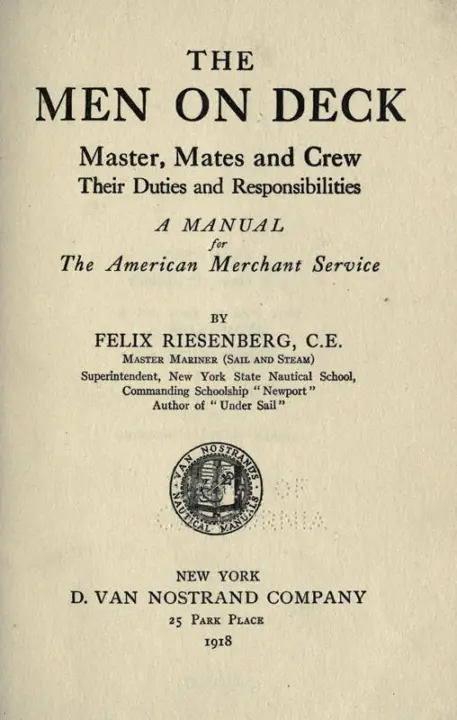
"The Men on Deck: Master, Mates and Crew, Their Duties and Responsibilities" by Felix Riesenberg is a manual for the American Merchant Service, likely written in the early 20th century. This informative work aims to clarify the roles and responsibilities of the various members of a ship's deck department, transitioning from the age of sail to the era of steam and steel. The book outlines the expectations and duties of seafarers, particularly focusing on the captain and his crew, thereby addressing the complexities of modern maritime operations. The opening of the book provides a comprehensive overview of the significant transitions within maritime practices, emphasizing the shift from traditional sailing vessels to steam-powered ships. It discusses the intricacies and responsibilities of the Master Mariner, who bears ultimate accountability for navigation, cargo safety, crew management, and adherence to maritime law. Riesenberg underscores the importance of proper training and knowledge within both the captain and crew, stressing that clarity in responsibilities is essential to maintaining order and discipline at sea in an increasingly complex environment. This introduction sets the stage for a detailed exploration of the maritime duties expected of various crew members, which continues throughout the manual.
Introduction adapted from the source catalogue; source summaries may be automatically generated.
Free to read · English · 104,758 words · No account needed
MAKE TIME FOR A GOOD BOOK
On by default. Untick to stop anonymous reading totals. Each page counts after 10 seconds in view. How this works.
Anonymous counting is on unless you have switched it off.
Cover the ends of mooring lines, to keep out dirt and grit; stow superfluous lines below—but handy—this keeps them away from harm, +and the junk boats+.
Unscrew and stow away all brass fittings—when in ports where these things can be disposed of—in most ports where the vessel lies at an unwatched wharf.
All persons leaving the vessel with packages, and suit cases—unless officers or officials—should show contents to the gangway watch.
No one should be allowed on the bridge or bridge deck, unless there on
business.
+Fire Hoses, Axes, Buckets, Extinguishers, etc.+ The Chief Mate is charged with the care and working order of the fire-fighting equipment of the vessel.
Fire drills must be held as required by law.
+Life-saving Equipment.+ The Chief Mate must pay special attention to the condition and readiness of the life boats, and their equipment:
Life boats.
Life rafts.
Life belts.
Ring buoys.
Water lights.
Storm-oil tanks.
He should see that the bread tins, after each inspection, are tightly screwed down, or the contents may spoil, or be unfit at the next inspection by the U. S. Steamboat Inspectors.
The list of required boat equipment is a long one and should be
carefully complied with.
The rockets and line-throwing gun should be kept in good order, lines and projectiles handy; charges measured out and sewed in proper bags and kept in a copper canister.
The boat-launching equipment must be kept in perfect working condition, davits, strongbacks, gripes and falls. The required tubs must be provided and the boat falls coiled in them, clear for running.
The Chief Mate must organize and carry out the required drills.
After all drills—see everything secured—hoses dried out, extinguishers recharged—if used, axes, life belts, ring buoys, life preservers, etc. stowed.
+Ground Tackle.+ The Chief Mate is charged with the good order and
upkeep of the ground tackle.
He should look after:
Anchors.
Chain.
Riding chocks.
Shackles.
Pins.
Forelocks.
Markings (by turns of wire on studs), paint shackles white, as an aid in noting run of chain at night.
Chain compressors.
Stoppers.
Chain should be ranged when in dry dock, if time permits, and locker cleaned out and painted. See that ends of the chains are lashed at the top of the chain locker.
The kedges and stream anchors should be where they can be got at. See that the necessary gear for getting them out is ready and stowed handy for use.
The windlass is in charge of the engineers. The Chief Mate should understand its working, and the Carpenter should also understand it in every detail.
Your reading position is saved on this browser. Take it to another device with a library code. Reading pages adapt to text, rather than matching a printed edition.
Felix Riesenberg
BEHIND THE BOOK
This eBook is for the use of anyone anywhere in the United States and most other parts of the world at no cost and with almost no restrictions whatsoever. You may copy it, give it away or re-use it under the terms of the Project Gutenberg License included with this eBook or online at www.gutenberg.org. If you are not located in the United States, you will have to check the laws of the country where you are located before using this eBook. Read the source licence.
The original source file, including credits and licence, is retained by this library. Request an original-format copy at no charge. Please include the book title and Project Gutenberg identifier #57820.
KEEP YOUR CURIOSITY GOING
Cécile Tormay

Moritz Busch
John L. Ransom
Frances Wright
Cécile Tormay

Mabel Potter Daggett