
Under Sail
Felix Riesenberg
THE CLASSIC COLLECTION · 1918
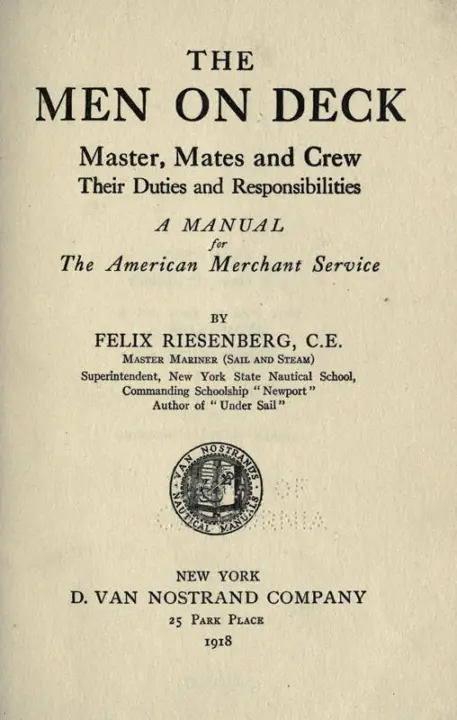
"The Men on Deck: Master, Mates and Crew, Their Duties and Responsibilities" by Felix Riesenberg is a manual for the American Merchant Service, likely written in the early 20th century. This informative work aims to clarify the roles and responsibilities of the various members of a ship's deck department, transitioning from the age of sail to the era of steam and steel. The book outlines the expectations and duties of seafarers, particularly focusing on the captain and his crew, thereby addressing the complexities of modern maritime operations. The opening of the book provides a comprehensive overview of the significant transitions within maritime practices, emphasizing the shift from traditional sailing vessels to steam-powered ships. It discusses the intricacies and responsibilities of the Master Mariner, who bears ultimate accountability for navigation, cargo safety, crew management, and adherence to maritime law. Riesenberg underscores the importance of proper training and knowledge within both the captain and crew, stressing that clarity in responsibilities is essential to maintaining order and discipline at sea in an increasingly complex environment. This introduction sets the stage for a detailed exploration of the maritime duties expected of various crew members, which continues throughout the manual.
Introduction adapted from the source catalogue; source summaries may be automatically generated.
Free to read · English · 104,758 words · No account needed
MAKE TIME FOR A GOOD BOOK
On by default. Untick to stop anonymous reading totals. Each page counts after 10 seconds in view. How this works.
Anonymous counting is on unless you have switched it off.
+General Cargo.+ Every general cargo is a rule unto itself. The Chief Mate who knows his business will see to the proper stowage. This is the cargo that demands care as to hold diagrams. The following points are recommended for consideration:
Keep perishable goods clear of the steel framing.
Cargo liable to leakage should be stowed low.
Cargo liable to damage from heat should be kept clear of engine-room bulkheads, steam lines, and not stowed close under upper deck when in hot weather trades.
Casks, bung up and bilge free. Stow from amidships to wings and ends of hold. Use four beds for each cask.
Casks, second tier—stow bilge and cutline.
Barrels, hogsheads, etc. (63 gals.) eight heights.
Puncheons (84 gals.) four heights.
Pipes, butts, (126 gals.) three tiers.
Always stow barrels, wet or dry, with head pieces vertical.
Stow with marks up and out.
Acids, on deck.
Oilskins, on deck.
Matches, on deck.
Hay, on deck.
Heavy, well-boxed cargo, low.
Light crates, on top.
Railroad iron, grating fashion.
Dunnage, if needed, 10 inches on floors, 15 inches in bilges.
Cargo ports, if fitted, blocked off with dunnage.
Care should be taken to stow liquors, canned goods, and things easily broken open, in parts of the hold and 'tween decks where they can be easily blocked off by less tempting cargo.
+Special Cargoes.+ Cargoes of chemicals, fruit, guano, jute, and the like, will require special care and consideration. The deck officers of a merchant vessel will do well if they keep and compare notes on matters such as these. A vast amount of information having to do with the important function of moving the products of the world is going begging for the want of suitable recording. Such knowledge carries with it the possibility for great saving. Merchant mariners, owners, and naval designers take notice. The cargo note book is an important part of the baggage of an officer.
+Munitions.+ Cargoes under the general heading of munitions call for the most careful handling. It is well for the Chief Mate to know just what is being stowed, and where. This knowledge should be of use in exercising increased care in the management and handling of the vessel. The Halifax disaster is a case in point.
+Cost Data.+ The Chief Mate who is on his job should keep cost data on stevedoring, and in fact on most operations performed on board ship. He should know how many men can work a hatch effectively, and what their pay is, and how much cargo they can stow, say in tons (2,000 lbs.) per working day:
Cost data resolves itself into this.
Amount of work done—any unit; tons of cargo—sq. ft. of paint.
Your reading position is saved on this browser. Take it to another device with a library code. Reading pages adapt to text, rather than matching a printed edition.
Felix Riesenberg
BEHIND THE BOOK
This eBook is for the use of anyone anywhere in the United States and most other parts of the world at no cost and with almost no restrictions whatsoever. You may copy it, give it away or re-use it under the terms of the Project Gutenberg License included with this eBook or online at www.gutenberg.org. If you are not located in the United States, you will have to check the laws of the country where you are located before using this eBook. Read the source licence.
The original source file, including credits and licence, is retained by this library. Request an original-format copy at no charge. Please include the book title and Project Gutenberg identifier #57820.
KEEP YOUR CURIOSITY GOING
Cécile Tormay

Moritz Busch
John L. Ransom
Frances Wright
Cécile Tormay

Mabel Potter Daggett