
Under Sail
Felix Riesenberg
THE CLASSIC COLLECTION · 1918
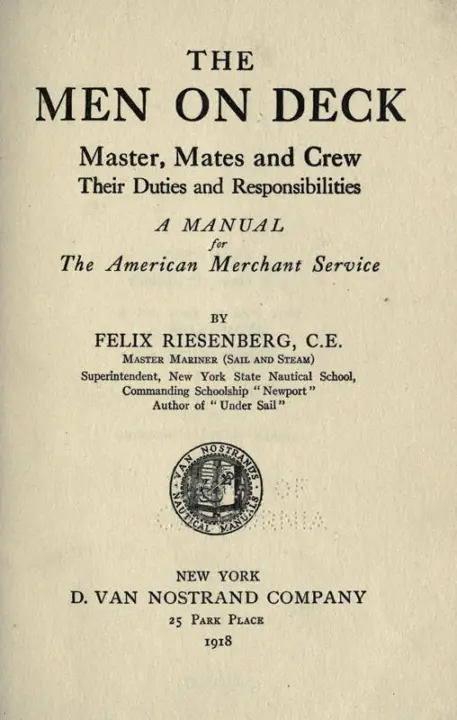
"The Men on Deck: Master, Mates and Crew, Their Duties and Responsibilities" by Felix Riesenberg is a manual for the American Merchant Service, likely written in the early 20th century. This informative work aims to clarify the roles and responsibilities of the various members of a ship's deck department, transitioning from the age of sail to the era of steam and steel. The book outlines the expectations and duties of seafarers, particularly focusing on the captain and his crew, thereby addressing the complexities of modern maritime operations. The opening of the book provides a comprehensive overview of the significant transitions within maritime practices, emphasizing the shift from traditional sailing vessels to steam-powered ships. It discusses the intricacies and responsibilities of the Master Mariner, who bears ultimate accountability for navigation, cargo safety, crew management, and adherence to maritime law. Riesenberg underscores the importance of proper training and knowledge within both the captain and crew, stressing that clarity in responsibilities is essential to maintaining order and discipline at sea in an increasingly complex environment. This introduction sets the stage for a detailed exploration of the maritime duties expected of various crew members, which continues throughout the manual.
Introduction adapted from the source catalogue; source summaries may be automatically generated.
Free to read · English · 104,758 words · No account needed
MAKE TIME FOR A GOOD BOOK
On by default. Untick to stop anonymous reading totals. Each page counts after 10 seconds in view. How this works.
Anonymous counting is on unless you have switched it off.
Look out for white water, squalls, get awnings in before they are blown away—never leaving the bridge, of course, unless the Master relieves.
+Ice.+ If in the dangerous latitudes look out for ice. Note sudden changes in the temperature of air and sea. The sea water should be taken every hour at least. Ice gives no warning—sense it, and slow down before it is too late. Remember the Titanic.
Watch the barometer changes—the clouds—the wind, and its changes, whether veering, or hauling.
+Important.+ Know the sailing ship routes—study the pilot charts—and always remember the possible speed and condition of sail, whether on the wind, or free, of sailing vessels that are liable to be met with in your vicinity.
+Night Orders.+ The night order book contains two sets of orders:
+A. Before taking charge make yourself thoroughly familiar with the position of the ship with reference to vessels in sight, any land or shoals or rocks that may be near; with the general condition of the weather, speed, revolutions, sail, if any is set, awnings, boats swung out, running lights, and the orders of the Captain for the night.+
+B. Make no change in the course—unless instructed to do so by the night orders, without obtaining the permission of the Captain—unless it is necessary to avoid immediate danger. Then report promptly to the Captain—by messenger or telephone.+
+C. Make no change in the speed, unless as directed by the night orders, or to avoid collision.+
+D. Report promptly to the Captain all lights upon the shore; discolored water; unusual weather conditions; and report all vessels sighted and their nature, when this can be determined. (At night, it is not usual to report every steamer passed.)+
+E. When in doubt about anything affecting the safety of the vessel,
call the Captain at once.+
+F. In the event of fire, or any kind of disturbance or accident, call the Captain at once, and report same.+
+G. Man overboard; act at once, stop, reverse, release water lights and ring buoys, call away quarter boat, and call Captain.+
+H. Keep lookouts posted after dark, or in fog. Comply with all the regulations for preventing collisions at sea. Call Captain if it gets thick; start fog signals at once.+
+I. Report all unusual changes in sea or weather to the Captain. If engines stop, or slow down without orders from the bridge, call Captain at once.+
+J. Take bearings on the course whenever suitable stars are available. Call Captain at any unusual change in deviation, or error.+
Your reading position is saved on this browser. Take it to another device with a library code. Reading pages adapt to text, rather than matching a printed edition.
Felix Riesenberg
BEHIND THE BOOK
This eBook is for the use of anyone anywhere in the United States and most other parts of the world at no cost and with almost no restrictions whatsoever. You may copy it, give it away or re-use it under the terms of the Project Gutenberg License included with this eBook or online at www.gutenberg.org. If you are not located in the United States, you will have to check the laws of the country where you are located before using this eBook. Read the source licence.
The original source file, including credits and licence, is retained by this library. Request an original-format copy at no charge. Please include the book title and Project Gutenberg identifier #57820.
KEEP YOUR CURIOSITY GOING
Cécile Tormay

Moritz Busch
John L. Ransom
Frances Wright
Cécile Tormay

Mabel Potter Daggett