Stolen Idols
E. Phillips (Edward Phillips) Oppenheim
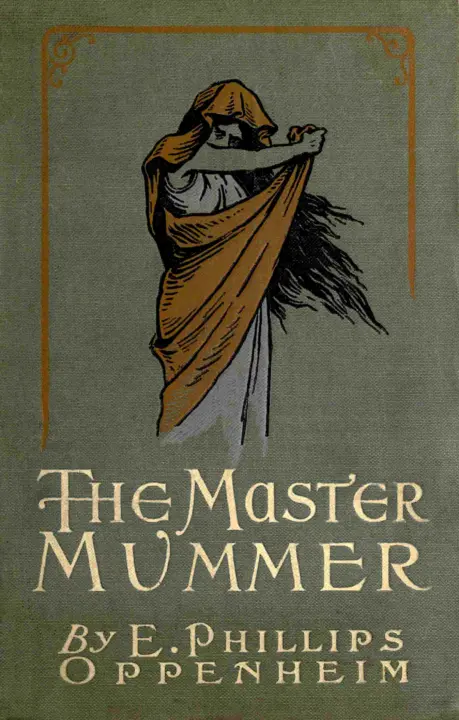
THE CLASSIC COLLECTION · 1904
"The Master Mummer" by E. Phillips Oppenheim is a novel written in the early 20th century. The story revolves around Arnold Greatson, a struggling writer who yearns for a more profound creative experience beyond the superficial lighthearted tales he has been penning. His desire for authenticity drives him to seek out real stories, eventually leading him to a fateful encounter at a train station and a subsequent dramatic incident involving a terrified young girl named Isobel de Sorrens and the mysterious man who claims to be her guardian. The opening portion of the novel introduces us to Arnold in his creative struggles, balancing light-hearted fiction with a deeper yearning for authenticity in his writing. His conversations with his friend Mabane reveal his frustration with the industry and his aspirations to depict genuine human experiences. After some insightful exchanges about the nature of art and inspiration, Arnold takes a decisive step to explore life more fully by venturing into the bustling world outside, where he soon encounters Isobel and witnesses a tragic and profound series of events that will alter his life fundamentally. The narrative weaves elements of mystery and drama, setting the stage for Arnold's transformation from a passive observer into an active participant in the lives of those around him.
Introduction adapted from the source catalogue; source summaries may be automatically generated.
Free to read · English · 75,621 words · No account needed
MAKE TIME FOR A GOOD BOOK
On by default. Untick to stop anonymous reading totals. Each page counts after 10 seconds in view. How this works.
Anonymous counting is on unless you have switched it off.
"Tell me," I asked softly, "what you see beyond that blue line."
"I can tell you more easily," she said, glancing down with a faint smile at my empty pages, "what I see by my side--a very lazy man. And," she continued, crumpling a little ball of heather in her fingers and throwing it with unerring aim at Allan, "another one over there!"
"My picture," Allan protested, "is finished."
"Nonsense!" she exclaimed, preparing to rise, but he waved her back.
"In my mind," he added. "Don't misunderstand me. The casual and ignorant observer glancing just now at my canvas might come to the same conclusion as you--a conclusion, by-the-bye, entirely erroneous. I will admit that my canvas is unspoilt. Nevertheless, my picture is painted."
She looked across at him reproachfully.
"Allan, how dare you!" she exclaimed. "Only Arnold has the right to be subtle. I have always regarded you as a straightforward and honest person. Don't disappoint me."
"St. Andrew forbid it!" Allan declared. "My meaning is painfully simple. I build up my picture first in my mind. Its transmission to canvas is purely mechanical. Here goes!"
He took up his palette, and in a few moments was hard at work. Isobel pointed downwards to my writing-pad.
"Can you too match Allan's excuse?" she asked. "Is your story already
written?"
I shook my head.
"I have been watching you," I answered. "Besides, for a perfectly lazy person, are you not rather a hard task-mistress? Consider that this is our first day of summer--the first time we have seen the sun make diamonds on the sea, the first west wind which has come to us with the scent of cowslips and wild roses. I claim the right to be lazy if I want to be."
She smiled.
"The poet," she murmured, "finds these things inspiring."
"The poet," I answered, "is an ordinary creature. Nowadays he eats mutton-chops, plays golf, and has a banking account. The real man of feeling, Isobel, is the man who knows how to be idle. Believe me, there is a certain vulgarity in seeking to make a stock-in-trade of these delicious moments."
"That is not fair," she protested. "How should we all live if none of
you did any work?"
"For your age, Isobel," I declared seriously, "you are very nearly a practical person. You make me more than ever anxious for an answer to my last question. What were you thinking of just now?"
Her eyes seemed to drift away from mine. A touch of her new seriousness returned. She pointed to that thin blue line.
"Beyond there," she said, "is to-morrow, and all the to-morrows to come. One sees a very little way."
Your reading position is saved on this browser. Take it to another device with a library code. Reading pages adapt to text, rather than matching a printed edition.
E. Phillips (Edward Phillips) Oppenheim
E. Phillips (Edward Phillips) Oppenheim
E. Phillips (Edward Phillips) Oppenheim
E. Phillips (Edward Phillips) Oppenheim
BEHIND THE BOOK
This eBook is for the use of anyone anywhere in the United States and most other parts of the world at no cost and with almost no restrictions whatsoever. You may copy it, give it away or re-use it under the terms of the Project Gutenberg License included with this eBook or online at www.gutenberg.org. If you are not located in the United States, you will have to check the laws of the country where you are located before using this eBook. Read the source licence.
The original source file, including credits and licence, is retained by this library. Request an original-format copy at no charge. Please include the book title and Project Gutenberg identifier #28161.
KEEP YOUR CURIOSITY GOING
Coulson Kernahan

Maurice Baring
Frances Wright
Cécile Tormay

Frederic Jesup Stimson

W. H. P. (William Henry Pope) Jarvis