Stolen Idols
E. Phillips (Edward Phillips) Oppenheim
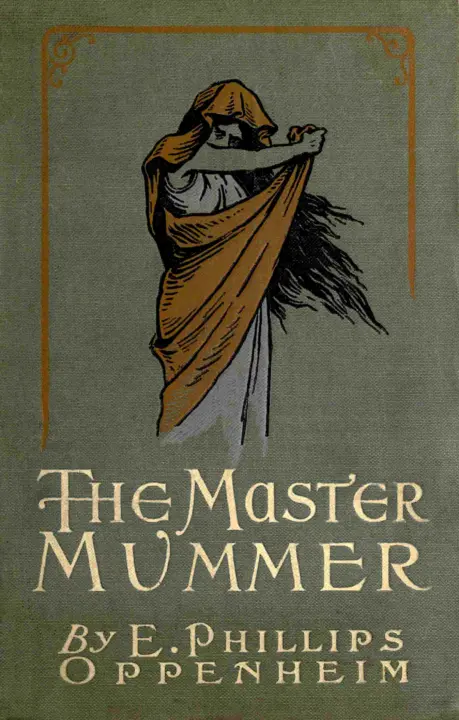
THE CLASSIC COLLECTION · 1904
"The Master Mummer" by E. Phillips Oppenheim is a novel written in the early 20th century. The story revolves around Arnold Greatson, a struggling writer who yearns for a more profound creative experience beyond the superficial lighthearted tales he has been penning. His desire for authenticity drives him to seek out real stories, eventually leading him to a fateful encounter at a train station and a subsequent dramatic incident involving a terrified young girl named Isobel de Sorrens and the mysterious man who claims to be her guardian. The opening portion of the novel introduces us to Arnold in his creative struggles, balancing light-hearted fiction with a deeper yearning for authenticity in his writing. His conversations with his friend Mabane reveal his frustration with the industry and his aspirations to depict genuine human experiences. After some insightful exchanges about the nature of art and inspiration, Arnold takes a decisive step to explore life more fully by venturing into the bustling world outside, where he soon encounters Isobel and witnesses a tragic and profound series of events that will alter his life fundamentally. The narrative weaves elements of mystery and drama, setting the stage for Arnold's transformation from a passive observer into an active participant in the lives of those around him.
Introduction adapted from the source catalogue; source summaries may be automatically generated.
Free to read · English · 75,621 words · No account needed
MAKE TIME FOR A GOOD BOOK
On by default. Untick to stop anonymous reading totals. Each page counts after 10 seconds in view. How this works.
Anonymous counting is on unless you have switched it off.
"A shade more to the right, please. There, just as you are now! Don't move! In five minutes I shall have finished for the day."
Isobel smiled.
"I think that your five minutes," she said, "last sometimes for a very long time. But I am not tired--no, not at all. I can stay like this if you wish until the light goes."
"You are splendid," Mabane murmured. "The best sitter--oh, hang it,
who's that?"
"There is certainly some one at the door," Isobel remarked.
Mabane paused in his work to shout fiercely, "Come in!" I too looked up from my writing. A woman was ushered into the room--a woman dressed in fashionable mourning, of medium height, and with a wealth of fair, fluffy hair, which seemed to mock the restraining black bands. Mrs. Burdett, visibly impressed, lingered in the background.
The woman paused and looked around. She looked at me, and the pen slipped from my nerveless fingers. I rose to my feet.
"Eil--Lady Delahaye!" I exclaimed.
She inclined her head. Her demeanour was cold, almost belligerent.
"I am glad to find you here, Arnold Greatson," she said. "You are a friend, I believe, of the man who murdered my husband?"
"You have been misinformed, Lady Delahaye," I answered quietly. "I was not even an acquaintance of his. We met that day for the first time."
By the faintest possible curl of the lips she expressed her contemptuous
disbelief.
"Ah!" she said. "I remember your story at the inquest. You will forgive me if, in company, I believe, with the majority who heard it, I find it a trifle improbable."
I looked at her gravely. This was the woman with whom I had once believed myself in love, the woman who had jilted me to marry a man of whom even his friends found it hard to speak well.
"Lady Delahaye," I said, "my story may have sounded strangely, but it was true. I presume that you did not come here solely with the purpose of expressing your amiable opinion of my veracity?"
"You are quite right," she admitted drily. "I did not."
She was silent for a few moments. Her eyes were fixed upon Isobel, and I did not like their expression.
"May I offer you a chair, Lady Delahaye?" I asked.
"Thank you, I prefer to stand--here," she answered. "This, I believe, is the young person who was with my husband?"
She extended a sombrely gloved forefinger towards Isobel, who met her
gaze unflinchingly.
"That is the young lady," I answered. "Have you anything to say to her?"
"My errand here is with her," Lady Delahaye declared. "What is it that
you call yourself, girl?"
Your reading position is saved on this browser. Take it to another device with a library code. Reading pages adapt to text, rather than matching a printed edition.
E. Phillips (Edward Phillips) Oppenheim
E. Phillips (Edward Phillips) Oppenheim
E. Phillips (Edward Phillips) Oppenheim
E. Phillips (Edward Phillips) Oppenheim
BEHIND THE BOOK
This eBook is for the use of anyone anywhere in the United States and most other parts of the world at no cost and with almost no restrictions whatsoever. You may copy it, give it away or re-use it under the terms of the Project Gutenberg License included with this eBook or online at www.gutenberg.org. If you are not located in the United States, you will have to check the laws of the country where you are located before using this eBook. Read the source licence.
The original source file, including credits and licence, is retained by this library. Request an original-format copy at no charge. Please include the book title and Project Gutenberg identifier #28161.
KEEP YOUR CURIOSITY GOING
Coulson Kernahan

Maurice Baring
Frances Wright
Cécile Tormay

Frederic Jesup Stimson

W. H. P. (William Henry Pope) Jarvis