
Last letters from the living dead man
David Patterson (Spirit) Hatch
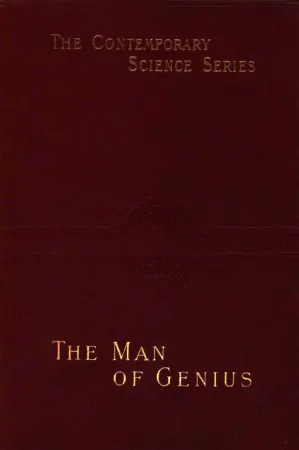
THE CLASSIC COLLECTION · 1891
"The Man of Genius" by Cesare Lombroso is a scientific publication written in the late 19th century. The book delves into the complex relationship between genius and madness, exploring the characteristics of individuals considered genius and how these traits intersect with patterns of mental illness. Lombroso examines historical figures and provides a foundational analysis of genius through a lens of physiological and psychological phenomena. The opening of the work sets the stage for an exploration of genius by referencing significant historical thoughts on the topic, from Aristotle to more contemporary thinkers. Lombroso reflects on his evolving views about genius relating to degradation and neurosis, suggesting that exceptional intellectual capabilities often stem from psychological anomalies. He lays out an argument that associates genius with various signs of degeneration, prompting readers to reconsider what defines genius and how societal perceptions may have historically conflated brilliance with madness. This thought-provoking introduction invites further examination of the intertwining nature of genius, mental health, and societal recognition.
Introduction adapted from the source catalogue; source summaries may be automatically generated.
Free to read · English · 130,716 words · No account needed
MAKE TIME FOR A GOOD BOOK
On by default. Untick to stop anonymous reading totals. Each page counts after 10 seconds in view. How this works.
Anonymous counting is on unless you have switched it off.
[350] “Toute une littérature est née de mon Insecte et de mon Oiseau.--L’Amour et la Femme restent et resteront, comme ayant deux bases, l’une scientifique, la nature même,--l’autre morale, le cœur des citoyens....
“J’ai défini l’histoire une résurrection.--C’est le titre le plus approprié à mon 4 volumes....
“En 1870, dans le silence universel, seul, je parlai. Mon livre fait en 40 jours fut la seule défense de la patrie....”
[351] He studies, as an important document, the journal of Louis XIV.’s digestion, and divides his reign into two periods--before and after the fistula. In the same way Francis I.’s reign is divided into the periods before and after the abscess. Conclusions of the following kind abound:--
“De toute l’ancienne monarchie, il ne reste à la France qu’un nom, Henri IV.; et deux chansons Gabrielle et Marlborough.”
[352] Pp. 119, 120, 121.
[353] Sbarbaro, e.g., in the midst of numberless absurdities, wrote: “The man who feels no hatred for the foul and unjust things which cumber our social life is the false phantom of a citizen, a eunuch in heart and mind” (Forche, 21).
“Parliamentary systems do not work well, since they do not allow of the best being at the top, and nonentities at the bottom” (Forche, 3). This, however, is borrowed from Machiavelli’s Decades.
“If you call me a malcontent,” he said to the Council of Public Instruction, “you do me honour: progress is due to rebels and malcontents. Christ Himself was a rebel and an agitator.”
[354] Revue politique et littéraire, 1888, No. 1.
[355] We have seen that a love of symbolism is one of the
characteristics of monomaniacs.
[356] M. Jules Tellier has not inaptly called him, in Victor Hugo’s style, “l’homme-frisson.”
[357] Responsibility in Mental Disease, p. 47.
[358] Knutzen, of Schleswig, in 1674, preached that there was neither God nor devil, that priests and magistrates were useless and pernicious, that marriage was unnecessary, that man ended with death, and that every one ought to be guided by his own inner consciousness of right. For this reason he gave to his disciples the name of the Conscientarii, garnishing his discourses with grotesque quotations. He went about begging and preaching in strange garments. It is not known what became of him after 1674. His writings are Epistola amici ad amicum, Schediasma de lacrimis Christi, &c.
[359] Responsibility, p. 53.
[360] Revue des Deux Mondes, 1880.
[361] Dubois, People of India, p. 360.
[362] 1 Samuel xxi. 14, 15.
[363] Ibid., xix. 9, 10, 23.
[364] Ibid., xix. 24.
[365] Berbrugger, Exploration Scientifique de l’Algérie, 1855.
[366] Western Barbary, p. 60.
[367] Travels, p. 133.
[368] Beck, Allegemeine Schilderung des Othom. Reiches., p. 177.
[369] Ibid., p. 529.
[370] Ida Pfeiffer, Voyage, vols. v., vi.
[371] Medhurst, State and Prospects, London, 1838, p. 75.
[372] Cook, Voyages, vol. ii. p. 19.
[373] Vol. iv. p. 49.
Your reading position is saved on this browser. Take it to another device with a library code. Reading pages adapt to text, rather than matching a printed edition.
BEHIND THE BOOK
This eBook is for the use of anyone anywhere in the United States and most other parts of the world at no cost and with almost no restrictions whatsoever. You may copy it, give it away or re-use it under the terms of the Project Gutenberg License included with this eBook or online at www.gutenberg.org. If you are not located in the United States, you will have to check the laws of the country where you are located before using this eBook. Read the source licence.
The original source file, including credits and licence, is retained by this library. Request an original-format copy at no charge. Please include the book title and Project Gutenberg identifier #50539.
KEEP YOUR CURIOSITY GOING
David Patterson (Spirit) Hatch
Coulson Kernahan

Ralph Waldo Emerson
Frances Wright

Edwin Abbott Abbott

Joseph Droz