
Last letters from the living dead man
David Patterson (Spirit) Hatch
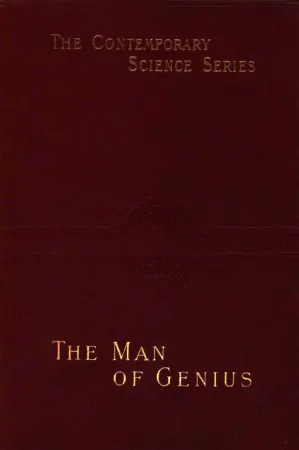
THE CLASSIC COLLECTION · 1891
"The Man of Genius" by Cesare Lombroso is a scientific publication written in the late 19th century. The book delves into the complex relationship between genius and madness, exploring the characteristics of individuals considered genius and how these traits intersect with patterns of mental illness. Lombroso examines historical figures and provides a foundational analysis of genius through a lens of physiological and psychological phenomena. The opening of the work sets the stage for an exploration of genius by referencing significant historical thoughts on the topic, from Aristotle to more contemporary thinkers. Lombroso reflects on his evolving views about genius relating to degradation and neurosis, suggesting that exceptional intellectual capabilities often stem from psychological anomalies. He lays out an argument that associates genius with various signs of degeneration, prompting readers to reconsider what defines genius and how societal perceptions may have historically conflated brilliance with madness. This thought-provoking introduction invites further examination of the intertwining nature of genius, mental health, and societal recognition.
Introduction adapted from the source catalogue; source summaries may be automatically generated.
Free to read · English · 130,716 words · No account needed
MAKE TIME FOR A GOOD BOOK
On by default. Untick to stop anonymous reading totals. Each page counts after 10 seconds in view. How this works.
Anonymous counting is on unless you have switched it off.
Croker, in his edition of Boswell, remarks that all the great English poets had no posterity. He names Shakespeare, Ben Jonson, Milton, Otway, Dryden, Rowe, Addison, Pope, Swift, Gay, Johnson, Goldsmith, Cowper. Hobbes, Camden, and many others, avoided marriage in order to have more time to devote to study. Michelangelo said, “I have more than enough of a wife in my art.” Among celibates may be mentioned also: Kant, Newton, Pitt, Fox, Fontenelle, Beethoven, Gassendi, Galileo, Descartes, Locke, Spinoza, Bayle, Leibnitz, Malebranche, Gray, Dalton, Hume, Gibbon, Macaulay, Lamb, Bentham, Leonardo da Vinci, Copernicus, Reynolds, Handel, Mendelssohn, Meyerbeer, Schopenhauer, Camoëns, Voltaire, Chateaubriand, Flaubert, Foscolo, Alfieri, Cavour, Pellico, Mazzini, Aleardi, Guerrazzi. And among women: Florence Nightingale, Catherine Stanley, Gaetana Agnesi (the mathematician), and Luigia Laura Bassi. A very large number of married men of genius have not been happy in marriage: Shakespeare, Dante, Marzolo, Byron, Coleridge, Addison, Landor, Carlyle, Ary Scheffer, Rovani, A. Comte, Haydn, Milton, Sterne, Dickens, &c. St. Paul boasted of his absolute continence; Cavendish altogether lacked the sexual instinct, and had a morbid antipathy to women. Flaubert wrote to George Sand: “The muse, however intractable, gives fewer sorrows than woman. I cannot reconcile one with the other. One must choose.”[39] Adam Smith said he reserved his gallantry for his books. Chamfort, the misanthrope, wrote: “If men followed the guidance of reason no one would marry; for my own part, I will have nothing to do with it, lest I should have a son like myself.” A French poet has said:
“Les grands esprits, d’ailleurs très-estimables, Ont très peu de talent pour former leurs semblables.”[40]
Unlikeness to Parents.--Nearly all men of genius have differed as much from their fathers as from their mothers (Foscolo, Michelangelo, Giotto, Haydn, &c.). That is one of the marks of degeneration. For this reason one notes physical resemblances between men of genius belonging to very different races and epochs; for example, Julius Cæsar, Napoleon, and Giovanni of the Black Bands; or Casti, Sterne, and Voltaire. They often differ from their national type. They differ by the possession of noble and almost superhuman characters (elevation of the forehead, notable development of the nose and of the head, great vivacity of the eyes); while the cretin, the criminal, and often the lunatic, differ by the possession of ignoble features: Humboldt, Virchow, Bismarck, Helmholtz, and Holtzendorf, do not show a German physiognomy. Byron was English neither in his face nor in his character; Manin did not show the Venetian type; Alfieri and d’Azeglio had neither the Piedmontese character nor face. Carducci’s face is not Italian. Nevertheless, one finds very notable and frequent exceptions. Michelangelo, Leonardo da Vinci, Raphael, and Cellini, presented the Italian type.
Your reading position is saved on this browser. Take it to another device with a library code. Reading pages adapt to text, rather than matching a printed edition.
BEHIND THE BOOK
This eBook is for the use of anyone anywhere in the United States and most other parts of the world at no cost and with almost no restrictions whatsoever. You may copy it, give it away or re-use it under the terms of the Project Gutenberg License included with this eBook or online at www.gutenberg.org. If you are not located in the United States, you will have to check the laws of the country where you are located before using this eBook. Read the source licence.
The original source file, including credits and licence, is retained by this library. Request an original-format copy at no charge. Please include the book title and Project Gutenberg identifier #50539.
KEEP YOUR CURIOSITY GOING
David Patterson (Spirit) Hatch
Coulson Kernahan

Ralph Waldo Emerson
Frances Wright

Edwin Abbott Abbott

Joseph Droz