
Last letters from the living dead man
David Patterson (Spirit) Hatch
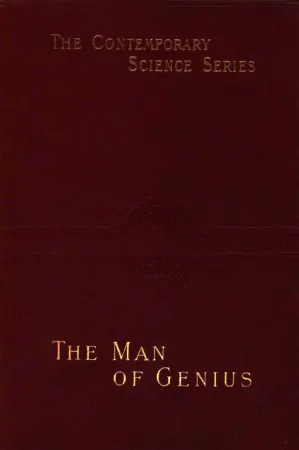
THE CLASSIC COLLECTION · 1891
"The Man of Genius" by Cesare Lombroso is a scientific publication written in the late 19th century. The book delves into the complex relationship between genius and madness, exploring the characteristics of individuals considered genius and how these traits intersect with patterns of mental illness. Lombroso examines historical figures and provides a foundational analysis of genius through a lens of physiological and psychological phenomena. The opening of the work sets the stage for an exploration of genius by referencing significant historical thoughts on the topic, from Aristotle to more contemporary thinkers. Lombroso reflects on his evolving views about genius relating to degradation and neurosis, suggesting that exceptional intellectual capabilities often stem from psychological anomalies. He lays out an argument that associates genius with various signs of degeneration, prompting readers to reconsider what defines genius and how societal perceptions may have historically conflated brilliance with madness. This thought-provoking introduction invites further examination of the intertwining nature of genius, mental health, and societal recognition.
Introduction adapted from the source catalogue; source summaries may be automatically generated.
Free to read · English · 130,716 words · No account needed
MAKE TIME FOR A GOOD BOOK
On by default. Untick to stop anonymous reading totals. Each page counts after 10 seconds in view. How this works.
Anonymous counting is on unless you have switched it off.
Lenau, in his “Moon of the Hypochondriàc,” sees, contrary to the usual practice of poets, in the cold moon, without water and without atmosphere, “the sexton of the planets, who, with a silver thread entwined, enchains the sleepers and draws them to death; she beckons with her finger, leads sleep-walkers astray, and counsels the thief.” Though, as a young man, he had frequently expressed his opinion that “mysticism is a symptom of insanity,” he often showed mystical tendencies, especially in his later poems.
In the Koran, there is not a single chapter which has any connection with another; on the contrary, it often happens that, in the course of a single sura, the ideas are interrupted, and follow each other almost at random. “On Mahomet,” writes Morkos, “the most contradictory verdicts may be pronounced, for it is impossible to deny his great excellence, while at the same time there is no disguising the fact that we find in him the most signal artifices of imposture, the grossest ignorance, and the greatest imprudence.”
It appears to me, moreover, that the great writers who have been under the dominion of alcohol, have a style peculiar to themselves, whose characteristics are a deliberate eroticism, and an inequality which is rather grotesque than beautiful, owing to too unrestrained fancy, frequent imprecations and abrupt transitions from the deepest melancholy to obscene gaiety, and a marked preference for such subjects as madness, drink, and the gloomiest scenes of death. “Poe,” says Baudelaire, “likes to place his figures against greenish or violet backgrounds, surrounded by the phosphorescence of decay, and the atmosphere of storms and orgies. He throws himself into grotesquery for the love of the grotesque, into horror for the love of the horrible.”
The same thing is done by Baudelaire himself, who loves to describe the effects of alcohol or opium.
“There are days when my heart faints in me, and the mud overwhelms me,”[448] sang poor Praga, who killed himself with alcohol, and who, singing the praises of wine, blasphemed thus:
“Let it come--the reproach of the sober man; come--the contempt of the human race,--come, the hell of the Eternal Father: I will go down into it with my glass in hand.”[449]
Steen, the drunken painter, usually painted drinking scenes. Hoffmann’s drawings ended in caricatures, his tales in extra-human extravagancies, his music in a senseless succession of sounds.
Alfred de Musset saw in the ladies of Madrid,
“sous un col de cigne
Un sein vierge et doré comme la jeune vigne.”
Murger admired women with green lips and yellow cheeks--no doubt through a species of colour-blindness, such as we have already met with among painters.
Your reading position is saved on this browser. Take it to another device with a library code. Reading pages adapt to text, rather than matching a printed edition.
BEHIND THE BOOK
This eBook is for the use of anyone anywhere in the United States and most other parts of the world at no cost and with almost no restrictions whatsoever. You may copy it, give it away or re-use it under the terms of the Project Gutenberg License included with this eBook or online at www.gutenberg.org. If you are not located in the United States, you will have to check the laws of the country where you are located before using this eBook. Read the source licence.
The original source file, including credits and licence, is retained by this library. Request an original-format copy at no charge. Please include the book title and Project Gutenberg identifier #50539.
KEEP YOUR CURIOSITY GOING
David Patterson (Spirit) Hatch
Coulson Kernahan

Ralph Waldo Emerson
Frances Wright

Edwin Abbott Abbott

Joseph Droz