
Last letters from the living dead man
David Patterson (Spirit) Hatch
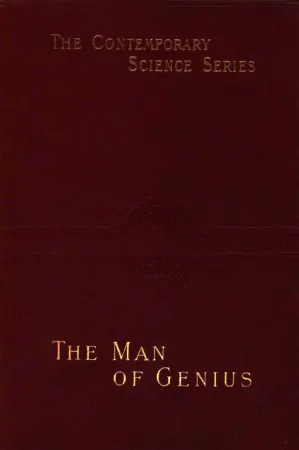
THE CLASSIC COLLECTION · 1891
"The Man of Genius" by Cesare Lombroso is a scientific publication written in the late 19th century. The book delves into the complex relationship between genius and madness, exploring the characteristics of individuals considered genius and how these traits intersect with patterns of mental illness. Lombroso examines historical figures and provides a foundational analysis of genius through a lens of physiological and psychological phenomena. The opening of the work sets the stage for an exploration of genius by referencing significant historical thoughts on the topic, from Aristotle to more contemporary thinkers. Lombroso reflects on his evolving views about genius relating to degradation and neurosis, suggesting that exceptional intellectual capabilities often stem from psychological anomalies. He lays out an argument that associates genius with various signs of degeneration, prompting readers to reconsider what defines genius and how societal perceptions may have historically conflated brilliance with madness. This thought-provoking introduction invites further examination of the intertwining nature of genius, mental health, and societal recognition.
Introduction adapted from the source catalogue; source summaries may be automatically generated.
Free to read · English · 130,716 words · No account needed
MAKE TIME FOR A GOOD BOOK
On by default. Untick to stop anonymous reading totals. Each page counts after 10 seconds in view. How this works.
Anonymous counting is on unless you have switched it off.
Here is a specimen--“The dream was so terrible, so wild, so frightful, that I wish I could tell myself it was nothing but a dream; ... yet I continue to weep, and to feel that my heart beats; I awaken, and find the sheets and the pillow wet.... Did I seize them in my dream and wipe my face? I do not know.... While I was sleeping, my hostile guests have been holding an orgy here.... Now they are gone, those savages, they are gone, but I find their traces in my tears. They have fled, and left the wine on the table,” &c.
He had previously, in the Albigenses, dropped some allusions to the terrible impression made on him by his dreams: “Terrible, often, is the might of dreams; it shakes, pains, presses, threatens, and if the sleeper does not awaken in time, in the twinkling of an eye, he is a corpse.”[447]
XII. The principal trace of the delusions of great minds is found in the very construction of their works and speeches, in their illogical deductions, absurd contradictions, and grotesque and inhuman fantasies. Thus Socrates was clearly of unsound mind when, after having all but arrived, intuitively, at Christian morality and Judaic monotheism, he directed his steps in accordance with a sneeze, or the voice and signs of his imaginary genius. Thus Cardan, who had anticipated Newton in discovering the laws of gravitation, and Dupuis in theology--who, in his book De Subtilitate, explains as hallucinations the strange and portentous symptoms of the possessed, and also of some of those hermits who were accounted saints, comparing them to the delirium of quartan fever--Cardan was insane, when he attributed to the influence of a genius, not only his scientific inspirations, but the creaking of the table and the vibration of the pen, when he declared that he had been several times bewitched, and when he produced his book On Dreams, which speaks to the mental pathologist as a pseudo-membrane would to the physical. In this, at first, he puts on record the most accurate and curious observations on the phenomena of dreams--e.g., how severe physical pains act with less energy, slight ones with greater--a fact recently confirmed by psychiatrists; that the insane are much given to dreaming; that in a dream, as on the stage, a long series of ideas passes in a very short space of time; and finally (and this is a remark of much justice) that men have dreams either entirely analogous to, or entirely at variance with, their own habits. But, after these clear and undoubted proofs of genius, he re-affirms one of the most absurd and contemptible theories ever held by the populace of ancient times, namely, that the slightest accidental circumstance of a dream must be the revelation of a more or less distant future. Thus he draws up, with the sincerest conviction, a dictionary, identical in form and origin (which last is undoubtedly pathological) with Cabalistic productions. Every object, every word, which may find a place in a dream, is there attached to a series of allusions which serve to interpret each other. Father may signify author, husband, son, commander. Feet, foundation of a house, arts, workmen, &c. A horse, appearing in a dream, may signify flight, riches, or a wife. Shoemaker and physician are interchangeable in meaning. In short, it is not actual analogies which prevail, but analogies in words, in sounds, even in terminations. Orior and morior have an equal prophetic value, because “since they differ from each other only by a single letter, the one passes over to the other.” We are seized with compassion for human nature and for ourselves, when we find him relating that a knight who suffered from the stone always, if he dreamed of food, had an attack on the following day, and adding cibos enim et dolores degustare dicimus--as though nature were in the habit of amusing herself by making puns in Latin. Yet this was the man who had intuitively divined the admirable theory of painful sensations in sleep already alluded to, and who, a physician, and one of no mean distinction, had clearly conceived the sympathetic action of the solar plexus.
Your reading position is saved on this browser. Take it to another device with a library code. Reading pages adapt to text, rather than matching a printed edition.
BEHIND THE BOOK
This eBook is for the use of anyone anywhere in the United States and most other parts of the world at no cost and with almost no restrictions whatsoever. You may copy it, give it away or re-use it under the terms of the Project Gutenberg License included with this eBook or online at www.gutenberg.org. If you are not located in the United States, you will have to check the laws of the country where you are located before using this eBook. Read the source licence.
The original source file, including credits and licence, is retained by this library. Request an original-format copy at no charge. Please include the book title and Project Gutenberg identifier #50539.
KEEP YOUR CURIOSITY GOING
David Patterson (Spirit) Hatch
Coulson Kernahan

Ralph Waldo Emerson
Frances Wright

Edwin Abbott Abbott

Joseph Droz