
Last letters from the living dead man
David Patterson (Spirit) Hatch
THE CLASSIC COLLECTION · 1891
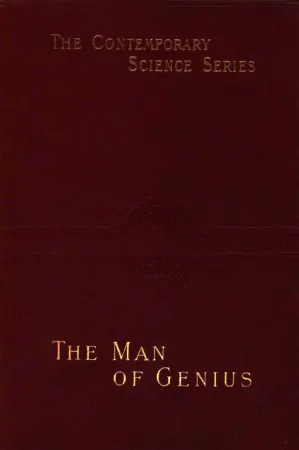
"The Man of Genius" by Cesare Lombroso is a scientific publication written in the late 19th century. The book delves into the complex relationship between genius and madness, exploring the characteristics of individuals considered genius and how these traits intersect with patterns of mental illness. Lombroso examines historical figures and provides a foundational analysis of genius through a lens of physiological and psychological phenomena. The opening of the work sets the stage for an exploration of genius by referencing significant historical thoughts on the topic, from Aristotle to more contemporary thinkers. Lombroso reflects on his evolving views about genius relating to degradation and neurosis, suggesting that exceptional intellectual capabilities often stem from psychological anomalies. He lays out an argument that associates genius with various signs of degeneration, prompting readers to reconsider what defines genius and how societal perceptions may have historically conflated brilliance with madness. This thought-provoking introduction invites further examination of the intertwining nature of genius, mental health, and societal recognition.
Introduction adapted from the source catalogue; source summaries may be automatically generated.
Free to read · English · 130,716 words · No account needed
MAKE TIME FOR A GOOD BOOK
On by default. Untick to stop anonymous reading totals. Each page counts after 10 seconds in view. How this works.
Anonymous counting is on unless you have switched it off.
“I have read their verses,” says Lemaître,[354] “and not even seen as much as the turkey in the fable, who, if he did not distinguish very well, at least saw something. I have been able to make nothing of these series of words, which--being connected together according to the laws of syntax--might be supposed to have some sense, and have none, and which spitefully keep your mind on the stretch in a vacuum, like a conundrum without an answer....
“‘En ta dentelle où n’est notoire
Mon doux évanouissement,
Taisons pour l’âtre sans histoire
Tel vœu de lèvres résumant.
Toute ombre hors d’un territoire
Se teinte itérativement
A la lueur exhalatoire
Des pétales de remuement.’....
“One of them, however, has explained to us what they intended doing, in a pamphlet modestly entitled, Traité du Verbe, by Stéphane Mallarmé. By this it appears that they have invented two things--the symbol, and ‘poetic instrumentation.’
“The invention of the symbolists seems to consist in not saying what feelings, thoughts, or states of mind they express by images. But even this is not new. A SYMBOL is, in short, an enlarged comparison of which only the second term is given--a connected series of metaphors. Briefly, the symbol is the old ‘allegory’ of our fathers.[355]
“Now, here is the second discovery made by our wild-eyed symbolists. Men have suspected, ever since Homer’s time, that there are relations, correspondences, affinities, between certain sounds, forms, and colours, and certain states of mind. For instance, it was felt that the repeated sound of a had something to do with the impression of freshness and peace produced by this line of Virgil--
“‘Pascitur in silva magna formosa juvenca.’
It was known that sounds may, like colours, be striking or subdued; like feelings, sad or joyful. But it was thought that these resemblances and relations are somewhat fugitive, having nothing constant or sharply-defined, and that they are, at least, hinted at by the sense of the words which compose the musical phrase.
“Now, attend to this! For these gentlemen, a = black, e = white, i = blue, o = red, u = yellow.
“Again, black = the organ, white = the harp, blue = the violin, red = the trumpet, yellow = the flute.
“Again, the organ expresses monotony, doubt, and simplicity; the harp, serenity; the violin, passion and prayer; the trumpet, glory and ovation; the flute, smiles and ingenuousness.
Your reading position is saved on this browser. Take it to another device with a library code. Reading pages adapt to text, rather than matching a printed edition.
BEHIND THE BOOK
This eBook is for the use of anyone anywhere in the United States and most other parts of the world at no cost and with almost no restrictions whatsoever. You may copy it, give it away or re-use it under the terms of the Project Gutenberg License included with this eBook or online at www.gutenberg.org. If you are not located in the United States, you will have to check the laws of the country where you are located before using this eBook. Read the source licence.
The original source file, including credits and licence, is retained by this library. Request an original-format copy at no charge. Please include the book title and Project Gutenberg identifier #50539.
KEEP YOUR CURIOSITY GOING
David Patterson (Spirit) Hatch
Coulson Kernahan

Ralph Waldo Emerson
Frances Wright

Edwin Abbott Abbott

Joseph Droz