
Last letters from the living dead man
David Patterson (Spirit) Hatch
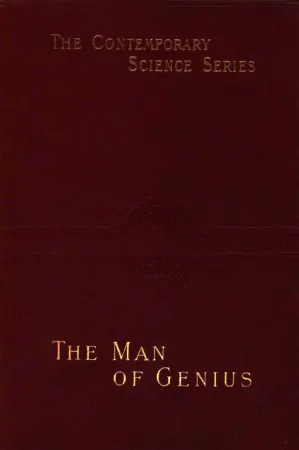
THE CLASSIC COLLECTION · 1891
"The Man of Genius" by Cesare Lombroso is a scientific publication written in the late 19th century. The book delves into the complex relationship between genius and madness, exploring the characteristics of individuals considered genius and how these traits intersect with patterns of mental illness. Lombroso examines historical figures and provides a foundational analysis of genius through a lens of physiological and psychological phenomena. The opening of the work sets the stage for an exploration of genius by referencing significant historical thoughts on the topic, from Aristotle to more contemporary thinkers. Lombroso reflects on his evolving views about genius relating to degradation and neurosis, suggesting that exceptional intellectual capabilities often stem from psychological anomalies. He lays out an argument that associates genius with various signs of degeneration, prompting readers to reconsider what defines genius and how societal perceptions may have historically conflated brilliance with madness. This thought-provoking introduction invites further examination of the intertwining nature of genius, mental health, and societal recognition.
Introduction adapted from the source catalogue; source summaries may be automatically generated.
Free to read · English · 130,716 words · No account needed
MAKE TIME FOR A GOOD BOOK
On by default. Untick to stop anonymous reading totals. Each page counts after 10 seconds in view. How this works.
Anonymous counting is on unless you have switched it off.
“We have been shown at Montmartre, in Dr. Blanche’s establishment, traces of charcoal-drawings on a wall. These half-effaced figures, one of which represented the Queen of Sheba, and the other some king, were the work of a distinguished young author, who has since recovered his reason. This illness had developed a new talent, which was non-existent, or at least played a most insignificant part, while he was in health.
“It is said that Marion Delorme met, in a madhouse, with the first man who conceived the idea of applying the forces of steam to the needs of industry, Salomon de Caus. Talents created by disease forsake the individual, for the most part, at the same time as the disease itself.”[296]
I had under treatment at Pavia, a peasant lad, aged twelve, who composed extremely original musical melodies, and bestowed on his companions in misfortune nicknames which fitted so well that they always kept them. With him was a little old man afflicted with rickets and pellagra who, when asked whether he was happy, replied, like a philosopher of ancient Greece, “All men are happy, even the rich, if they are only willing.”
Many of my pupils still remember B----, by turns musician, servant, porter, keeper of a cookshop, tinman, soldier, public letter-writer, but always unfortunate. He left us an autobiography, which, apart from a few orthographical mistakes in spelling, would be quite worth printing; and he asked me for his discharge in terms which, for an uneducated working man, were wanting neither in beauty nor in originality.
Not long ago I heard a poor hawker of sponges, when insane, thus conjecture and sum up the cardinal idea of the circulation of life: “We do not die. When the soul is worn out it melts, and is turned into another shape. In fact, when my father had buried a dead mule, we afterwards saw mushrooms growing in great numbers on the same spot, and the potatoes in the same place, which were formerly very small, grew to twice their usual size.”
Thus a vulgar mind, enlightened by the energy of mania, stumbles on theories which the greatest thinkers arrive at with difficulty.
G. B., a maniac, nephew of a celebrated author, said to me one day, when I hesitated before permitting him to ride a somewhat skittish horse, “No fear, doctor--similia similibus.”
M. G., a merchant, suffering from melancholia, said to some one who had called him “Count” by mistake, “What count? I have kept plenty of accounts--I know no others!”
Your reading position is saved on this browser. Take it to another device with a library code. Reading pages adapt to text, rather than matching a printed edition.
BEHIND THE BOOK
This eBook is for the use of anyone anywhere in the United States and most other parts of the world at no cost and with almost no restrictions whatsoever. You may copy it, give it away or re-use it under the terms of the Project Gutenberg License included with this eBook or online at www.gutenberg.org. If you are not located in the United States, you will have to check the laws of the country where you are located before using this eBook. Read the source licence.
The original source file, including credits and licence, is retained by this library. Request an original-format copy at no charge. Please include the book title and Project Gutenberg identifier #50539.
KEEP YOUR CURIOSITY GOING
David Patterson (Spirit) Hatch
Coulson Kernahan

Ralph Waldo Emerson
Frances Wright

Edwin Abbott Abbott

Joseph Droz